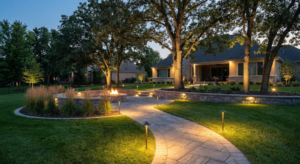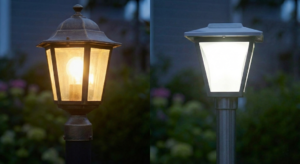
Most homeowners focus on choosing the right garden lighting fixtures, picking the perfect uplighting for trees, or laying out pathway landscape lights that guide guests to the front door. Those choices matter — but none of them will perform well without a properly sized, correctly installed landscape lighting transformer powering the system.
This landscape lighting transformer guide walks you through everything you need to know: how transformers work, how to calculate the right wattage, step-by-step installation instructions, and how to diagnose the most frustrating problems homeowners encounter after the job is done.
Whether you are setting up a simple low voltage landscape lighting kit for the first time or upgrading a whole-yard professional landscape lighting system, the information here will help you get it right.
Key Takeaways
- This landscape lighting transformer guide covers sizing, wiring, and troubleshooting in one place.
- Always add up fixture wattage before selecting a transformer to avoid overloads.
- LED landscape lights dramatically reduce load and extend transformer life.
- Most low voltage landscape lighting kits run on 12V AC at 150–600 watts.
- Voltage drop is the most common cause of dim pathway landscape lights.
- Professional landscape lighting installations often use multi-tap transformers for better zone control.
How a Low Voltage Landscape Lighting Transformer Works
A landscape lighting transformer steps down standard 120V household current to a safer 12V AC output. That lower voltage powers the cables buried in your yard and the fixtures attached to them — pathway landscape lights, LED landscape lights, uplighting for trees, and other garden lighting fixtures — without posing a significant shock hazard, adhering to National Electrical Code safety standards.
Most residential transformers sold in low voltage landscape lighting kits range from 150 to 600 watts and include a built-in timer, photocell sensor, or both. Higher-end units used in professional landscape lighting installations often feature multiple tap outputs (typically 12V, 13V, and 14V) to compensate for voltage drop over long wire runs.
The transformer mounts on an exterior wall or post, plugs into a GFCI-protected outdoor outlet, and connects to one or more cable runs that branch out through the landscape.
Comparison: Transformer Types for Outdoor Landscape Lighting
| Transformer Type | Wattage Range | Best For | Typical Cost |
|---|---|---|---|
| Basic Single-Tap | 150–300W | Small DIY kits, front-yard accents | $40–$90 |
| Multi-Tap | 300–600W | Medium yards, voltage drop compensation | $90–$200 |
| Smart / Wi-Fi | 150–600W | Advanced app control, zone scheduling | $150–$350 |
| Commercial / Pro | 600–1,200W+ | Professional landscape lighting, large estates | $250–$800+ |
How to Size a Landscape Lighting Transformer
Choosing the wrong wattage is the most common and costly mistake homeowners make. An undersized transformer will trip breakers or overheat; an oversized one wastes money up front and may not trigger the dimming features some LED landscape lights rely on.
Step-by-Step: Calculating Your Transformer Size
- List every fixture and its wattage. Write down each pathway landscape light, uplighting for tree, spotlight, and garden lighting fixture. Check the label or manufacturer spec sheet for wattage — do not guess.
- Add up total wattage. Sum all fixture wattage to get your base load.
- Apply the 80% rule. American Lighting Association best practices recommend loading a transformer to no more than 80% of its rated capacity. Divide your total wattage by 0.80 to find the minimum transformer rating. For example, 240 watts of fixtures requires at least a 300-watt transformer.
- Account for future expansion. If you plan to add more outdoor landscape lighting later, size up one tier now. Adding a second transformer later costs more than buying a larger one upfront.
- Confirm your outlet can support it. A standard 15-amp, 120V circuit supports up to 1,800 watts. A 600-watt transformer is well within that range, but always verify your GFCI outlet is properly grounded.
- Match to your cable runs. Long runs (over 100 feet) benefit from a multi-tap transformer so you can boost voltage slightly to offset drop at the end of the run.
Conditional reasoning: If you are installing only 8–10 LED landscape lights, a 150W unit is usually sufficient. If you are running 20 or more fixtures across multiple zones with uplighting for trees included, choose a 300W or larger multi-tap model.
LED vs. Halogen Landscape Lighting Fixtures: Pros & Cons
Many older low voltage landscape lighting kits shipped with halogen bulbs. Upgrading to LED landscape lights makes a significant difference in transformer load and long-term cost, offering verified LED energy savings data that confirms their efficiency.
LED Landscape Lights
- Pro: Use 75–80% less wattage than equivalent halogen fixtures.
- Pro: Longer lifespan — industry estimates commonly cite 25,000–50,000 hours.
- Pro: Run cooler, reducing heat stress on the transformer and wiring.
- Con: Higher upfront cost per fixture compared to halogen equivalents.
- Con: Some budget LED landscape lights produce inconsistent color temperatures.
Halogen Landscape Lights
- Pro: Lower initial purchase price.
- Pro: Warm, familiar color rendering that many homeowners prefer.
- Con: Higher wattage increases transformer load significantly.
- Con: Shorter lifespan (typically 2,000–5,000 hours) means frequent bulb replacement.
- Con: Generate more heat, which can shorten overall system life in warm climates.
Conditional reasoning: If you are starting a new outdoor landscape lighting project from scratch, choose LED landscape lights from the beginning. If you are upgrading an existing halogen system, you may be able to downsize your transformer significantly, saving money on the hardware replacement.
Landscape Lighting Transformer Installation: Step-by-Step
Installing a low voltage transformer is a manageable DIY project for most homeowners. Follow local electrical codes and manufacturer instructions throughout.
- Choose the mounting location. Mount the transformer on an exterior wall or post within 6 feet of a GFCI-protected outdoor outlet. It should be at least 12 inches off the ground to avoid water intrusion.
- Mount the transformer bracket. Use weather-resistant hardware. Most units include a mounting plate that attaches to the wall before the transformer snaps or bolts into place.
- Connect your cable runs. Strip 1/2 inch of insulation from each 12-gauge or 14-gauge low voltage cable end. Insert into the terminal block connectors inside the transformer housing and tighten the screws firmly.
- Lay the cable through your landscape. Route cable at least 3 inches below soil where it crosses foot-traffic areas, or use cable stakes in low-traffic garden beds. Avoid sharp bends that can damage the conductor.
- Connect fixtures using quick-connect connectors. Snap the connector onto the cable at each fixture location. The piercing connectors penetrate the cable insulation automatically — no wire stripping needed at each fixture.
- Set the timer and photocell. Program your timer settings for your preferred on/off times. A photocell will turn the system on at dusk automatically, which extends transformer relay life compared to a fixed timer alone.
- Test the system. Plug in the transformer, set to manual ON, and walk the full run to confirm every fixture lights up. Use a multimeter to check voltage at the far end of each cable run — a reading between 10.8V and 12V indicates healthy voltage delivery.
Do’s and Don’ts for Landscape Lighting Transformer Installation
| DO | DON’T |
|---|---|
| Use a GFCI-protected outdoor outlet | Plug into an indoor extension cord run outside |
| Apply the 80% wattage rule when sizing | Max out the transformer’s rated capacity |
| Use 12-gauge wire for runs over 100 feet | Use 16-gauge wire on long runs (causes voltage drop) |
| Mount the transformer at least 12 inches off ground | Mount at ground level where water can pool |
| Keep all connections sealed and weatherproof | Leave wire splices exposed to moisture |
| Test voltage at the end of each run | Assume voltage is fine without measuring |
Comprehensive Transformer Troubleshooting
For more detailed diagnostics, see our guide on comprehensive transformer troubleshooting.
Dim or Flickering Pathway Landscape Lights
This is almost always caused by voltage drop — the voltage at the fixture end of a long cable run falls below the minimum the fixture requires. Test with a multimeter at the first and last fixture on the run. If the last fixture reads below 10.8V, you have a voltage drop problem.
Solutions: Switch to a heavier gauge wire, shorten individual runs, connect from multiple output taps, or upgrade to a multi-tap transformer to boost output voltage on affected zones.
Transformer Trips the Breaker or Overloads
Add up all fixture wattages on the affected output. If the total exceeds 80% of the transformer’s rated wattage, you are overloaded. Remove fixtures from the run, redistribute them across zones, or upgrade to a higher-wattage unit.
Timer or Photocell Not Working
Check that the photocell sensor is not obstructed by vegetation or directly facing another light source, which can confuse the sensor into thinking it is still daylight. For timer issues, reset to factory defaults and reprogram. In very cold climates, cheaper digital timers can lose their programs during power interruptions — consider a transformer with a battery backup timer.
Some Fixtures Are On but Others Are Not
Inspect the quick-connect connectors at the dark fixtures. Corroded or improperly seated connectors are the most common culprit. Also check the terminal block connections at the transformer for loose wires.
Real-World Example: Resizing a Backyard Lighting System (Hypothetical)
Consider a homeowner in the Atlanta suburbs who purchased a low voltage landscape lighting kit several years ago with 15 halogen pathway lights and 5 halogen uplights for trees. The original 300W transformer was running near capacity.
After swapping all 20 halogen fixtures for LED landscape lights averaging 4 watts each, the total load dropped from approximately 280 watts to just 80 watts. This allowed the homeowner to downsize to a 150W smart transformer, add Wi-Fi scheduling, and still have headroom to add more garden lighting fixtures in the future — all while cutting energy consumption by roughly 70%.
This scenario illustrates why upgrading to LED is often the single most impactful change a homeowner can make to an existing outdoor landscape lighting system.
Landscape Lighting Design Tips for Better Results
Even the best transformer cannot fix a poorly designed lighting layout. Here are key professional design principles used in professional landscape lighting installations.
- Layer your light sources. Combine uplighting for trees, pathway landscape lights, and accent fixtures for depth and visual interest.
- Avoid overlighting. More fixtures does not always mean better results. Restraint creates drama. Over-lit yards often look flat and commercial.
- Use color temperature consistently. Mixing cool-white and warm-white LED landscape lights creates a disjointed appearance. Choose one color temperature (typically 2700K–3000K for residential settings) and stick with it across all garden lighting fixtures.
- Zone your runs by purpose. Put pathway landscape lights on one output zone and uplighting for trees on another. This lets you control brightness and timing independently.
- Plan for the transformer location first. Your transformer placement determines the practical length of your wire runs and the size of the unit you will need. Design from the transformer outward, not the other way around.
Quick Answers: Frequently Asked Questions
What wattage transformer do I need for landscape lighting?
Add up the wattage of all your fixtures, then divide by 0.80 to apply the 80% rule. For example, 200 watts of fixtures requires at least a 250W transformer.
How far can low voltage landscape lighting cable run?
With 12-gauge wire, runs up to 200 feet are generally manageable. Longer runs or heavier loads require heavier gauge wire or a multi-tap transformer to compensate for voltage drop.
Does a landscape lighting transformer need a GFCI outlet?
Yes. Most local building codes and the National Electrical Code require all outdoor outlets to be GFCI-protected. This protects against electrical shock in wet conditions.
Can I run LED and halogen fixtures on the same transformer?
Yes, as long as the total wattage stays within the 80% limit. Be aware that some LED landscape lights are sensitive to voltage fluctuations that halogen bulbs tolerate more easily.
How long do landscape lighting transformers last?
Quality transformers typically last 10–20 years with proper installation and maintenance. Overloading, moisture intrusion, and power surges are the most common causes of early failure.
What voltage should landscape lighting be?
Most residential low voltage landscape lighting systems operate at 12V AC. Fixtures measured between 10.8V and 12V are receiving adequate power. Below 10.8V, you will likely notice dimness or flickering.
Do I need a permit to install landscape lighting?
In most jurisdictions, low voltage (12V) landscape lighting does not require a permit. However, any work on your 120V household electrical circuit — such as adding an outdoor outlet — typically does require a permit and may need you to hire a licensed electrician.
What is the difference between a single-tap and multi-tap transformer?
A single-tap transformer outputs only 12V. A multi-tap unit offers multiple output voltages (12V, 13V, 14V) so you can compensate for voltage drop on longer wire runs by connecting those zones to a higher voltage tap.
Can I install a landscape lighting transformer myself?
Most homeowners can safely install a low voltage transformer as a DIY project. The transformer itself plugs into a standard GFCI outlet — no hardwiring is involved. Always follow manufacturer instructions and local codes.
How do I know if my transformer is too small?
Signs of an undersized transformer include tripped breakers, fixtures that dim or flicker, and the transformer housing feeling hot to the touch during normal operation.
Glossary of Key Terms
- Voltage Drop: The reduction in electrical voltage that occurs along the length of a wire run as power travels from the transformer to each fixture. Excessive voltage drop causes dim or flickering outdoor landscape lighting.
- GFCI (Ground Fault Circuit Interrupter): A special type of electrical outlet or breaker that cuts power within milliseconds when it detects a ground fault. Required by code for all exterior outlets and essential for safe landscape lighting transformer installations.
- Multi-Tap Transformer: A landscape lighting transformer with multiple output voltage settings (typically 12V, 13V, and 14V) that allows the installer to compensate for voltage drop on longer wire runs.
- Low Voltage Landscape Lighting: An outdoor lighting system that operates at 12V AC rather than standard 120V household current, making it safer, easier to install, and more energy-efficient for residential use.

Conclusion: Get the Foundation Right
Every well-lit yard starts with a landscape lighting transformer that is correctly sized, properly installed, and matched to the fixtures it powers. Skip that foundation and even the most beautiful garden lighting fixtures will underperform.
Use this landscape lighting transformer guide as your reference from the planning stage through installation and beyond. Size up using the 80% rule, make the switch to LED landscape lights for maximum efficiency, and test your voltage at the end of every run before you bury the cable for good.
If you are planning a new outdoor landscape lighting project or upgrading an existing system, explore our full selection of low voltage landscape lighting kits, professional-grade transformers, and LED landscape lights to find everything you need in one place.