Every homeowner weighing an outdoor lighting upgrade eventually hits the same wall: spend more on professional landscape lighting, or save upfront with a DIY kit? The answer is not as obvious as the price tags suggest. The true cost of outdoor landscape lighting stretches well beyond the initial purchase — it includes energy use, fixture lifespan, labor time, potential mistakes, and the long-term value added to your property.
This article breaks down both paths honestly. You will learn exactly where each option costs more, where each saves money, and — most importantly — which approach makes the most financial sense for your specific situation.
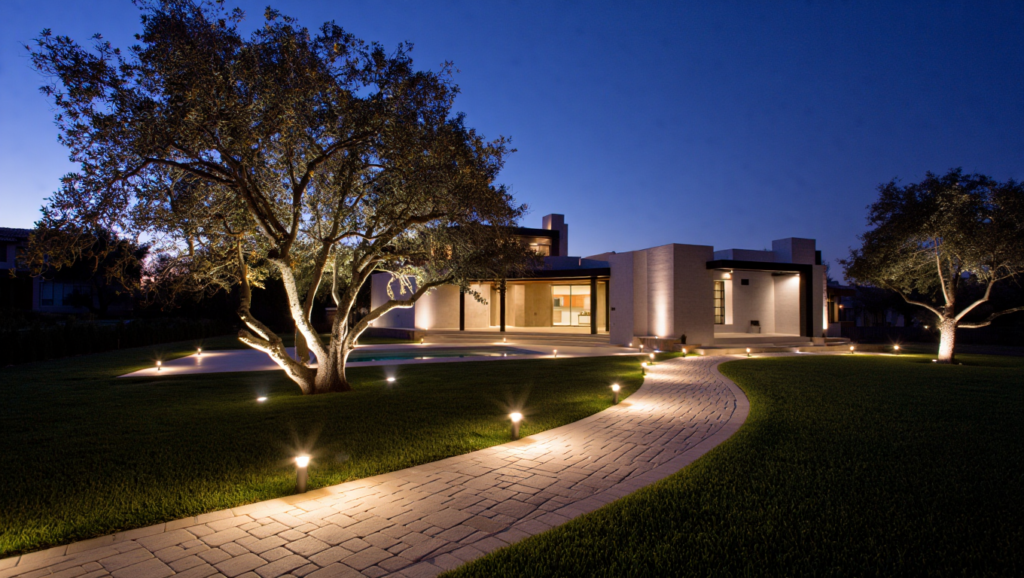
Key Takeaways
- Professional landscape lighting delivers a polished, long-lasting result that adds measurable curb appeal.
- Low voltage landscape lighting kits can cost less initially, but improper installation multiplies expenses quickly.
- LED landscape lights dramatically reduce energy bills compared to halogen alternatives, regardless of who installs them. Learn more about the benefits of LED over halogen lighting.
- A licensed installer understands comprehensive landscape lighting design principles that most homeowners lack without prior experience.
- DIY works well for simple pathway landscape lights; complex professional uplighting techniques for trees typically benefits from professional placement.
- Long-term maintenance, warranty coverage, and fixture quality often tip the financial balance toward professional installation.
What Each Option Actually Involves
Professional Landscape Lighting: What You Are Paying For
When you hire a licensed outdoor lighting contractor, you are not simply paying for labor. You are paying for a complete landscape lighting design, proper transformer sizing, code-compliant wiring, professional-grade fixtures, and a warranty on both parts and installation.
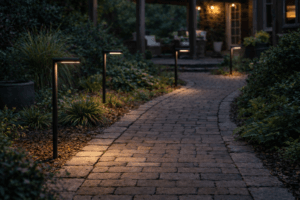
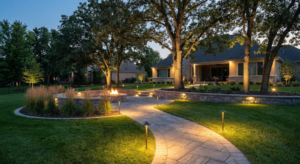
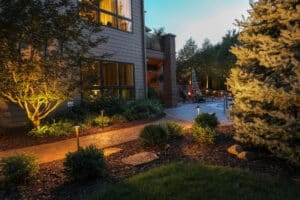
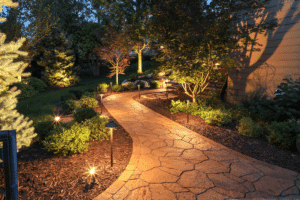
A contractor will assess your property’s layout, calculate the correct wattage load, select weather-resistant garden lighting fixtures, and position each light — whether pathway landscape lights, uplighting for trees, or accent fixtures along a fence line — for maximum visual effect and minimal energy waste.
Industry professionals typically use commercial-grade LED landscape lights and landscape lighting transformers rated for continuous outdoor use. These components are not available at most retail stores. They are sourced through professional supply channels and carry multi-year warranties that consumer-grade products rarely match.
DIY Landscape Lighting: What the Kits Include
Low voltage landscape lighting kits sold at home improvement retailers typically include a small transformer (usually 100–300 watts), a set of pathway landscape lights or spotlights, and a length of 12- or 14-gauge outdoor wire. These kits are designed for straightforward installation and are genuinely accessible to homeowners with basic tool skills.
Most kits use LED landscape lights, which is a meaningful improvement over the halogen fixtures included in older DIY sets. The fixtures themselves, however, are usually constructed with less durable materials than professional-grade equivalents — thinner metal, lower IP (ingress protection) ratings, and smaller weatherproof seals.
Head-to-Head Cost Comparison
Upfront Costs
| Cost Category | DIY (Typical Range) | Professional (Typical Range) |
|---|---|---|
| Fixtures (8–12 units) | $80 – $250 | $400 – $1,200 |
| Transformer | $40 – $120 | $150 – $500 |
| Wiring & connectors | $20 – $60 | Included in labor |
| Labor | $0 (your time) | $500 – $2,000+ |
| Design consultation | $0 | $0 – $300 (often included) |
| Total estimate | $140 – $430 | $1,050 – $4,000+ |
Note: Ranges vary significantly by region, property size, and fixture selection. These are general market estimates, not guarantees.
The upfront gap is real and significant. For many homeowners on a tight budget, DIY is the only viable starting point. However, these numbers do not reflect what happens over a 5–10 year ownership period.
Long-Term Cost Factors
Fixture lifespan plays a large role in the true cost equation. Professional-grade garden lighting fixtures are typically rated for 50,000+ hours of LED operation with robust housings designed for freeze-thaw cycles and UV exposure. Consumer kit fixtures, while improving, often show degradation — faded finishes, corroded sockets, cracked lenses — within 3–5 years in harsh climates.
Energy consumption matters too. A poorly designed DIY system may use more fixtures at higher wattages than necessary to compensate for poor placement. A well-executed landscape lighting design by a professional often uses fewer, better-positioned fixtures to achieve superior results with lower total wattage.
Repair and replacement costs are the hidden budget-killers in DIY. Many homeowners report discovering, months or years after installation, that connections have corroded, transformers are undersized for the load, or fixtures have shifted and no longer illuminate their intended targets. Fixing these problems yourself costs time; hiring someone to fix them costs money.
Step-by-Step: How a Professional Landscape Lighting Installation Works
Understanding the professional process helps explain why it costs what it does — and why it often performs better over time.
- Site assessment. The contractor walks the property at dusk to evaluate existing light sources, architectural features, plant material, and client goals.
- Landscape lighting design. A fixture layout is created, specifying the type, placement, and aim of each light — including professional uplighting techniques for trees, downlighting from eaves, and pathway landscape lights along walkways.
- Transformer sizing. Total wattage is calculated and a landscape lighting transformer is selected that can handle the load with room for future expansion. If you are unsure how to proceed, consult our guide to properly size your landscape lighting transformer.
- Wire routing. Low voltage cable is buried or hidden along natural contours to avoid visibility and damage.
- Fixture installation. Each fixture is staked, aimed, and connected using gel-filled waterproof wire connectors rated for direct burial.
- System programming. The transformer is set with automatic dusk-to-dawn timers or astronomical clock functions to optimize energy use.
- Final walkthrough. The contractor reviews the result with the homeowner and adjusts aim as needed.
This process typically takes one to two days for a mid-sized residential property. Each step requires knowledge that takes time to acquire — time that has real monetary value.
Pros and Cons of Each Approach
Professional Landscape Lighting
Pros:
- Expert landscape lighting design tailored to your property
- Commercial-grade fixtures with longer warranties
- Code-compliant installation with proper grounding
- Energy-efficient transformer programming
- Time savings — no learning curve or weekend labor required
Cons:
- Significantly higher upfront cost
- Requires scheduling and coordination with a contractor
- Less personal control over small changes or additions
- Quality varies widely between contractors
DIY Low Voltage Landscape Lighting Kits
Pros:
- Low initial investment
- Immediate availability at hardware stores
- Flexible — easy to reposition fixtures
- Satisfying hands-on project for engaged homeowners
- Good for simple layouts with few fixtures
Cons:
- Lower fixture durability and shorter lifespan
- Transformer may be undersized for expansion
- Improper installation can cause connection failures
- No professional design guidance
- Cumulative repair and replacement costs can exceed professional pricing over time
Do’s and Don’ts for Either Approach
DO:
- Use LED landscape lights regardless of which path you choose — they use significantly less energy than halogen alternatives. See the benefits of LED over halogen lighting for details.
- Bury or properly secure all outdoor wiring to prevent tripping hazards and UV damage.
- Choose a transformer with at least 20–25% more capacity than your current load to allow for future additions. Learn how to properly size your landscape lighting transformer.
- Test the full system at night before finalizing any fixture positions.
- Use gel-filled waterproof wire connectors rated for direct burial, even for above-ground connections.
- Pay attention to color temperature; warm white (2700K–3000K) is ideal for most properties. Read our guide on selecting the perfect color temperature.
DON’T:
- Overload a small landscape lighting transformer — this shortens its lifespan and can cause flickering or tripped circuits.
- Assume all LED landscape lights are equal — check lumens, selecting the perfect color temperature (warm white 2700K–3000K is ideal for most properties), and IP rating.
- Place uplighting for trees directly at the base of the trunk where water collects. Instead, review professional uplighting techniques for trees.
- Skip a timer or photocell — leaving lights on 24 hours significantly increases energy costs.
- Choose a contractor based solely on price — licensing, insurance, and fixture brand matter.
When to Choose Professional vs. DIY: Conditional Guidance
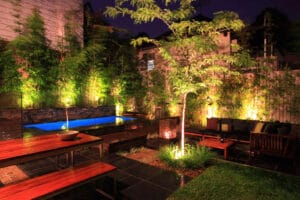
If your project involves more than 15 fixtures or complex features like uplighting for trees, water features, or multi-zone control, professional landscape lighting is almost always the smarter financial choice. The complexity of transformer sizing, wire runs, and fixture placement at scale introduces error risks that compound costs quickly. For inspiration, explore our guide on comprehensive landscape lighting design principles.
If you are lighting a simple walkway with 6–8 pathway landscape lights and have a modest budget, a quality low voltage landscape lighting kit is a reasonable and cost-effective starting point. Many homeowners successfully manage small-scale DIY installations for years without significant problems. Check out our list of budget-friendly DIY lighting projects to get started.
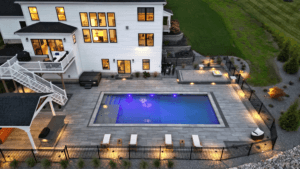
If you plan to sell your home within 3–5 years, professional landscape lighting design is worth considering. Real estate professionals consistently note that well-executed outdoor lighting improves perceived home value and listing appeal — an ROI that a basic DIY kit rarely matches.
If long-term energy efficiency is your top priority, professional installation paired with a programmable landscape lighting transformer and high-efficiency LED landscape lights will outperform a DIY setup over a 5–10 year period, even accounting for the higher initial cost.
Hypothetical Case Study: The Ramirez Home
Consider a homeowner — call her Maria — who owns a two-story colonial in the suburbs of Charlotte, North Carolina. She wanted to illuminate her front landscaping: two oak trees, a curved stone walkway, and a low hedge line along the driveway.
Maria first tried a DIY kit from a local hardware store. She spent approximately $220 and installed 10 pathway landscape lights and two spotlights for the trees. Within 18 months, three fixture stakes had corroded, one spotlight had shifted to aim at the ground, and the transformer began cycling on and off intermittently — a sign of an overloaded circuit she had expanded without upgrading the unit.
She then hired a professional outdoor lighting company, which replaced everything and redesigned the layout using 14 LED fixtures, a 300-watt programmable transformer, and a buried wire run. Total cost: $2,400. Three years later, the system is fully operational, unchanged, and her energy costs for the system are noticeably lower than with the DIY setup — partly because the professional fixtures were more efficient, and partly because the transformer is programmed to reduce output after midnight.
Total spent on DIY (including partial repairs): $310. Total professional investment: $2,400. But the professional system is projected to last another 7–10 years with minimal maintenance. The math begins to shift.
Quick Answers: FAQ Section
Q: Is low voltage landscape lighting safe for DIY installation? Yes, low voltage systems (typically 12V) are among the safest electrical projects homeowners can attempt. They do not require permits in most jurisdictions and pose minimal shock risk compared to line voltage systems. However, always follow National Electrical Code safety standards regarding burial depths and connections.
Q: How much does professional landscape lighting typically cost? Most residential projects range from $1,000 to $5,000 depending on the number of fixtures, property size, and regional labor rates. Larger or more complex installations can exceed that range.
Q: Do LED landscape lights really save money over time? Yes. According to U.S. Department of Energy data on LED efficiency, LED landscape lights use significantly less energy than halogen or incandescent alternatives and last far longer — often 25,000 to 50,000 hours — reducing both energy bills and replacement frequency.
Q: What size landscape lighting transformer do I need? Add up the total wattage of all your fixtures and choose a transformer rated at 25–30% above that total. This allows for expansion and reduces strain on the unit. Use our guide to properly size your landscape lighting transformer for help.
Q: Can I mix DIY and professional components? In some cases, yes. A professional contractor can design a system and use fixtures you purchase, though many prefer to work with their own supply chain to back their warranties. Discuss this upfront.
Q: How long does professional landscape lighting installation take? A standard residential installation typically takes one to two days. Very large properties or phased installations may require more time.
Q: Does landscape lighting increase home value? Industry professionals and real estate experts widely agree that well-designed outdoor landscape lighting improves curb appeal and can positively influence perceived home value, particularly for evening showings.
Q: How deep should low voltage landscape lighting wire be buried? The National Electrical Code safety standards recommends burying low voltage landscape wire at least 6 inches deep. Deeper burial (12 inches) reduces the risk of accidental damage from digging or lawn equipment.
Q: What color temperature is best for outdoor landscape lights? Warm white, in the 2700K–3000K range, is most commonly recommended for residential landscape lighting. It is flattering to both plants and architecture without appearing harsh or clinical. Learn more about selecting the perfect color temperature.
Q: How often do professional landscape lighting systems need maintenance? Most professional systems require only annual maintenance — typically cleaning lenses, checking connections, and re-aiming fixtures that have shifted. Some contractors offer annual service contracts.
Glossary of Terms
Low Voltage Landscape Lighting: An outdoor lighting system that operates at 12 volts rather than standard household current (120V). It is safer, energy-efficient, and well-suited for residential DIY installation or professional use.
Landscape Lighting Transformer: An electrical device that converts standard 120V household current to the 12V required by low voltage systems. It typically includes timers, photocells, and zone controls to automate the lighting schedule.
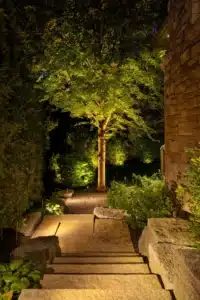
Uplighting: A technique in landscape lighting design where fixtures are aimed upward to illuminate trees, architectural features, or vertical surfaces from below, creating dramatic shadow and depth. Master this skill with our guide on professional uplighting techniques for trees.
LED Landscape Lights: Fixtures using light-emitting diode technology, which consumes far less energy and lasts significantly longer than halogen or incandescent bulbs. They are now the industry standard for both professional and DIY outdoor lighting applications. Understand the benefits of LED over halogen lighting to see why they are preferred.
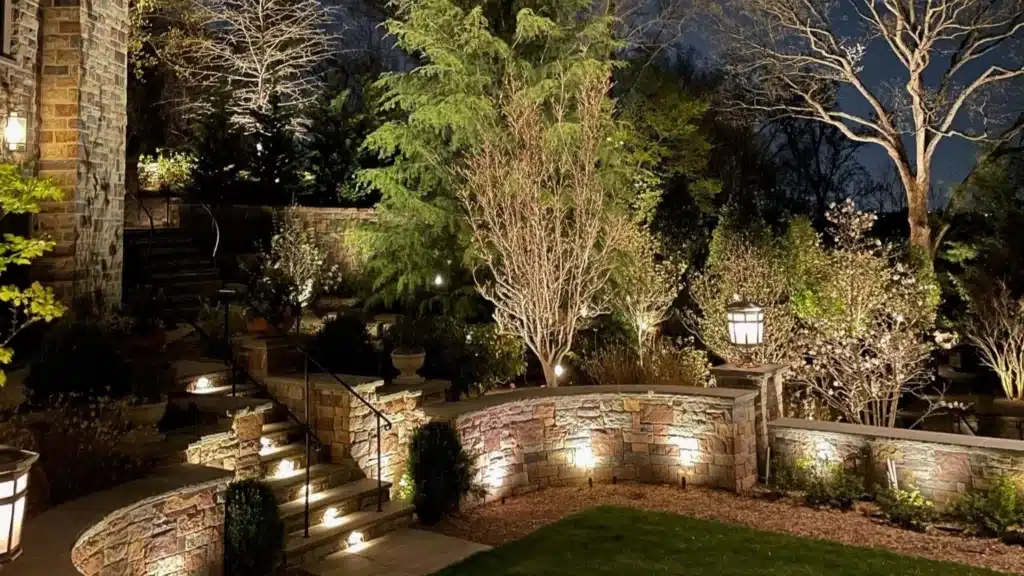
Conclusion: Make the Choice That Fits Your Property and Timeline
There is no single right answer to the professional versus DIY debate in outdoor landscape lighting — but there are smarter choices depending on your goals. For simple, small-scale projects with a tight budget, a quality low voltage landscape lighting kit is a legitimate starting point. Explore our budget-friendly DIY lighting projects for ideas. For complex designs, large properties, or homeowners who want lasting results with minimal ongoing effort, professional landscape lighting is the stronger long-term investment.
The most financially sound decision is to be honest about your timeline, your skill level, and what you truly want the finished product to look like. If you want professionally executed professional uplighting techniques for trees, coordinated pathway landscape lights, and a programmable landscape lighting transformer that runs itself — that level of result almost always requires professional expertise grounded in Illuminating Engineering Society industry standards.
Ready to take the next step? Find a trusted local lighting contractor for a site assessment, or explore our guide to budget-friendly DIY lighting projects for a weekend project.