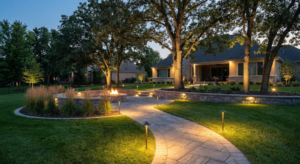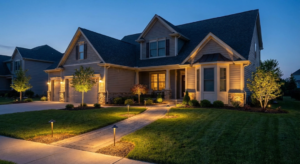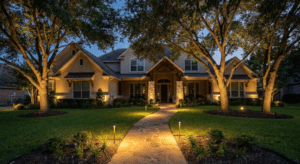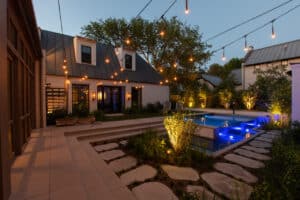
Homeowners across America are discovering that strategic outdoor lighting transforms properties from ordinary to extraordinary after sunset. Whether you’re highlighting architectural features, illuminating pathways for safety, or showcasing your prize-winning garden, understanding landscape lighting cost helps you budget effectively and avoid unexpected expenses.
This comprehensive guide breaks down every cost factor from basic DIY kits to premium professional installations. You’ll learn what influences pricing, how to identify hidden fees, and which investment level delivers the best value for your specific needs. By the end, you’ll have the knowledge to make informed decisions that enhance your home’s beauty and security without breaking your budget.
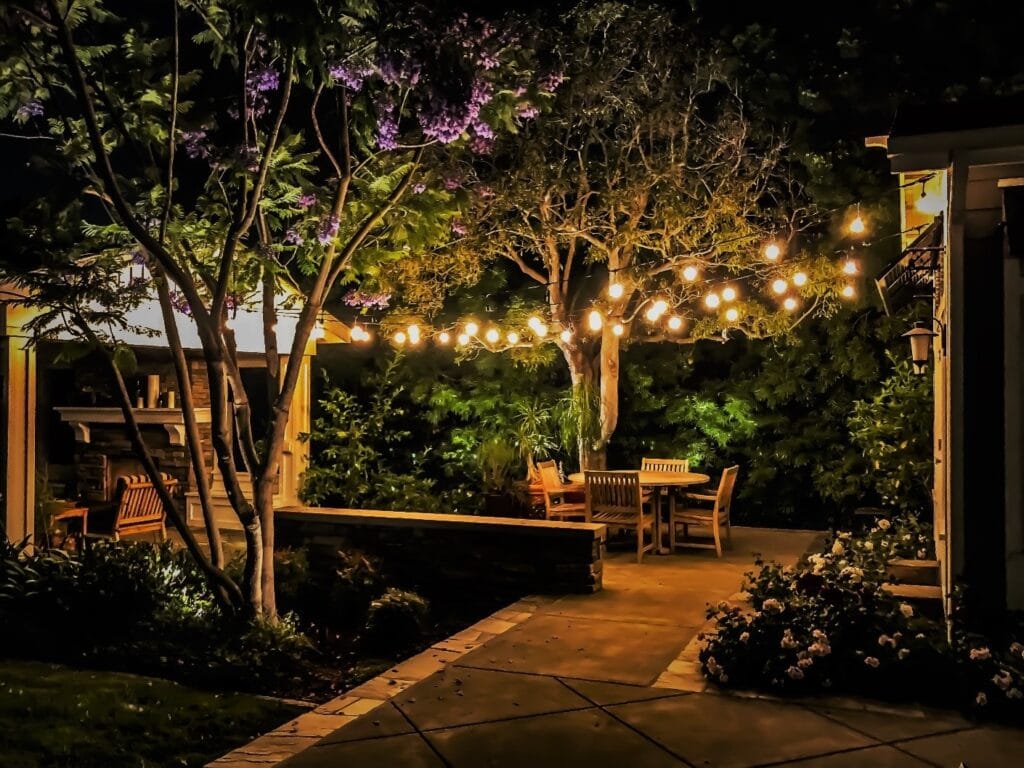
Key Takeaways
Essential Facts About Landscape Lighting Cost
• Professional landscape lighting typically costs $100–$300 per fixture installed, including materials and labor
• Low-voltage LED systems reduce energy bills by 75% compared to traditional halogen bulbs
• Transformer quality significantly impacts system reliability and can range from $150 to $800
• DIY pathway lighting kits offer the most budget-friendly entry point at $200–$500
• Design consultations add $150–$500 but prevent costly installation mistakes
• Maintenance and bulb replacement should be budgeted at $100–$300 annually
Understanding Landscape Lighting Cost Factors
System Type and Complexity
The foundation of your landscape lighting cost depends heavily on which system you choose. Low voltage landscape lighting kits represent the most accessible entry point, operating at 12 volts through a landscape lighting transformer. These systems prioritize safety and energy efficiency, making them ideal for homeowner installation.
Professional landscape lighting systems incorporate sophisticated controls, zoning capabilities, and commercial-grade fixtures. If you need whole-property coverage with automated scheduling and weather sensors, expect professional-grade equipment. If you’re simply lighting a front walkway, a basic kit will suffice.
High-voltage systems (120V) cost more upfront and require licensed electricians, but they’re necessary for powerful spotlights and distant fixture placement.
Material Quality and Fixture Selection
Garden lighting fixtures vary dramatically in construction quality. Budget brass-plated fixtures cost $15–$40 each but may corrode within 3–5 years. Solid brass or copper fixtures range from $80–$300 per piece and can last 15–25 years with minimal maintenance.
LED landscape lights dominate modern installations because they consume 75% less electricity than halogen alternatives and last 25,000–50,000 hours. While LED fixtures cost $10–30 more upfront, they eliminate frequent bulb replacements and reduce long-term operating costs.
Uplighting for trees requires fixtures with specific beam angles and sufficient lumens to reach canopy heights. These specialized units typically cost $100–$250 per fixture installed.
Labor and Installation Expenses
Professional installation accounts for 40–60% of total project costs. Expect to pay $50–$100 per fixture for labor, though complex terrain, buried utilities, or extensive trenching can increase this substantially.
Licensed electricians charge $75–$150 per hour for high-voltage work. Low-voltage installations by landscape lighting specialists typically cost less but still require expertise in proper transformer sizing, wire gauge selection, and voltage drop calculations.
Do-it-yourself installation saves thousands but demands time, physical effort, and technical knowledge. Most homeowners complete a 10-fixture pathway system in 8–12 hours.
Landscape Lighting Cost Breakdown by Project Type
| Project Type | DIY Cost Range | Professional Cost Range | Best For |
|---|---|---|---|
| Basic pathway lighting (8-10 fixtures) | $200–$800 | $1,200–$2,500 | Entry-level curb appeal |
| Front yard accent package | $400–$1,200 | $2,000–$4,000 | Highlighting architecture and landscaping |
| Full property lighting (20-30 fixtures) | $1,000–$2,500 | $4,000–$8,000 | Comprehensive coverage and security |
| High-end custom design (40+ fixtures) | Not recommended | $8,000–$15,000+ | Luxury homes with extensive grounds |
| Tree uplighting only (4-6 trees) | $300–$700 | $1,500–$3,000 | Dramatic focal points |
Entry-Level Systems
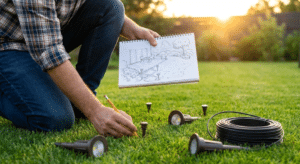
Low voltage landscape lighting kits provide everything needed for basic installation: transformer, fixtures, wire, and connectors. Quality starter kits from reputable manufacturers cost $200–$500 and include 6–10 pathway lights with a 150-watt transformer.
These systems work well for straightforward applications like illuminating walkways or small garden beds. The National Association of Landscape Professionals notes that properly installed low-voltage systems deliver excellent safety and aesthetic benefits at minimal cost.
Mid-Range Professional Installation
Most residential projects fall into this category, combining quality fixtures with professional landscape lighting design. Expect $2,500–$5,000 for a comprehensive front yard installation including pathway lights, accent lighting for key features, and uplighting for 2–3 focal points.
Professional designers assess your property’s architecture, landscaping, and usage patterns to create layered lighting that balances function and beauty. This consultation-based approach prevents common mistakes like overlighting, poor fixture placement, and inadequate transformer capacity.
Premium Custom Systems
Luxury installations incorporate smart controls, color-changing LEDs, integrated audio, and extensive fixture counts. These projects often exceed $10,000 and include ongoing maintenance contracts.
High-end systems feature commercial-grade components, lifetime warranties on brass fixtures, and sophisticated programming capabilities. The Illuminating Engineering Society recommends professional design for properties exceeding one acre or requiring more than 40 fixtures.
Hidden Costs Most Homeowners Miss
Transformer Upgrades and Electrical Work
Your landscape lighting transformer must handle total wattage with 20% reserve capacity. Undersized transformers cause dimming, flickering, and premature failure.
Budget transformers ($80–$150) lack essential features like automatic timers, photocells, and multiple taps for voltage adjustment. Professional-grade units ($250–$800) provide better voltage regulation and longer service life.
If your property lacks suitable exterior outlets, adding dedicated circuits costs $300–$800 through a licensed electrician.
Wire and Connectivity Materials
Professional installations use 12-gauge or 10-gauge direct burial cable, which costs $0.40–$0.80 per foot. Many DIY kits include inadequate 16-gauge wire that causes significant voltage drop beyond 50 feet.
Quality wire connectors (silicone-filled waterproof types) cost $2–$5 each versus $0.50 for basic twist connectors that fail in moisture. Budget an additional $50–$150 for proper connectivity materials.
Ongoing Electricity Costs
LED landscape lights consume 3–7 watts per fixture compared to 20–50 watts for halogen bulbs. A 20-fixture LED system running 8 hours nightly costs approximately $50–$80 annually versus $200–$350 for equivalent halogen lighting.
Smart timers and photocells prevent lights from running unnecessarily, reducing electricity waste by 30–40%.
Maintenance and Replacement
Budget $100–$300 annually for cleaning fixtures, trimming vegetation that blocks light, replacing damaged fixtures, and addressing wire issues. LED bulbs rarely need replacement during the first decade, but transformers and timers may require service every 5–7 years.
Professional maintenance plans cost $150–$400 annually and include system inspection, adjustment, and priority service.
Step-by-Step Guide to Estimating Your Project Cost
Step 1: Survey your property and identify lighting priorities. Mark locations for pathway safety, architectural highlights, landscaping features, and security lighting.
Step 2: Count required fixtures for each area. Pathway lights typically space 6–8 feet apart. Accent lights depend on feature size and desired effect.
Step 3: Calculate total wattage by multiplying fixture count by individual fixture wattage (typically 3–7W for LEDs). Add 20% for transformer capacity.
Step 4: Determine wire runs from transformer to furthest fixtures. This affects wire gauge requirements and material costs.
Step 5: Decide between DIY installation and professional service. Compare time investment, skill requirements, and warranty considerations.
Step 6: Get three quotes if hiring professionals. Verify licensing, insurance, and fixture warranties before committing.
Step 7: Add 15–20% contingency for unexpected challenges like rocky soil, underground obstacles, or design adjustments.
Landscape Lighting Design Considerations That Affect Cost
Layered Lighting Approach
Professional landscape lighting design employs three lighting layers: ambient (general illumination), task (pathway and safety), and accent (focal points and drama). Each layer requires different fixture types and placements.
Ambient lighting uses subtle downlighting from elevated positions, costing $150–$300 per location. Task lighting prioritizes visibility with pathway landscape lights at $50–$150 per fixture installed. Accent lighting highlights specific features using spotlights or uplights at $100–$250 each.
The American Lighting Association emphasizes that layered design creates depth and visual interest while avoiding the “stadium lighting” effect common in over-lit yards.
Smart Controls and Automation
Basic timers add $30–$80 to system cost, while smartphone-controlled systems range from $200–$600. Advanced automation with astronomical timers, dimming, and zone control can exceed $1,000.
If you value convenience and want seasonal adjustments without manually resetting timers, choose mid-range smart controls at $300–$500. If you’re satisfied with simple on/off scheduling, basic timers deliver adequate functionality.
For those interested in full automation, learning how to choose and set landscape lighting timers can simplify long-term management.
Specialty Applications
Water feature lighting requires submersible fixtures ($80–$300 each) and GFCI protection. Pool and spa lighting must meet strict electrical codes, often doubling installation costs compared to standard landscape applications.
Seasonal color-changing lights cost $40–$150 per fixture and appeal to homeowners who enjoy holiday decorating. Year-round white LED systems offer better value for most applications.
Pros and Cons of Different Lighting Approaches
DIY Installation
Pros:
- Saves $1,500–$5,000 in labor costs
- Complete control over fixture placement and timing
- Opportunity to learn system operation and maintenance
- Flexible project timeline without contractor scheduling
Cons:
- Requires 8–20 hours of physical labor
- Risk of improper installation causing system failures
- No professional warranty or service guarantees
- Potential code violations with high-voltage work
- Learning curve for voltage calculations and wire sizing
Professional Installation
Pros:
- Expert landscape lighting design optimizes aesthetics
- Licensed installers ensure code compliance
- Warranty protection on labor and materials
- Access to commercial-grade fixtures unavailable to consumers
- Completed in 1–3 days versus weeks for DIY
Cons:
- Costs 2–4 times more than DIY approaches
- Less control over specific placement decisions
- Requires scheduling and property access coordination
- May include upselling of unnecessary features
When weighing these options, it’s helpful to review a detailed comparison of professional installation versus DIY.
Do’s and Don’ts for Cost-Effective Landscape Lighting
Do’s
Do invest in quality transformers even if you economize on fixtures. A reliable transformer prevents costly service calls and system failures.
Do use LED landscape lights exclusively. The energy savings and longevity justify the minimal upfront premium.
Do plan for future expansion by oversizing your transformer by 30–40%. Adding fixtures later costs far less than replacing the transformer.
Do prioritize pathway and entrance lighting before decorative accents. Safety and functionality deliver better value than purely aesthetic lighting.
Do request itemized quotes from multiple contractors. This reveals where you’re paying premiums and enables meaningful comparisons.
Don’ts
Don’t purchase fixtures based solely on initial cost. Five-year total cost of ownership (electricity, replacement, maintenance) matters more.
Don’t skip proper wire burial depth. Shallow installations risk damage from lawn maintenance and freeze-thaw cycles.
Don’t overlight your property. Strategic placement of 15 well-positioned fixtures creates better effects than 30 randomly placed lights.
Don’t ignore manufacturer warranties. Fixtures with 5–10 year warranties cost slightly more but prevent replacement expenses.
Don’t attempt high-voltage work without proper licensing. Code violations create safety hazards and complicate future home sales.
Real-World Cost Example
The Martinez family in suburban Denver wanted to enhance their front yard’s curb appeal and improve pathway safety. After consulting with a landscape lighting specialist, they approved a $3,200 project including:
- Eight pathway landscape lights along the front walk ($600 installed)
- Four uplighting fixtures for two mature oak trees ($800 installed)
- Three accent spots highlighting the home’s stone facade ($600 installed)
- 300-watt professional transformer with timer and photocell ($400)
- Professional landscape lighting design consultation ($250)
- Trenching, wiring, and labor ($550)
The installation took two days, and the LED system adds approximately $45 to their annual electricity costs. After one year, the Martinezes report increased evening enjoyment of their front yard and numerous neighbor compliments. This hypothetical example reflects typical mid-range project costs and outcomes.
Quick Answers – Frequently Asked Questions
Q: How much does landscape lighting cost per fixture installed?
Professional installation averages $100–$300 per fixture including materials and labor. DIY approaches cost $20–$100 per fixture depending on quality.
Q: Are LED landscape lights worth the extra cost?
LED lights consume 75% less electricity, last 15–25 years, and eliminate frequent bulb replacement, delivering better long-term value despite higher initial costs.
Q: What size landscape lighting transformer do I need?
Calculate total fixture wattage and add 20–30% capacity reserve. A 10-fixture LED system (50W total) needs a minimum 75W transformer, though 150W provides expansion room. Learn more in our guide on how to size your landscape lighting transformer.
Q: Can I install landscape lighting myself to save money?
Low-voltage systems are DIY-friendly and can save $1,500–$5,000 in labor. High-voltage installations require licensed electricians for safety and code compliance.
Q: How much does it cost to light a large tree?
Uplighting for trees costs $200–$500 per tree professionally installed, depending on tree size, fixture quality, and site conditions. For best results, explore how to uplight trees effectively.
Q: What are the ongoing costs of landscape lighting?
LED systems cost $40–$80 annually in electricity for 15–20 fixtures. Budget $100–$300 yearly for landscape lighting maintenance essentials.
Q: Do landscape lights increase home value?
Quality outdoor lighting enhances curb appeal and can contribute to home value, though the return varies by market and overall property condition.
Q: How long does professional installation take?
Most residential projects require 1–3 days depending on fixture count, terrain complexity, and weather conditions.
Q: Should I get multiple quotes for landscape lighting?
Request three itemized quotes to compare pricing, fixture quality, warranty terms, and included services. Price differences of 30–50% are common.
Q: What’s the difference between low voltage and high voltage systems?
Low voltage systems (12V) are safer, more energy-efficient, and DIY-friendly. High voltage (120V) provides more power for distant or large fixtures but requires professional installation.
Glossary of Terms
Low Voltage Landscape Lighting: Outdoor lighting systems operating at 12 volts through a transformer, offering safer installation and reduced energy consumption compared to standard 120-volt systems.
Landscape Lighting Transformer: An electrical device that converts standard 120-volt household current to 12 volts for safe operation of low-voltage outdoor lighting systems, typically featuring built-in timers and capacity for multiple fixture zones.
Lumens: The measurement of total visible light output from a fixture, with pathway lights typically requiring 50–150 lumens and accent lights needing 200–400 lumens depending on application.
Uplighting: A lighting technique where fixtures are placed at ground level aimed upward to illuminate trees, architectural features, or walls, creating dramatic shadows and highlighting vertical elements.

Conclusion
Understanding landscape lighting cost empowers you to create beautiful, functional outdoor spaces that fit your budget. Whether you choose affordable low voltage landscape lighting kits for a weekend DIY project or invest in professional landscape lighting design with premium fixtures, the key is matching your spending to your specific needs and long-term goals.
Quality LED landscape lights, properly sized transformers, and strategic design deliver the best value regardless of budget level. By accounting for hidden costs like electricity, maintenance, and potential upgrades, you’ll avoid financial surprises and enjoy your outdoor lighting investment for years to come.
Ready to transform your property’s nighttime appearance? Start by identifying your top three lighting priorities, setting a realistic budget that includes a 15–20% contingency, and gathering quotes from licensed professionals in your area. Your well-lit landscape awaits.