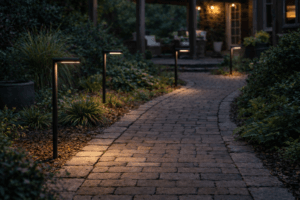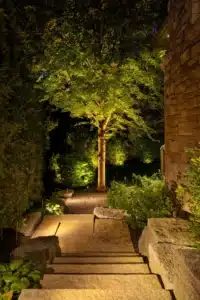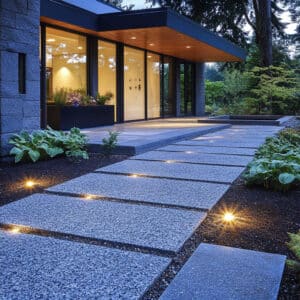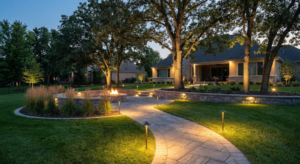
Choosing between LED and halogen technology represents one of the most significant decisions in outdoor landscape lighting. Whether you’re illuminating pathways, highlighting architectural features, or creating ambient garden lighting, the bulb technology you select affects everything from monthly electricity bills to maintenance schedules and visual aesthetics. This comprehensive comparison examines both technologies across performance, cost, durability, and design considerations to help you make an informed decision for your property.
Key Takeaways
- LED landscape lights last 25,000–50,000 hours versus halogen’s 2,000–4,000 hours
- LEDs consume 75–80% less energy than comparable halogen fixtures
- Halogen bulbs produce warmer light (2,700–3,000K) preferred by some designers
- Initial LED costs are 2–4 times higher but pay back through energy savings
- Low voltage landscape lighting kits work with both technologies
- Professional landscape lighting installations increasingly favor LED systems

Understanding the Technology Behind Each Option
How LED Landscape Lights Work
Light-emitting diodes produce illumination when electrical current passes through semiconductor material. Unlike traditional bulbs that generate light through heated filaments, LEDs convert electricity directly into photons with minimal heat waste. This fundamental difference explains why garden lighting fixtures using LED technology operate cooler and more efficiently than alternatives.
Modern LED landscape lights incorporate drivers that regulate voltage and current, ensuring consistent performance across varying conditions. The Department of Energy notes that quality LED systems maintain 70% of initial brightness even after 50,000 hours of operation, making them exceptionally reliable for pathway landscape lights and uplighting for trees. For more on maximizing efficiency, explore our guide to energy-efficient landscape lighting solutions.
How Halogen Lights Function
Halogen bulbs represent an evolution of traditional incandescent technology. They contain a tungsten filament surrounded by halogen gas within a quartz envelope. When electricity heats the filament to approximately 3,000 degrees Celsius, it emits bright white light. The halogen gas enables the filament to operate at higher temperatures without degrading as quickly as standard incandescent bulbs.
This technology produces excellent color rendering and a warm glow that many designers appreciate for creating inviting outdoor spaces. However, the high operating temperature means halogen fixtures require careful placement away from flammable materials and vegetation.
Comprehensive Performance Comparison
| Feature | LED Landscape Lights | Halogen Lights |
|---|---|---|
| Lifespan | 25,000–50,000 hours | 2,000–4,000 hours |
| Energy Consumption | 4–12 watts typical | 20–50 watts typical |
| Heat Output | Minimal (cool to touch) | High (very hot) |
| Color Temperature | 2,700–6,500K (variable) | 2,700–3,000K (warm) |
| Dimming Capability | Excellent with compatible transformers | Good with standard dimmers |
| Color Rendering Index | 80–95 CRI | 100 CRI |
| Operating Cost (per 1,000 hours) | $0.50–$1.50 | $2.50–$6.00 |
| Warranty Period | 3–5 years typical | 1–2 years typical |
Note: If you’re deciding between warm and cool tones, understanding color temperature in landscape lighting can help you match your aesthetic goals.
Cost Analysis: Initial Investment vs. Long-Term Value
Upfront Expenses
Professional landscape lighting installations using halogen technology typically cost $200–$400 per fixture including labor. Comparable LED systems range from $300–$800 per fixture. For a standard residential landscape lighting design featuring 12–15 fixtures, expect to invest an additional $1,200–$4,800 for LED over halogen.
However, this calculation becomes more complex when factoring the landscape lighting transformer. LED systems require transformers rated for lower total wattage, potentially reducing transformer costs by $100–$300 compared to systems supporting power-hungry halogen bulbs. To ensure you choose the right size, see our detailed guide on how to size your landscape lighting transformer correctly.
Operating and Maintenance Costs
A typical halogen pathway light consuming 35 watts operated five hours nightly costs approximately $15–$25 annually in electricity at average U.S. rates. An equivalent LED fixture using 7 watts costs $3–$5 annually. Across 15 fixtures over ten years, the energy savings alone reach $1,800–$3,000.
Replacement costs amplify these differences. Halogen bulbs requiring replacement every 1–2 years add $15–$30 per fixture including labor. LEDs typically require no bulb replacement during the same period, saving an additional $1,500–$3,000 over a decade.
Pros and Cons of Each Technology
LED Advantages and Disadvantages
Pros:
- Exceptional energy efficiency reduces operating costs by 75–80%
- Extended lifespan minimizes maintenance and replacement needs
- Cool operation prevents plant damage and reduces fire risk
- Available in multiple color temperatures for design flexibility
- Instant full brightness without warm-up period
- Resistant to vibration and impact damage
Cons:
- Higher initial purchase and installation costs
- Some users find color quality less natural than halogen
- Requires compatible dimming systems and landscape lighting transformers
- Performance can degrade in extreme heat without proper heat sinking
- Blue light spectrum may attract more insects in certain wavelengths
Halogen Advantages and Disadvantages
Pros:
- Lower upfront costs make projects more accessible
- Superior color rendering (100 CRI) shows true colors
- Warm light temperature creates inviting ambiance
- Compatible with existing low voltage landscape lighting kits
- Familiar technology for most electricians and installers
- Dimmable with standard dimming equipment
Cons:
- High energy consumption increases monthly electricity bills
- Short lifespan requires frequent bulb replacement
- Extreme heat output can damage fixtures and nearby plants
- Generates significant UV radiation that attracts insects
- Fragile filament vulnerable to vibration and shock
- Less environmentally sustainable due to frequent replacement
Application-Specific Recommendations
When to Choose LED Landscape Lights
If you prioritize long-term value over immediate savings, LED technology delivers superior return on investment. Calculate payback period by dividing the additional upfront cost by annual energy savings—most residential installations achieve payback within 3–5 years.
If your design includes uplighting for trees or fixtures mounted near vegetation, LEDs’ cool operation prevents heat damage to bark and foliage. The Illuminating Engineering Society recommends LED sources for any fixture within 18 inches of living plants. Learn professional techniques in our guide to uplighting trees for dramatic nighttime effects.
If you want minimal maintenance, LED reliability means fewer service calls and ladder trips. This proves especially valuable for hard-to-reach fixtures on steep slopes or tall architectural features.
When to Consider Halogen
If budget constraints are paramount and you need immediate installation, halogen’s lower entry cost makes projects feasible that might otherwise be postponed. Some homeowners report preferring incremental upgrades over delayed complete installations.
If color accuracy is critical for showcasing artwork, water features, or specific plantings, halogen’s perfect color rendering preserves natural hues. Many landscape lighting designers still specify halogen for premium residential projects where color fidelity justifies higher operating costs.
If you’re working with existing systems, retrofitting halogen fixtures to LED sometimes requires transformer upgrades and compatibility testing. In these scenarios, continuing with halogen bulbs may be more practical for the short term. For guidance on whether to DIY or hire a pro, read our comparison of DIY vs. professional landscape lighting installation.
Installation Considerations and Best Practices
Do’s and Don’ts for LED Installation
Do:
- Verify transformer compatibility before purchasing LED bulbs
- Use fixtures rated for outdoor use with appropriate IP ratings
- Install LED fixtures where cool operation provides safety benefits
- Consider color temperature options (2,700K for warm, 4,000K for neutral)
- Consult manufacturer specifications for proper spacing in pathway landscape lights
Don’t:
- Mix LED and halogen bulbs on the same transformer circuit
- Exceed the maximum fixture count for your landscape lighting transformer
- Install LEDs in fully enclosed fixtures without ventilation
- Ignore voltage drop calculations on extended cable runs—see our guide to fixing voltage drop in low-voltage lighting systems
- Assume all LED bulbs work with existing dimming systems
Step-by-Step Conversion Process
Converting existing halogen systems to LED requires careful planning:
- Audit your current system by documenting total wattage, fixture count, and transformer specifications. Record the amp rating and total capacity.
- Calculate new LED load by selecting equivalent LED replacements and totaling their wattage. LEDs typically reduce total load by 70–85%.
- Verify transformer compatibility since some older magnetic transformers don’t work well with LED technology. Electronic transformers designed for LED loads perform better.
- Test with a pilot installation by converting 2–3 fixtures first. Verify proper brightness, check for flickering, and confirm dimming functionality.
- Complete the conversion by replacing all halogen bulbs with LEDs. Some professionals recommend converting entire zones at once rather than mixing technologies.
- Adjust transformer settings if your system includes multiple taps. Lower voltage taps may provide optimal LED performance.
Pro Tip: Always ensure your system uses low-voltage landscape lighting, which is safer, more efficient, and easier to maintain—especially for retrofits.
Real-World Example: Residential Landscape Transformation
A homeowner in suburban Atlanta replaced 18 halogen pathway and accent lights with LED equivalents. The original system consumed 630 watts total (35 watts per fixture) and required bulb replacement every 18–24 months at $25 per service call.
The LED retrofit reduced consumption to 126 watts (7 watts per fixture) while maintaining comparable brightness levels. Over the subsequent three years, the homeowner reported:
- Annual energy savings of $87 based on local electricity rates
- Zero bulb replacements compared to previous 24 replacements over three years
- Reduced landscape lighting transformer heat and extended transformer life
- Cooler fixture surfaces that eliminated previous concerns about contact with mulch
The project cost $1,440 for LED bulbs and minor wiring upgrades. With combined energy and maintenance savings of approximately $690 annually, payback occurred in just over two years.
Note: This represents a typical residential scenario based on industry reports, though specific results vary by usage patterns and local utility rates.
Environmental and Safety Considerations
LED landscape lights contain no mercury or hazardous gases, making disposal simpler than compact fluorescent alternatives. The Environmental Protection Agency recognizes LED technology as environmentally preferable due to reduced energy consumption and longer service life. For authoritative details, refer to the U.S. Department of Energy’s guide to LED lighting.
Halogen bulbs’ high surface temperatures—often exceeding 500 degrees Fahrenheit—present burn risks and fire hazards. Many building codes require minimum clearances between halogen fixtures and combustible materials. Garden lighting fixtures using halogen technology need protective guards in areas with foot traffic.
LED systems’ low voltage nature (typically 12V or 24V) combined with cool operation creates safer outdoor landscape lighting installations, particularly important for properties with children or pets.
Quick Answers – FAQ Section
How long do LED landscape lights actually last?
Quality LED landscape lights last 25,000–50,000 hours, equivalent to 15–25 years with typical residential usage of 5 hours nightly, compared to halogen’s 2–3 year lifespan.
Can I replace halogen bulbs with LED in existing fixtures?
Yes, if your landscape lighting transformer is compatible with LED loads and the fixture provides adequate heat dissipation; verify specifications with the manufacturer before converting. If you’re unsure whether to tackle this yourself, review the pros and cons of DIY vs. professional landscape lighting installation.
Do LED landscape lights work in cold weather?
LEDs perform excellently in cold temperatures, often better than in heat, with no warm-up time required unlike some gas-discharge alternatives.
Why do some LED landscape lights flicker?
Flickering typically results from incompatible transformers, voltage drops on long cable runs, or poor-quality LED drivers; professional-grade low voltage landscape lighting kits minimize these issues. Learn how to diagnose and fix this in our guide to fixing voltage drop in low-voltage lighting systems.
Are LED landscape lights worth the extra cost?
For most applications, yes—energy savings and eliminated replacement costs typically provide payback within 3–5 years, with continuing savings for decades thereafter.
What color temperature should I choose for LED outdoor lighting?
Most landscape lighting designs use 2,700–3,000K for warm ambiance matching traditional halogen, though 4,000K provides crisper white light for security applications. Dive deeper into this topic with our guide to understanding color temperature in landscape lighting.
Can LED landscape lights be dimmed like halogen?
Yes, but require LED-compatible dimming transformers or controls; not all LED bulbs support dimming, so verify specifications before purchase.
Do LED lights attract fewer insects than halogen?
LEDs can attract fewer insects when using warmer color temperatures (below 3,000K) with minimal UV output, unlike halogen which emits more UV radiation. Choosing the right color temp is key—see our color temperature guide for best practices.
How much can I save on electricity with LED landscape lights?
Typical savings reach 75–80% compared to halogen, translating to $10–$20 annually per fixture depending on usage patterns and local electricity rates.
What happens if one LED fails in a series circuit?
In quality low voltage landscape lighting kits, each fixture connects independently, so one failure doesn’t affect others unlike some series-wired Christmas light strings.
Glossary of Terms
Lumen Output: The total quantity of visible light emitted by a source, measured in lumens; more accurate than wattage for comparing brightness between LED and halogen technologies.
Color Rendering Index (CRI): A measurement from 0–100 indicating how accurately a light source displays colors compared to natural sunlight; halogen scores 100 while quality LEDs range from 80–95.
Landscape Lighting Transformer: A device that converts standard 120V household current to low voltage (typically 12V or 24V) for safe outdoor lighting systems; must be properly sized for total fixture load. Learn how in our guide to how to size your landscape lighting transformer correctly.
Color Temperature: Measured in Kelvin (K), this describes the warmth or coolness of light appearance; lower numbers (2,700K) appear warm and yellow while higher numbers (5,000K+) appear cool and blue.
Conclusion
The choice between LED landscape lights and halogen technology ultimately depends on your priorities, budget, and performance requirements. LED systems deliver superior long-term value through dramatic energy savings, minimal maintenance, and exceptional longevity that far outlasts halogen alternatives. For homeowners and businesses committed to sustainability and total cost of ownership, LED represents the clear choice for modern landscape lighting design.
However, halogen maintains relevance for specific applications where perfect color rendering justifies higher operating costs, or where budget constraints make LED’s initial investment prohibitive. The technology’s warm, inviting glow continues to appeal to designers and homeowners who prioritize aesthetics over efficiency.
Regardless of your choice, invest in quality fixtures from reputable manufacturers, ensure proper installation by qualified professionals, and match your landscape lighting transformer to your system’s requirements. Consider starting with LED for new installations while potentially maintaining existing halogen systems until natural replacement cycles make conversion practical.
Ready to upgrade your outdoor lighting? Find a certified Tru-Scapes lighting professional who can assess your property, recommend appropriate technologies, and design a system that balances your aesthetic vision with practical performance requirements.