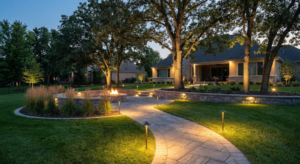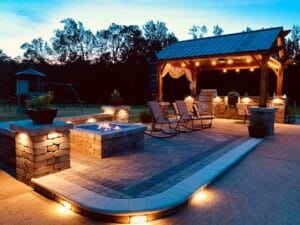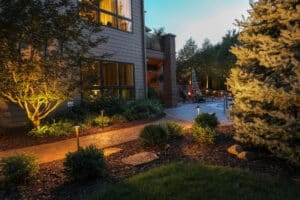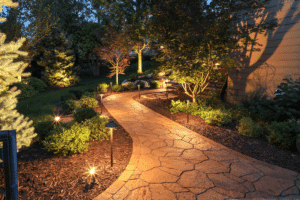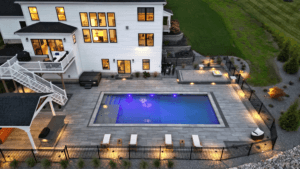
After the sun goes down, most landscapes disappear into darkness. Tree uplighting changes that entirely. This tree uplighting guide walks you through everything you need—from choosing the right outdoor landscape lighting fixtures to programming your transformer—so your trees become dramatic focal points instead of shadowy silhouettes.
Uplighting for trees isn’t just about aesthetics. It improves home security by eliminating dark corners, adds perceived property value, and extends the usability of your outdoor spaces well into the evening. Whether you’re installing a simple low voltage landscape lighting kit for the first time or upgrading to professional landscape lighting, the principles in this guide apply.
By the end of this article, you’ll understand exactly which fixtures to buy, where to place them, how to wire them safely, and how to avoid the most common mistakes homeowners make when lighting trees.
Key Takeaways
• A tree uplighting guide helps you choose the right beam angle, wattage, and fixture type.
• LED landscape lights consume up to 75% less energy than older halogen fixtures.
• Low voltage landscape lighting kits (12V) are safe, DIY-friendly, and code-compliant.
• Fixture placement matters: start 1–3 feet from the trunk and angle at 45–60 degrees.
• A quality landscape lighting transformer protects your system and enables timers or dimmers.
• Layering uplighting with pathway landscape lights creates depth and curb appeal.
What Is Tree Uplighting?
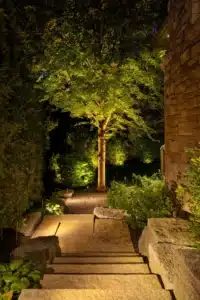
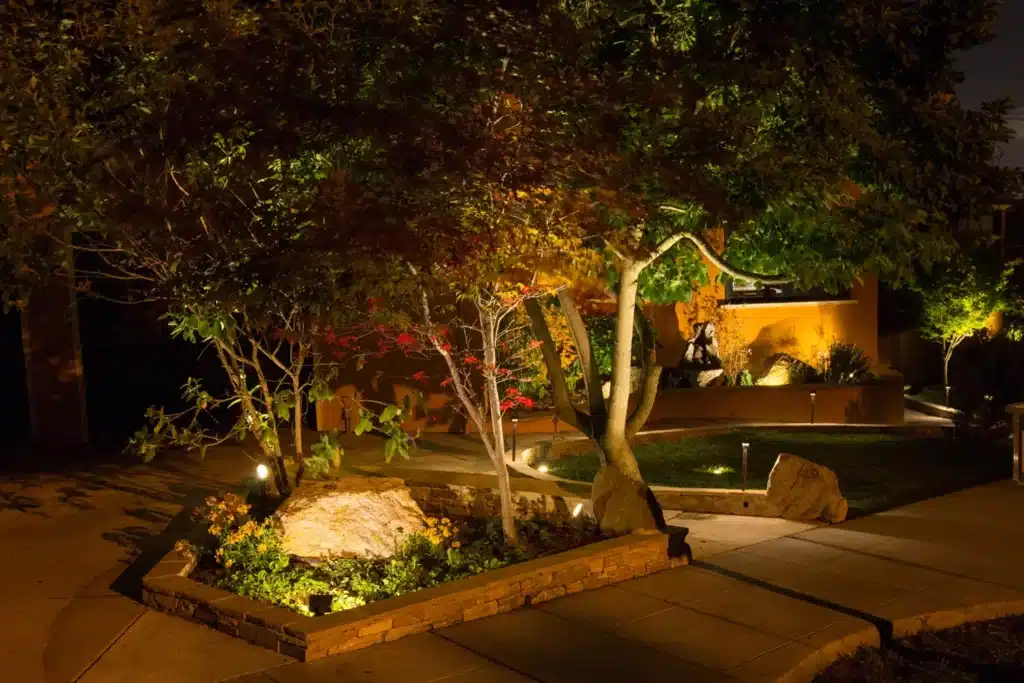
Tree uplighting is a landscape lighting technique in which fixtures are installed at or near ground level and aimed upward to illuminate a tree’s canopy, trunk, or branching structure. The effect creates drama, depth, and visual interest that no other lighting technique can replicate.
Unlike moonlighting techniques—which mimic moonlight falling from above—uplighting reveals texture in the bark, casts shadows through branches, and makes trees appear larger and more sculptural. Many landscape designers use both techniques together for maximum effect.
Key point: Uplighting is most effective on trees with interesting trunk texture, an asymmetric canopy, or dramatic branching patterns, such as oaks, Japanese maples, crape myrtles, and palms.
Choosing the Right Fixtures for Uplighting Trees
LED vs. Halogen: The Clear Winner
Modern LED landscape lights have replaced halogen as the standard for outdoor landscape lighting. The energy savings are significant—LEDs use a fraction of the wattage for the same lumen output—and they last tens of thousands of hours with minimal maintenance. According to data from the U.S. Department of Energy, LED technology outperforms older lighting sources on both efficiency and longevity. For a deeper dive into LED versus halogen performance, explore our detailed comparison.
| Feature | LED Landscape Lights | Halogen Lights |
|---|---|---|
| Energy Use | 3–10 watts typical | 20–50 watts typical |
| Lifespan | 25,000–50,000 hours | 2,000–5,000 hours |
| Heat Output | Low | High |
| Color Temperature | 2700K–6500K options | Warm only (~3000K) |
| Cost Over Time | Low (energy savings) | High (bulb replacement) |
| Best For | All uplighting applications | Legacy system replacements |
Fixture Types for Tree Uplighting
Not every garden lighting fixture is suited to uplighting. Here are the most common options: • Bullet or spot fixtures: Narrow beam (10°–25°) for tall, narrow trees or specific trunk details.
• Well lights (in-ground): Flush-mount, nearly invisible during the day; ideal for high-traffic areas.
• Flood fixtures: Wide beam (45°–60°) for spreading canopies like oaks or maples.
• Adjustable stake fixtures: Easy to reposition; great for seasonal changes or DIY installs.
Beam Angle Guide
If you need to light a tall, columnar tree like an Italian cypress, choose a narrow beam (10°–15°). If you need to illuminate a wide-spreading shade tree, choose a flood fixture with a 45° or wider beam. The goal is to fill the canopy without spilling light onto neighboring properties or into the sky.
Step-by-Step Tree Uplighting Installation
Follow these steps to install a basic low voltage landscape lighting system for tree uplighting.
- Plan your layout. Walk the property at night with a flashlight to identify which trees you want to highlight. Sketch the fixture locations and measure cable runs.
- Calculate your load. Add up the wattage of all planned fixtures. Your landscape lighting transformer must handle that total wattage with at least 20% headroom. Be sure to properly size your landscape lighting transformer to ensure system longevity.
- Choose and install your transformer. Mount the transformer near an outdoor GFCI outlet, ideally at least 12 inches above grade. Set your timer or photocell for automatic operation.
- Lay your cable. Use 12-gauge or 10-gauge direct burial cable for runs longer than 100 feet. Bury it at least 6 inches deep to protect against lawn equipment.
- Position your fixtures. Place the first fixture 1–3 feet from the base of the trunk. Angle it at approximately 45–60 degrees upward toward the primary visual interest area—usually the first major branching point.
- Test before burying. Connect fixtures, turn on the transformer, and evaluate the effect at night. Adjust angle and position before finalizing placement.
- Bury cables and secure fixtures. Use ground stakes to anchor fixtures firmly so they don’t shift over time.
- Program your transformer. Set timers so lights activate at dusk and turn off at a reasonable hour—both for energy savings and to avoid light pollution.
Fixture Placement: Do’s and Don’ts
| DO | DON’T |
|---|---|
| Place fixtures 1–3 ft from the trunk | Place fixtures directly against the trunk |
| Use 2–3 fixtures for large or multi-trunk trees | Use a single fixture for a tree wider than 15 ft |
| Angle fixtures at 45–60 degrees for natural shadows | Aim straight up—this creates a flat, unnatural look |
| Test placement at night before finalizing | Assume daytime placement looks good at night |
| Choose warm white (2700K–3000K) for a natural look by selecting the right color temperature | Use cool white (5000K+) on trees—it looks clinical |
Understanding the Landscape Lighting Transformer
The landscape lighting transformer is the heart of any low voltage system. It converts standard 120V household current to 12V AC, which powers your LED landscape lights safely. Choosing the right transformer matters more than most homeowners realize.
Wattage sizing: Add up the total wattage of all your fixtures. Choose a transformer rated for at least 25% more than that total. For example, if your fixtures total 80 watts, install a 100-watt or 150-watt transformer.
Features to look for: Multi-zone timers, photocell sensors, and built-in circuit breakers are standard on quality transformers. If you plan to expand your system later, choose a higher-capacity model from the start.
If you need to control multiple lighting zones—uplighting on trees versus pathway landscape lights near the entrance—learn about creating independent lighting zones that allow independent scheduling for each zone.
Pros and Cons of DIY vs. Professional Landscape Lighting
| DIY with a Low Voltage Kit | Professional Landscape Lighting |
|---|---|
| Pros | Pros |
| Lower upfront cost; kits available at hardware stores | Expert design, commercial-grade fixtures, warranty support |
| Flexible—rearrange as trees grow or needs change | Optimized photometric layout for maximum visual impact |
| Cons | Cons |
| Consumer fixtures may not be as durable or weather-resistant | Higher upfront installation cost |
| Design mistakes are common without experience | Less hands-on control for homeowners who want flexibility |
Before weighing DIY against professional installation, consider your comfort level with electrical components and design aesthetics.
Landscape Lighting Design Principles for Trees
Good landscape lighting design follows a few fundamental rules that separate amateur results from professional-looking installations.
Layering: Combine uplighting on trees with pathway landscape lights, garden lighting fixtures near beds, and architectural lighting on the home’s facade. Layering creates dimension and prevents the flat, “spotlighted” look.
Restraint: More light is not better. Overlighting is one of the most common mistakes. Use the minimum wattage needed to achieve the desired effect, and keep fixtures hidden so the light—not the hardware—is what you notice. Adhering to the National Park Service outdoor lighting principles helps protect local wildlife and reduces skyglow while maintaining beauty.
Color temperature consistency: Mixing warm white (2700K) and cool white (5000K) fixtures in the same landscape looks disjointed. Pick one color temperature and stick with it across the entire system.
If you need to highlight a specimen tree that serves as the focal point of the front yard, direct more fixture attention and slightly higher wattage there. If you need to create a uniform, understated glow along a tree-lined driveway, use lower wattage and consistent fixture spacing.
Real-World Example: Front-Yard Oak Tree Uplighting
Hypothetical scenario: A homeowner in suburban Georgia has a 40-foot white oak with a wide-spreading canopy and deeply furrowed bark. The goal is to make the tree a dramatic focal point from the street.
Solution: Three 7-watt LED bullet fixtures were placed in a triangular arrangement 2 feet from the trunk, each angled at approximately 50 degrees. A 100-watt landscape lighting transformer with a dusk-to-10pm timer powers the system along with four pathway landscape lights on the same run. The warm 3000K color temperature matches the adjacent porch lighting.
Result: The tree became the dominant visual element of the yard at night, with the bark texture visible from the street and canopy shadows casting on the home’s facade. Total system cost was under $300 installed as a DIY project, using a widely available low voltage landscape lighting kit supplemented with three additional spot fixtures.
Quick Answers: Tree Uplighting FAQ
What is tree uplighting?
Tree uplighting is a technique where ground-level fixtures are aimed upward to illuminate a tree’s trunk, bark, or canopy at night. It creates dramatic shadow and texture effects not achievable with any other method.
How many fixtures do I need to uplight a tree?
Most trees 15–25 feet tall require two or three fixtures for balanced coverage. Large trees over 30 feet with wide canopies may need four or more, positioned in a triangular or square arrangement around the base.
What wattage should I use for tree uplighting?
For small ornamental trees (under 15 feet), 3–5 watt LED fixtures are typically sufficient. For large shade trees 25 feet and taller, 7–12 watt fixtures provide enough brightness without over-lighting.
Is low voltage landscape lighting safe to install yourself?
Yes. Low voltage systems operate at 12V AC, which is safe to handle and does not require a licensed electrician in most U.S. jurisdictions. Always connect to a GFCI-protected outdoor outlet and follow local code requirements. You can follow our step-by-step low voltage installation guide to get started safely.
What color temperature is best for uplighting trees?
Warm white (2700K–3000K) is the most natural-looking and widely recommended for tree uplighting. It complements wood tones, green foliage, and most architectural materials without looking clinical or harsh.
Can I use solar lights for tree uplighting?
Solar fixtures can work for very small accent lighting, but they generally lack the consistent brightness and beam control needed for quality tree uplighting. Low voltage LED systems are strongly preferred for any serious installation.
How deep should landscape lighting cables be buried?
A minimum of 6 inches is standard for low voltage cable, though 8–12 inches is better in areas with regular lawn maintenance. Check local codes, as some jurisdictions have specific requirements.
What is a landscape lighting transformer and do I need one?
A landscape lighting transformer converts 120V household current to 12V for safe outdoor use. It is a required component of any low voltage landscape lighting system. Look for models with timers and photocell sensors for convenient automatic operation.
How do I reduce light pollution from uplighting?
Choose fixtures with tight beam angles and cutoff shields that direct light only at the tree. Use the minimum effective wattage, and set timers so lights don’t run all night. To reduce light pollution, follow the responsible outdoor lighting guidelines from the IES.
What’s the difference between uplighting and moonlighting?
Uplighting places fixtures at ground level pointing upward, creating bold shadows and revealing bark texture. Moonlighting places fixtures high in the tree canopy pointing downward, simulating soft natural moonlight filtering through branches. Many professional designs use both techniques together.
Glossary of Key Terms
Low Voltage Landscape Lighting
An outdoor lighting system that operates at 12V AC using a step-down transformer. Low voltage systems are safe for DIY installation and widely used for residential garden and tree lighting applications.
Beam Angle
The spread of light emitted by a fixture, measured in degrees. Narrow beam angles (10°–25°) concentrate light on a specific area, while wide beam angles (45°+) spread illumination over a broader surface.
Landscape Lighting Transformer
A device that reduces standard 120V household current to 12V for use in low voltage outdoor lighting systems. Quality transformers include timers, multi-zone circuits, and overload protection.
Color Temperature (Kelvin / K)
A measure of the color appearance of light. Lower Kelvin values (2700K–3000K) produce warm, amber-toned light. Higher values (5000K+) produce cool, blue-toned light. Warm white is typically preferred for natural-looking landscape lighting.
Conclusion: Light Up What Matters
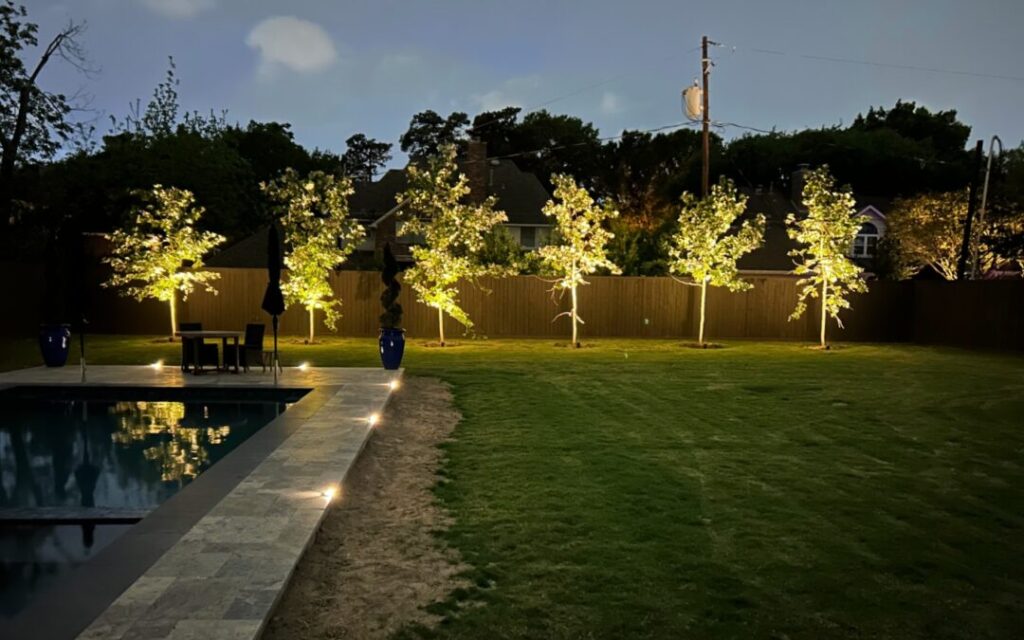
A well-executed tree uplighting guide gives you the tools to turn ordinary landscaping into something memorable. The principles are straightforward: choose quality LED landscape lights, size your landscape lighting transformer correctly, position fixtures at the right distance and angle, and layer your lighting design for depth and visual interest.
Whether you start with a simple low voltage landscape lighting kit or commission a full professional landscape lighting design, the trees in your yard deserve to be seen at night. They’re permanent features that define your property’s character—and with the right uplighting, they’ll do that around the clock.
Ready to get started? Explore our selection of LED landscape lights and low voltage kits, contact landscape lighting services in Wheaton for a custom design, or reach out to our lighting design team for a free consultation.