KEY TAKEAWAYS
- Correct lumens for landscape lighting vary by fixture type, zone purpose, and surrounding light levels.
- Pathway landscape lights perform best in the 100–200 lumen range for safe, glare-free illumination. See our pathway light spacing and placement guide for optimal results.
- Uplighting for trees typically requires 120–300 lumens depending on tree height and canopy density. Learn more with our guide to professional tree uplighting techniques.
- LED landscape lights deliver the same or better brightness than halogen at a fraction of the wattage. Review our LED versus halogen fixture comparison for detailed performance data.
- Over-lighting is as damaging to landscape design as under-lighting — restraint produces better results.
- A layered lumen approach across ambient, accent, and task zones creates a balanced outdoor lighting design. Our landscape lighting zone planning guide breaks down the strategy.
Why Lumens Matter More Than Watts in Outdoor Landscape Lighting
For decades, homeowners bought light bulbs by wattage. Higher watts meant brighter light, and the system worked well enough — until LED landscape lights changed the equation entirely. A modern LED fixture delivering 200 lumens may draw only 2–3 watts. The halogen equivalent drew 20 watts for the same output. Wattage no longer tells you how bright a light is. Lumens do.
Understanding lumens for landscape lighting is the single most important step in building an outdoor lighting system that looks intentional rather than accidental. Too few lumens and your pathway disappears into darkness. Too many and your garden feels like a parking lot. The right lumen range — matched to fixture type, placement, and zone — is what creates the layered, professional result that well-designed outdoor landscape lighting is known for.
This guide gives you the exact lumen ranges used by professional landscape lighting designers, organized by fixture type and application, so you can make confident decisions about every light in your system.
What Is a Lumen? Understanding Brightness in Plain Terms
A lumen is the standard unit of measurement for visible light output. It measures the total amount of light emitted by a source in all directions — not how much power it uses, not how far the beam travels, but how much actual light it produces. For definitive technical definitions, consult the Illuminating Engineering Society photometric standards.
One useful comparison: a standard 60W incandescent household bulb produces roughly 800 lumens. A candle produces about 12 lumens. Most landscape lighting fixtures operate in a much narrower range — typically between 50 and 700 lumens — because outdoor lighting works best when it is focused, layered, and subtle rather than uniformly bright.
The Illuminating Engineering Society (IES) distinguishes between lumens (total light output) and foot-candles (light intensity at a surface). For landscape lighting design purposes, lumens are the more practical measure — they tell you how much light the fixture produces before beam angle and distance affect what reaches the ground or surface.
Lumens by Fixture Type: The Complete Reference Guide
Pathway Landscape Lights
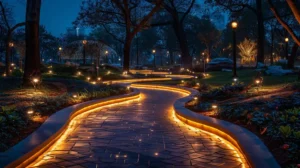
Recommended range: 100–200 lumens
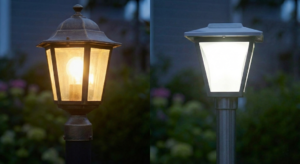
Pathway landscape lights serve a functional and aesthetic purpose simultaneously. They mark edges, guide foot traffic, and create gentle definition along walkways and garden bed borders. The goal is visibility without glare — a pedestrian should be able to see where they are walking without the fixture itself drawing the eye away from the surrounding landscape.
Fixtures below 100 lumens often disappear in competition with ambient light from nearby windows or street lights. Fixtures above 200 lumens create pools of harsh light that interrupt the visual flow of the pathway rather than guiding it. The 100–200 lumen sweet spot delivers exactly enough light for safe navigation while keeping the fixture visually subordinate to the landscape it is illuminating. For precise spacing guidance, consult our pathway light spacing and placement guide.
Uplighting for Trees and Shrubs
Recommended range: 120–300 lumens
Uplighting for trees is one of the most impactful landscape lighting techniques available, but lumen selection here requires matching output to the scale of the subject. A small ornamental tree or compact shrub — 6 to 10 feet tall — is well served by 120–180 lumens. A mature shade tree with a dense canopy 20–30 feet tall may require 250–300 lumens to read clearly against the night sky.
The key variable is not just tree height but canopy density. A dense evergreen absorbs light differently than an open-canopied deciduous tree. If you need to light a large specimen tree with a full spread and heavy foliage, use two fixtures at 200 lumens each rather than one fixture at 400 lumens — the distributed lower-output approach creates more even, natural-looking illumination than a single high-output beam. Our guide to professional tree uplighting techniques walks through placement, angling, and fixture selection.
Garden Lighting Fixtures and Accent Lights
Recommended range: 50–185 lumens
Garden accent lighting — fixtures used to highlight planters, garden walls, sculptures, water features, or decorative elements — generally operates at the lower end of the lumen scale. The purpose is to draw attention to a specific feature, not to flood the surrounding area with light.
For small garden features like a birdbath or container planter, 50–100 lumens is sufficient. For larger garden bed areas or low retaining walls, 120–185 lumens provides enough output to read clearly without spilling light beyond the intended focal point.
Step and Deck Lights
Recommended range: 12–100 lumens
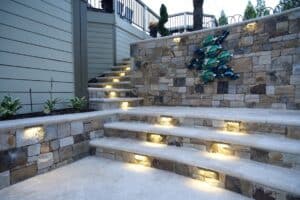
Step lights and deck riser lights are pure task lighting — their sole job is to prevent trips and falls by marking elevation changes. They operate at the lowest lumen levels in any outdoor lighting system. Recessed step lights in the 12–50 lumen range are standard for residential applications. Higher outputs above 100 lumens create uncomfortable glare at ankle level and draw too much visual attention to the structural element rather than the overall space.
Flood Lights and Security Lighting
Recommended range: 700–1300 lumens
Flood lighting and security-oriented outdoor lighting operate in a completely different lumen category from decorative landscape lighting. These fixtures are designed for wide-area coverage, deterrence, and visibility at distance. For residential driveways, garage areas, and perimeter security zones, 700–1000 lumens is standard. For commercial properties or large estate perimeters where professional landscape lighting is deployed at scale, 1000–1300 lumens per fixture is common.
It is important to note that flood lighting and decorative landscape lighting serve entirely different purposes and should never be substituted for each other. Using a 1000-lumen flood in a garden bed accent position will destroy the layered visual balance of an otherwise well-designed system.
Wall Wash Fixtures
Recommended range: 200–400 lumens
Wall washing — directing light across a fence, garden wall, or home exterior to highlight texture and create depth — requires enough output to read clearly across the full height of the surface without washing out detail. For standard 6-foot privacy fencing, 200–300 lumens is ideal. For taller masonry walls or home facade washing, 300–400 lumens delivers the coverage needed.
Lumen Reference Table: Landscape Lighting by Application
| Application | Recommended Lumens | Fixture Type | Effect |
|---|---|---|---|
| Pathway edges and walkways | 100–200 lm | Stake path light | Safe navigation, gentle definition |
| Small tree uplighting (under 10 ft) | 120–180 lm | Ground uplight | Vertical accent, depth |
| Large tree uplighting (over 15 ft) | 200–300 lm | Ground uplight | Canopy illumination, drama |
| Garden accent and planters | 50–185 lm | Spotlight, well light | Focal point highlight |
| Step and deck risers | 12–100 lm | Recessed step light | Safety, subtle definition |
| Fence and wall washing | 200–400 lm | Wall wash fixture | Texture, boundary depth |
| Driveway and security zones | 700–1300 lm | Flood light | Wide coverage, deterrence |
| Patio and seating ambient | 200–400 lm | Downlight, post light | Comfortable social lighting |
| Water features | 50–150 lm | Submersible or grazing | Reflective, dynamic effect |
How to Calculate Total Lumens for Your Landscape Lighting System
Calculating the total lumen output of your system is a useful quality check — but it is secondary to getting the per-fixture lumen range right for each application. A system with 10 correctly specified fixtures at appropriate lumen levels will always outperform a system with 20 fixtures chosen by wattage alone.
Step 1 — List every fixture and its planned application.
Assign each fixture to a category: pathway, uplight, accent, step, flood, or wall wash.
Step 2 — Apply the recommended lumen range for each application.
Use the reference table above. For each fixture, note the midpoint of the recommended range as your target lumen output.
Step 3 — Select LED fixtures that match each target.
LED landscape lights are now available across the full lumen spectrum in precise increments. Match each fixture selection to the target lumen output for its application rather than defaulting to a single lumen level across all fixtures. When comparing options, our LED versus halogen fixture comparison helps clarify long-term efficiency implications.
Step 4 — Check total wattage against your transformer.
Once fixtures are selected, add their wattage ratings. Multiply by 1.2 to get your minimum landscape lighting transformer size. For a typical residential system using all LED landscape lights across 12–16 fixtures, total wattage rarely exceeds 100–150W — well within the range of a standard 150W or 300W transformer. Use our landscape transformer sizing guide to avoid undersizing errors.
Step 5 — Test and adjust in the field.
Install fixtures at planned positions before burying wire. Walk the system after dark and assess whether each fixture is delivering the intended visual effect. Lumen output interacts with beam angle, fixture height, surface reflectivity, and surrounding ambient light in ways that are impossible to predict entirely from a plan. Field adjustment is a normal and necessary part of professional landscape lighting design. Follow our low voltage installation walkthrough for final calibration steps.
LED vs. Halogen: Lumens Per Watt Comparison
One of the most practical reasons to choose LED landscape lights over halogen is lumen-per-watt efficiency — the amount of usable light produced for every watt of power consumed.
| Metric | LED Landscape Lights | Halogen Fixtures |
|---|---|---|
| Lumens per watt | 80–100 lm/W | 15–20 lm/W |
| Typical fixture wattage | 2W–10W | 20W–50W |
| Output at 4W (LED) vs 20W (halogen) | ~320–400 lm | ~300–400 lm |
| Lifespan | 25,000–50,000 hours | 2,000–4,000 hours |
| Heat output | Minimal | High |
| Color rendering (CRI) | 80–90+ | 95–100 |
| Dimming compatibility | Most modern units | Standard |
As the table shows, a 4W LED fixture and a 20W halogen fixture can produce nearly identical lumen output — the LED achieves it at one-fifth the energy cost. According to U.S. Department of Energy LED efficiency data, LED lighting uses at least 75% less energy than traditional incandescent and halogen sources while delivering comparable or superior light output.
The tradeoff is color rendering index (CRI). Halogen fixtures naturally score higher on CRI — meaning colors appear slightly more true-to-life under halogen. For most residential landscape lighting applications, the difference is negligible. For high-end professional landscape lighting installations where plant and stone color accuracy matters significantly, a high-CRI LED (90+) closes the gap almost entirely.
Pros and Cons of High-Lumen vs. Low-Lumen Landscape Fixtures
Pros of Higher Lumen Output (300+ lm):
- Better visibility for security and safety zones
- More effective on large trees, tall walls, and wide surfaces
- Greater flexibility — can be dimmed down if needed
- Performs well in areas with competing ambient light sources
Cons of Higher Lumen Output:
- Creates glare when used in close-range accent positions
- Overwhelms neighboring lower-output fixtures, destroying visual balance
- Increases transformer load, particularly across multiple zones
- Light pollution risk — excess lumen output spills beyond the intended target
Pros of Lower Lumen Output (50–200 lm):
- Ideal for intimate garden zones and close-range accent lighting
- Minimal light pollution and neighbor impact
- Lower wattage draw — smaller transformer required
- Creates the layered, subtle effect associated with professional landscape lighting
Cons of Lower Lumen Output:
- Insufficient for large trees, security zones, or wide surface washing
- Can disappear entirely in areas with competing ambient light
- May require more fixtures to achieve adequate coverage
Do’s and Don’ts of Choosing Lumens for Landscape Lighting
| Do | Don’t |
|---|---|
| Match lumen output to the specific application and fixture position | Use the same lumen level for every fixture in your system |
| Use 100–200 lm for pathway lights to avoid glare using our pathway light spacing and placement guide | Exceed 200 lm on pathway stake lights at ground level |
| Layer lumen levels across ambient, accent, and task zones per our landscape lighting zone planning guide | Mix flood-level lumens (700+) into decorative accent positions |
| Choose high-CRI LED fixtures (90+) for garden bed and plant accents | Assume wattage tells you how bright an LED fixture will be — review fixture wattage and lumen requirements |
| Test fixture placement in the dark before finalizing positions using our low voltage installation walkthrough | Buy fixtures based on lumen output alone without checking beam angle |
| Size your transformer to 120% of total fixture wattage with our landscape transformer sizing guide | Overload your transformer by adding high-lumen fixtures without recalculating load |
| Use two lower-output uplights for large trees rather than one high-output per our professional tree uplighting techniques | Point a single high-lumen uplight directly into a tree canopy from below |
Getting Lumens Right in a Front Yard Redesign
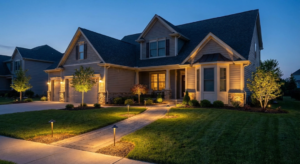
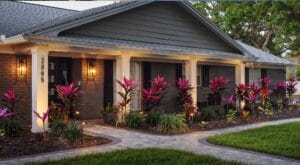
A homeowner in suburban Georgia was replacing an aging halogen outdoor lighting system with a new LED landscape lighting setup. The original system used identical 35W halogen bulbs — roughly 400 lumens each — across all fixture types: pathway lights, uplights, and step lights. The result was a front yard that looked flat and overlit, with no visual hierarchy between the walkway, the entry garden, and the home facade.
The redesign assigned lumen levels by application.Pathway landscape lights were replaced with 150-lumen LED stake lights. Two ornamental Japanese maples received 180-lumen LED ground uplights each.
Step lights at the entry stoop were replaced with 35-lumen recessed risers. A single 300-lumen wall wash fixture was added to graze the home’s brick facade.
Total system wattage dropped from approximately 280W to 38W. Visual quality improved significantly — the layered lumen approach created clear depth and hierarchy that the uniform halogen system never achieved. The new landscape lighting transformer required was a 60W unit, down from a 300W model.
Quick Answers – FAQ
Q: How many lumens do I need for landscape lighting in general?
A; Most residential landscape lighting systems use fixtures ranging from 50 to 300 lumens per fixture depending on application. Pathway lights perform best at 100–200 lumens, accent and garden lights at 50–185 lumens, and tree uplights at 120–300 lumens. For broader context, explore our comprehensive outdoor lighting planning resource.
Q: Is 200 lumens bright enough for outdoor pathway lights?
A; Yes. 200 lumens is at the upper end of the recommended range for pathway landscape lights and delivers clear, comfortable illumination for safe navigation without creating glare at ground level. Consult our pathway light spacing and placement guide for optimal positioning.
Q: How many lumens do I need to uplight a tree?
A; For small ornamental trees under 10 feet, 120–180 lumens is sufficient. For larger trees over 15 feet with dense canopies, 200–300 lumens is more appropriate. Using two lower-output fixtures rather than one high-output unit creates more even coverage on larger specimens. Learn implementation details in our guide to professional tree uplighting techniques.
Q: Are more lumens always better for outdoor lighting?
A; No. Over-lighting is one of the most common mistakes in landscape lighting design. Excess lumens destroy visual balance, create glare, contribute to light pollution, and increase transformer load unnecessarily. The right lumen level for each application produces a better result than the highest available output.
Q: What lumens are best for LED landscape lights?
A; LED landscape lights are available across the full lumen spectrum. For most residential applications, fixtures in the 100–300 lumen range cover the majority of use cases. Match lumen output to the specific application — pathway, uplight, accent, or flood — rather than choosing a single output level for all fixtures. Review our LED versus halogen fixture comparison for selection guidance.
Q: How do lumens affect my landscape lighting transformer size?
A; Lumens themselves do not directly determine transformer size — wattage does. However, higher-lumen fixtures typically draw more watts. When selecting fixtures, always check the wattage rating alongside lumen output, then total all fixture wattages and multiply by 1.2 to determine the minimum transformer rating your system requires. Use our landscape transformer sizing guide for precise calculations.
Q: What is the difference between lumens and watts in landscape lighting?
A; Watts measure energy consumption; lumens measure light output. A 4W LED fixture can produce the same lumens as a 20W halogen fixture. For modern LED landscape lighting systems, lumens are the correct measure of brightness — wattage only tells you the energy cost of producing that brightness. Learn more in our guide to fixture wattage and lumen requirements.
Q: How many lumens do low voltage landscape lighting kits typically include?
A; Most low voltage landscape lighting kits include pathway and accent fixtures in the 50–200 lumen range per fixture. Kit fixtures are typically adequate for basic installations but may not offer the lumen precision or range needed for complex multi-zone landscape lighting designs.
Q: What lumens should I use for uplighting a house facade?
A; For residential home facade washing, 200–400 lumens per fixture is the standard range. The exact output depends on facade height, material reflectivity, and the desired visual intensity — lighter colored surfaces require less output than dark brick or stone.
Glossary of Terms
Lumen (lm)
The standard unit of measurement for total visible light output from a source. In landscape lighting, lumens replace watts as the primary measure of brightness because LED fixtures produce far more lumens per watt than older halogen or incandescent sources. For authoritative definitions, reference the Illuminating Engineering Society photometric standards.
Foot-Candle (fc)
A measure of light intensity at a specific surface, equal to one lumen per square foot. Used by professional lighting designers to specify illumination levels at the ground or wall surface rather than at the fixture itself.
Color Rendering Index (CRI)
A scale from 0 to 100 that measures how accurately a light source renders the true colors of objects compared to natural daylight. Higher CRI values (90+) are preferred for garden lighting fixtures where plant and material color accuracy matters.
Beam Angle
The spread of a light beam measured in degrees. A narrow beam angle (15–30°) concentrates lumens in a focused spot, ideal for uplighting trees or spotlighting features. A wide beam angle (60–120°) spreads lumens across a broader surface, better suited to pathway and ambient applications.
Conclusion
Getting lumens right is what separates a landscape lighting system that looks designed from one that simply looks installed. The lumen ranges in this guide are not arbitrary — they reflect the visual physics of how light behaves at distance, across surfaces, and in competition with surrounding ambient light levels.
The core principle is restraint applied with precision. Pathway landscape lights at 100–200 lumens, garden lighting fixtures and accents at 50–185 lumens, uplighting for trees at 120–300 lumens, and flood zones at 700–1300 lumens — each range exists because it produces the right visual result for that specific application without overwhelming the zones around it.
Choosing the correct lumens for landscape lighting is not a complicated process once you understand that different applications demand different outputs. Match lumen level to purpose, layer those outputs across your ambient, accent, and task zones using our landscape lighting zone planning guide, choose efficient LED landscape lights that deliver the target output at minimal wattage per our LED versus halogen fixture comparison, and size your landscape lighting transformer to handle the total load with room to grow using our landscape transformer sizing guide.
Ready to build your system? Browse our full selection of LED landscape lights, pathway fixtures, uplights, and transformers — and use our lumen and wattage guide to specify every fixture in your design before you order a single component. For electrical safety compliance, always follow National Electrical Code low-voltage requirements during installation.