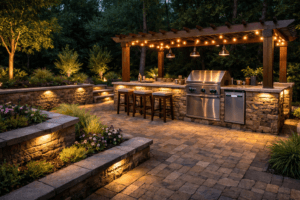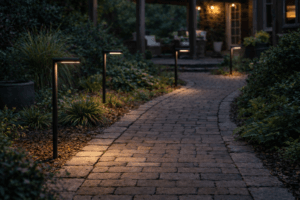
Let’s be real. Your yard is a series of different projects, isn’t it? One year, you put in the patio. The next, you hired an irrigation crew. Now, you’re thinking about landscape lighting, but you’re worried about them digging up the lawn again and, worse, hitting one of those sprinkler lines.
This piecemeal approach is how most of us do it. But it’s also the most expensive, disruptive, and frustrating way to build the yard of your dreams. The irrigation team’s trenching machine cuts through your cable line. The lighting installer bangs their head wondering how to run a wire around a buried water main.
There is a much, much smarter way.
It’s called an Integrated Landscape approach. This is the simple, powerful idea that your yard’s systems—especially your lighting and your irrigation—should be planned together. This article is your guide to these streamlined yard solutions. We’ll explore why combining these two projects is the biggest “pro-tip” in modern landscaping and how it sets you up for a beautiful, functional, and headache-free yard for decades.
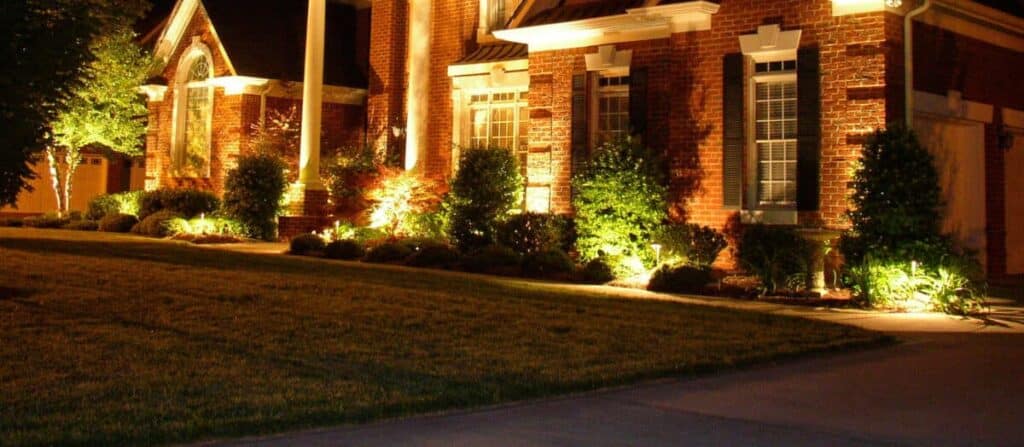
What Do We Mean by an “Integrated Landscape”?
An “Integrated Landscape” isn’t a product you can buy in a box. It’s a philosophy. It’s the decision to stop thinking of your yard as a list of separate, competing projects and start thinking of it as one single, cohesive system.
At its core, this approach focuses on the two big “underground” systems:
- Landscape Lighting: Specifically, professional, professional, low-voltage (12V) lighting systems that require buried wires to connect fixtures.
- Irrigation: The system of pipes, valves, and sprinkler heads that keeps your lawn and gardens watered.
Why these two? Because they share the exact same space—the top 6 to 18 inches of your soil. When they are installed without “talking” to each other, the result is chaos. When they are planned together, the result is pure efficiency.
The “Why”: 5 Huge Benefits of Planning Lighting & Irrigation Together
If you’re about to install either system, stopping to plan for both will be the best decision you make. The benefits are almost laughably one-sided.
1. The Obvious Win: Massive Cost Savings
This is the big one. The single most expensive part of any underground installation isn’t the materials—it’s the labor and equipment for trenching.
- Piecemeal Way: You pay an irrigation crew to rent a trencher, dig up your yard, and lay pipes. Two years later, you pay a lighting contractor to rent a trencher, dig up your yard (often in the same places), and lay wires. You are paying for the most difficult part of the job twice.
- Integrated Way: The trenching is done once. The crew digs a single, strategically planned trench. The irrigation pipe goes in, and the low-voltage lighting wire is laid right alongside it. The cost for labor and disruption is cut nearly in half.
2. A Single, Clean Installation
We’ve all seen yards that look like a construction zone for an entire summer. Planning combined outdoor systems is the antidote to this.
Instead of facing two separate, multi-week disruptions, you have one. Your lawn is only dug up once. Your garden beds are only disturbed once. The cleanup happens once. For homeowners who value their time and their home’s appearance, this is a massive benefit.
3. Eliminating “Oops”: No More Cut Lines
This is the nightmare scenario for any contractor. The lighting installer, digging a hole for an uplight, sinks their shovel… right through a pressurized irrigation line. The project grinds to a halt. Water shoots everywhere. Now you have a plumbing repair bill on top of your lighting bill.
The same is true in reverse. An irrigation crew’s trencher can’t see a buried 12V lighting wire. A single cut can take down your entire system and lead to a long, frustrating search for the break.
When you install them together, a single, accurate map is created. The lighting tech knows the pipe is two inches to the left. The irrigation tech knows the wire is six inches deep. This “system awareness” is priceless.
4. A Smarter, More Cohesive Design
A great design isn’t just about what things look like; it’s about how they work.
- Problem: An irrigation head is placed without thinking, and it sprays an arc of hard water directly onto a beautiful brass path light, five nights a week. Within a year, that light’s lens is covered in mineral deposits, and the bulb’s effect is ruined.
- Solution: In an integrated design, the lighting designer says, “I’m putting an expensive uplight here to feature this tree.” The irrigation designer replies, “Great, I’ll use a 180-degree head on the other side of the tree, so it never gets soaked.”
This collaboration prevents
long-term performance issues. You can place transformers in high, dry locations, away from valve boxes. You can place fixtures to light a water feature without being soaked by the irrigation that waters it.
5. Future-Proofing Your Yard
What happens in five years when you want to add a deck or a new garden bed? With an integrated plan, you just pull out the “map.”
You know exactly where your main wire and pipe runs are. You can tap into the 12V line to add more lights for the new deck. You can easily add a new irrigation zone from the manifold. Your yard becomes a flexible, expandable system, not a minefield of buried, unknown obstacles.
The Old Way vs. The Integrated Way
This simple table breaks down the difference in approach.
| Feature | The Old, Piecemeal Way | The Integrated Landscape Way |
| Trenching | Paid for twice. Done at separate times. | Paid for once. Done at the same time. |
| Disruption | Two (or more) separate project timelines. | One clean, efficient project. |
| Risk | Very high. Cut lines (water, power, cable) are common. | Very low. All components are mapped and installed together. |
| Design | Systems often “fight” each other (e.S., sprinklers hitting lights). | Systems work in harmony. Fixtures are safe from water spray. |
| Cost | High. You pay for redundant labor and future repairs. | Lower. Labor costs are shared, and future repairs are minimized. |
| Final Result | A yard with “patches” and potential weak points. | A single, streamlined yard solution that works. |
How to Plan Your Irrigation Lighting Systems
Okay, so you’re sold on the “why.” But how do you do this?
Step 1: The Design Is Everything
Do not let a single shovel hit the dirt until you have a plan for both systems. Even if you only have the budget to install the irrigation this year, plan the lighting now.
- Hire a Pro: The best way is to hire a landscape designer or a high-end landscape contractor who has experience designing both systems. They will be the “quarterback” for the whole project.
- Get Your Contractors to Talk: If you hire a separate irrigation company and a lighting specialist (like Tru-Scapes!), you need to play matchmaker. Get both team leads on-site at the same time. Make them walk the property together and map out their runs.
Step 2: The Trenching & Installation Strategy
This is where the magic happens. The plan is to dig the fewest trenches possible.
- Shared Trenches: For most residential projects, it is perfectly safe and allowable by code to run low-voltage 12V lighting wire in the same trench as flexible poly irrigation pipe.
- Safety & Separation: They don’t need to be touching. A good practice is to lay the irrigation pipe at the bottom of the trench (e.g., 12 inches deep) and the 12V wire on a separate “shelf” in the trench (e.g., 6 inches deep). This provides separation and makes future service easy.
- Critical Note: This only applies to low-voltage lighting. You cannot do this with 120V line-voltage power. This is a primary reason why professional-grade 12V systems (like the brass fixtures Tru-Scapes offers) are the only smart choice for irrigation lighting systems. They are safe to work with and safe to be near water pipes.
Step 3: Choose “System-Ready” Components
An integrated system is only as strong as its weakest part. Because these systems live together, they must be durable.
- For Lighting: This is not the place for plastic, big-box store kits. You need professional-grade components designed to last 20+ years underground, right next to a water system.
- Solid Brass Fixtures: Brass won’t corrode, rust, or crack from moisture or temperature swings.
- Waterproof Connections: Use high-quality, grease-filled wire connectors to ensure the 12V connection is completely sealed from moisture.
- Durable Transformer: A high-quality, multi-tap stainless steel transformer is the “brain” of your lighting.
- For Irrigation: Get a system with a “smart” controller. These Wi-Fi-enabled boxes allow you to control your sprinklers from your phone and will automatically adjust watering based on the weather.
The Future: Smart Homes and Combined Outdoor Systems
The integration doesn’t just stop underground. With modern tech, you can manage both systems from the palm of your hand.
While they will likely run on separate apps (one for your Tru-Scapes smart transformer, one for your irrigation controller), they are part of the same “smart home” ecosystem.
You can set your lights to turn on automatically at 6:00 PM and your sprinklers to run Zone 1 at 5:00 AM. Both systems work on a set schedule, completely automated, and in total harmony. You get the beauty and the health for your yard, all with zero daily effort.
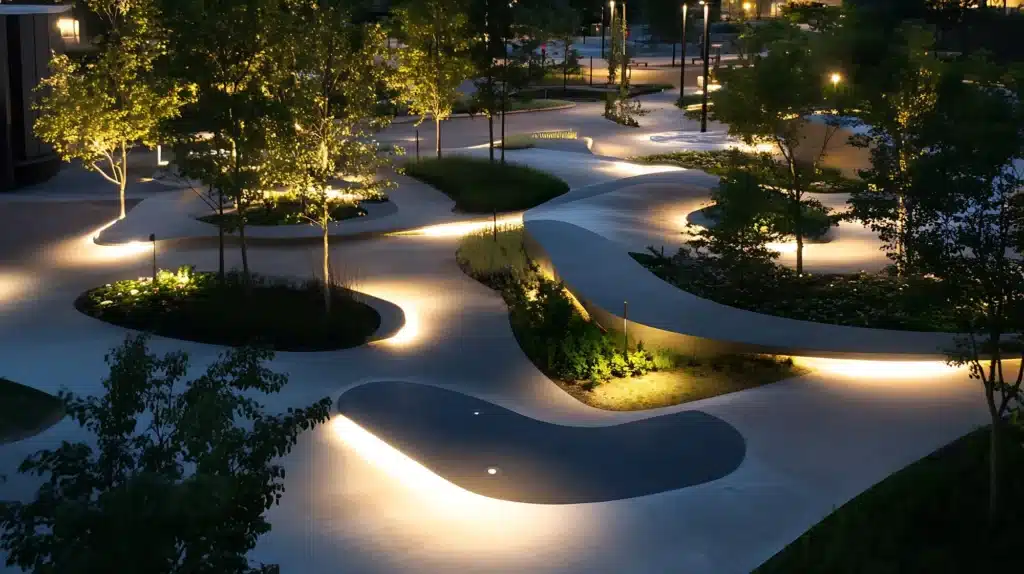
Don’t Dig Twice
An Integrated Landscape plan isn’t a luxury; it’s just smart. It’s the difference between a yard that feels like a constant, expensive battle and one that works for you.
By planning your lighting and irrigation as one project, you save money, prevent massive headaches, and get a cleaner, more professional, and more durable final product. You’re investing in a single, streamlined system, not just two separate parts.
So, if you’re planning on breaking ground for a new sprinkler system, pause and ask yourself: “Where will the lights go?” Planning for that high-quality, 12V lighting system now—even if you just lay the main wire in the trench—will be the smartest decision you make all year.
What’s been your biggest “oops” with yard projects? Have you ever had a contractor cut a line? Share your stories or questions in the comments below!