KEY TAKEAWAYS
- The best landscape lighting design ideas for small yards use vertical light to create the illusion of space.
- LED landscape lights use 2W–10W per fixture, making them ideal for compact low voltage systems. For detailed performance data, review this LED versus halogen fixture comparison.
- Pathway landscape lights spaced 6–8 feet apart define edges without overcrowding a small yard. Consult our pathway light placement and spacing guidelines for optimal results.
- Uplighting for trees and tall shrubs draws the eye upward, making tight spaces feel larger. Learn more with our guide to tree uplighting techniques for vertical emphasis.
- A 150W landscape lighting transformer is typically sufficient for most small yard installations. Use our transformer sizing guide for outdoor lighting to calculate your exact needs.
- Layering ambient, accent, and task lighting across zones creates a professional result on any budget. Our landscape lighting zone planning guide breaks down the strategy.
Why Small Yards Deserve Smarter Landscape Lighting Design Ideas
A small yard is not a limitation — it is a design challenge that rewards precision. Large properties can absorb mistakes: an extra fixture here, an oversized transformer there. Small yards cannot. Every light placement decision is visible, every shadow deliberate, every fixture either adding depth or creating clutter.
The best landscape lighting design tips for compact yards share one philosophy: do more with less. Rather than filling every corner with fixtures, thoughtful small yard lighting uses layered zones, vertical emphasis, and carefully chosen garden lighting fixtures to create the impression of a space far larger than its footprint suggests. If you’re feeling constrained by your property’s dimensions, exploring design strategies for maximizing small yards can shift your perspective before you begin planning.
This guide covers the techniques, fixture types, and planning steps that professional landscape lighting designers use on small properties — adapted for homeowners who want to achieve those results with a straightforward low voltage system.
Understanding the Three Layers of Outdoor Landscape Lighting
Before selecting a single fixture, understand that every well-designed outdoor lighting scheme — regardless of yard size — operates in three distinct layers. Skipping any one of them is the most common reason small yard lighting feels flat or incomplete. For foundational methodology, the Illuminating Engineering Society design standards provide industry-recognized frameworks for residential applications.
Layer 1: Ambient Lighting
Ambient light provides the overall base illumination for the space. In a small yard, this typically comes from wall-mounted fixtures near the home, post lights at entry points, or soft downlighting from overhead structures like pergolas. The goal is a comfortable, even baseline brightness that makes the space feel safe and usable after dark.
Layer 2: Accent Lighting
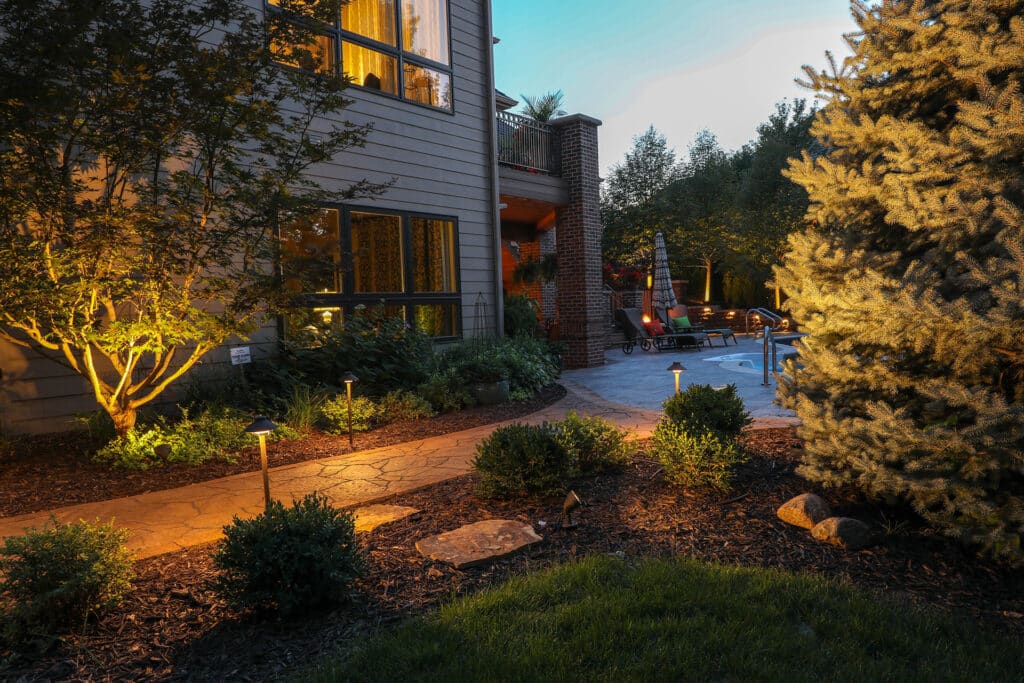
Accent lighting creates visual interest by highlighting specific features — a specimen tree, a garden wall, a water feature, or a decorative planter. Uplighting for trees is the most impactful accent technique in a small yard because it draws the eye vertically, expanding the perceived boundaries of the space. A single well-placed uplight on a mature shrub or small ornamental tree can transform the entire character of a compact garden. Our guide to tree uplighting techniques for vertical emphasis walks through placement, angling, and fixture selection.
Layer 3: Task Lighting
Task lighting serves functional purposes: illuminating steps, defining pathway edges, lighting a grill area or seating zone. Pathway landscape lights fall into this category. In a small yard, task lighting should be low-profile and directional — bright enough to be useful, subtle enough not to overwhelm the accent layer. Review our pathway light placement and spacing guidelines to ensure even, glare-free coverage.
7 Landscape Lighting Design Ideas That Work Best in Small Yards
1. Use Uplighting to Create Vertical Depth
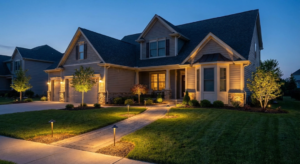
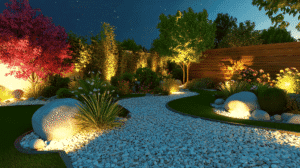
In a small yard, horizontal space is limited. Vertical space is not. Uplighting for trees, tall ornamental grasses, or a garden wall draws the eye upward and creates a sense of height that expands the perceived size of the space. Position LED uplights 1–2 feet from the base of the target plant or structure, angled at 45–60 degrees. Use warm white (2700K–3000K) for a natural, inviting glow. For detailed implementation steps, consult our tree uplighting techniques for vertical emphasis.
2. Define Edges With Low-Profile Pathway Lights
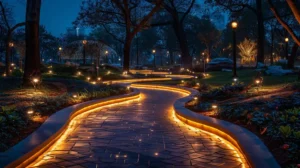
Pathway landscape lights do double duty in small yards: they provide functional illumination and visually define the borders of the space, making it feel intentional and designed. Space them 6–8 feet apart — slightly closer than the standard 8–10 foot spacing used in larger yards — to create a stronger sense of enclosure and definition along walkways and garden bed edges. Our pathway light placement and spacing guidelines provide exact measurements and visual examples.
3. Wash Fences and Walls With Grazing Light
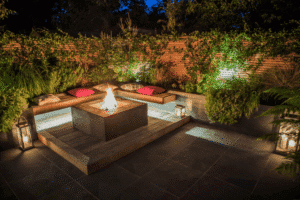
A fence or garden wall is one of the most underutilized surfaces in a small yard. Placing low-profile wall wash fixtures at the base of a fence and angling them upward creates a grazing effect that highlights texture, adds depth, and makes the boundary feel like a designed feature rather than a property limit. This technique works especially well on brick, stone, or timber fence panels.
4. Downlight From Overhead Structures
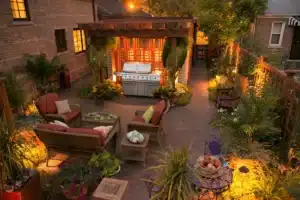
If your small yard includes a pergola, arbor, or covered patio, installing downlights within the overhead structure creates a layered, intimate atmosphere without consuming any ground-level space. Recessed LED fixtures or hanging pendant-style garden lighting fixtures mounted in a pergola roof deliver focused pools of light that define the seating area clearly.
5. Mirror Light Across Water Features
Even a small pond, birdbath, or container water feature can become a dramatic focal point with the right lighting. Placing a warm LED spotlight to graze across the water surface — or using a submersible fixture within it — creates reflective movement that makes a compact yard feel dynamic and larger than it is.
6. Use Moonlighting for a Natural Ambient Effect
Moonlighting involves placing a downward-facing fixture high in a tree canopy, mimicking the soft, dappled effect of natural moonlight filtering through leaves. It is one of the most sophisticated landscape lighting design ideas for small yards because it adds ambient coverage without any ground-level fixtures. A single moonlight fixture positioned 15–20 feet up in a mature tree can illuminate an entire small patio or garden area with a soft, natural wash.
7. Layer Color Temperature Intentionally
Color temperature — measured in Kelvins — has a strong psychological effect on how a space feels. Warm white (2700K–3000K) creates a cozy, intimate atmosphere ideal for seating areas and garden beds. Cool white (4000K–5000K) creates a crisp, modern look better suited to architectural features or driveways. In a small yard, mixing color temperatures deliberately — warm for living zones, neutral for pathways — creates visual separation between areas without relying on physical barriers.
Planning Your Small Yard Lighting: Step-by-Step
Step 1 — Audit your space at night.
Walk your yard after dark with a flashlight. Identify which areas feel unsafe, which features deserve highlighting, and where the natural eye travel leads. This honest assessment becomes the foundation of your lighting plan.
Step 2 — Identify your three zones.
Even in a small yard, divide the space into at least two or three zones: entry/pathway, main garden or lawn, and any seating or entertainment area. Each zone gets its own lighting treatment. Our landscape lighting zone planning guide provides a framework for mapping these layers effectively.
Step 3 — Choose your fixture types per zone.
Assign fixture types to each zone based on function: pathway landscape lights for edges and walkways, uplights for accent features, downlights or wall washers for ambient fill, and task lights for functional areas like steps and cooking zones.
Step 4 — Calculate your total fixture wattage.
List every fixture and its wattage. Total them up. For a small yard using LED landscape lights, a full system of 12–16 fixtures typically draws between 40W and 120W total — well within the range of a standard 150W landscape lighting transformer. When comparing fixture options, our LED versus halogen fixture comparison helps clarify long-term energy implications.
Step 5 — Select and size your transformer.
Multiply your total wattage by 1.2 to get your minimum transformer rating. Most small yard installs are served comfortably by a 150W unit. If you plan to expand in the future, a 300W transformer gives you room to grow without replacing the unit. Use our transformer sizing guide for outdoor lighting to avoid undersizing errors.
Step 6 — Plan your wire runs.
Map the shortest logical wire path from the transformer to each fixture zone. Keep runs under 100 feet on 12 AWG direct burial wire to avoid voltage drop. For small yards, a simple home-run approach — running wire directly from the transformer to each fixture or small group — is usually sufficient without needing a hub. If you encounter dimming at the end of a run, our voltage drop troubleshooting and prevention guide provides exact recalibration steps.
Step 7 — Install, test, and adjust.
Install fixtures at planned positions, connect wire, and test the full system before burying any cable. Walk the yard in the dark and adjust fixture angles, heights, and positions based on real-world visual results rather than the plan alone.
Fixture Comparison: Best Options for Small Yard Landscape Lighting
| Fixture Type | Best Use in Small Yards | Wattage (LED) | Effect | Relative Cost |
|---|---|---|---|---|
| Pathway stake lights | Walkway edges, bed borders | 2W–5W | Low ambient, directional | Low |
| Ground uplights | Trees, shrubs, walls | 4W–9W | Dramatic vertical accent | Low–Medium |
| Wall wash fixtures | Fences, garden walls | 3W–7W | Texture, depth, boundary definition | Medium |
| Recessed deck/step lights | Steps, deck risers, borders | 1W–3W | Safety, subtle definition | Medium |
| Downlights (overhead) | Pergolas, arbors, tree canopy | 5W–12W | Soft ambient, moonlight effect | Medium–High |
| Spotlights | Focal point features, sculptures | 5W–15W | Targeted dramatic accent | Medium |
Pros and Cons of Low Voltage Landscape Lighting Kits for Small Yards
Pros:
- All-in-one solution — transformer, wire, and fixtures included
- Lower upfront cost than buying components separately
- Designed for DIY installation with no electrician required
- Most kits are LED-based, keeping energy consumption low
- Good starting point for first-time outdoor lighting installs
Cons:
- Kit transformers are often undersized for future expansion
- Fixture quality in budget kits varies widely
- Limited design flexibility — fixture styles may not match your aesthetic
- Wire gauges in kits are sometimes lighter than recommended for longer runs
- Upgrading later may require replacing the transformer entirely If you need a quick, budget-friendly solution for a straightforward small yard with fewer than 10 fixtures, a low voltage landscape lighting kit is a practical starting point. If you want design flexibility, higher fixture quality, or plan to expand the system over time, purchasing components separately gives you better long-term value.
Do’s and Don’ts of Small Yard Landscape Lighting Design
| Do | Don’t |
|---|---|
| Use warm white (2700K–3000K) for garden and seating zones | Mix color temperatures randomly across the same zone |
| Space pathway lights 6–8 feet apart for even coverage using pathway light placement and spacing guidelines | Over-illuminate — more fixtures does not mean better results |
| Choose low-profile fixtures that complement your landscape style | Use oversized fixtures that dominate a compact space visually |
| Layer ambient, accent, and task lighting across distinct zones per our landscape lighting zone planning guide | Rely on a single fixture type for the entire yard |
| Size your transformer to 120% of total fixture wattage with our transformer sizing guide for outdoor lighting | Run your transformer at or above 100% capacity |
| Use LED landscape lights to keep energy draw low — see our LED versus halogen fixture comparison | Install halogen fixtures in a system you plan to expand |
| Test fixture placement before burying any wire | Bury wire before confirming final fixture positions |
Transforming a 400 sq. ft. Urban Backyard
A homeowner in a mid-size Midwestern city had a narrow 400 square foot backyard enclosed by a timber privacy fence on three sides. The space included a small bluestone patio, two ornamental trees, and a raised garden bed along the back fence line.
Rather than filling the ground plane with fixtures, the lighting plan focused on vertical elements: two LED uplights positioned at the base of each ornamental tree, three wall wash fixtures aimed upward along the back fence, and five low-profile pathway stake lights defining the patio edge.
Total fixture count: 10. Total system wattage: 68W. Transformer selected: 150W, operating at 45% capacity. The result was a yard that felt significantly more spacious after dark than during the day — the upward light on the trees and fence created a sense of enclosure and depth that the daylight hours, with their flat overhead sun, never achieved. The homeowner reported that the patio became genuinely usable in the evenings for the first time since moving in.
Quick Answers – FAQ
Q: What are the best landscape lighting design ideas for a small backyard?
A; Uplighting for trees, wall washing fences and boundaries, and using low-profile pathway lights to define edges are the three most effective techniques for small yards. Layering these across ambient, accent, and task zones creates a professional result without overcrowding the space. Explore more landscape lighting design tips for compact yards for additional strategies.
Q: How many lights do I need for a small yard?
A; Most small yards of 400–800 square feet are well-served by 8–16 strategically placed fixtures. Quality of placement matters far more than quantity — 10 well-positioned lights will always outperform 20 randomly placed ones.
Q: What wattage transformer do I need for a small yard lighting system?
A; For a small yard using LED landscape lights, total system wattage typically falls between 40W and 120W. A 150W landscape lighting transformer provides sufficient capacity with room for future additions, operating comfortably at 50–80% load. Use our transformer sizing guide for outdoor lighting to calculate your exact requirements.
Q: Are low voltage landscape lighting kits good for small yards?
A; Yes, for straightforward installs with fewer than 10 fixtures. For more design flexibility or higher fixture quality, purchasing a separate transformer and individual fixtures gives better results and easier future expansion.
Q: What color temperature is best for garden lighting in a small yard?
A; Warm white at 2700K–3000K is the most widely recommended choice for residential garden and patio spaces. It creates an inviting, natural atmosphere and flatters most plant and hardscape colors.
Q: Can I do landscape lighting design myself or do I need a professional?
A; Low voltage systems are safe and practical for DIY installation. However, if your design involves complex multi-zone wiring, significant electrical work, or premium fixture placement for a high-end property, consulting a professional landscape lighting designer adds measurable value.
Q: How do I make a small yard look bigger with landscape lighting?
A; Focus light upward rather than outward. Uplighting for trees, wall washing vertical surfaces, and moonlighting from overhead canopy all draw the eye up rather than along the ground plane, creating a sense of vertical space that makes compact yards feel larger. Our guide to tree uplighting techniques for vertical emphasis provides detailed placement instructions.
Q: What is the most energy-efficient outdoor lighting option for a small yard?
A; LED landscape lights are the most energy-efficient choice available. A full 12-fixture small yard system using LED fixtures typically draws less power than two standard halogen bulbs, according to U.S. Department of Energy LED performance data.
Glossary of Terms
Color Temperature A measurement in Kelvins (K) that describes the warmth or coolness of a light source. In landscape lighting design, warm white (2700K–3000K) is standard for residential gardens, while cooler temperatures (4000K+) suit modern architectural applications.
Uplighting A landscape lighting technique where a fixture is positioned at or near ground level and aimed upward to illuminate trees, shrubs, walls, or architectural features. Uplighting is one of the most effective landscape lighting design ideas for creating depth and vertical interest in small yards. Learn implementation details in our guide to tree uplighting techniques for vertical emphasis.
Moonlighting A downlighting technique where a fixture is installed high in a tree canopy or elevated structure and aimed downward to mimic the soft, dappled effect of natural moonlight. It provides wide ambient coverage from a single fixture with minimal visual intrusion.
Landscape Lighting Transformer A device that converts standard 120V household current to the 12V output used by low voltage landscape lighting systems. Sized in watts, the transformer determines how many fixtures the system can power simultaneously. Proper sizing is critical — use our transformer sizing guide for outdoor lighting to avoid performance issues.
Conclusion
Small yards reward intentional design more than any other outdoor space. The landscape lighting design ideas that work best here — uplighting for vertical depth, pathway lights for edge definition, wall washing for boundary interest, and layered color temperatures for zone separation — are not complicated to execute.
They simply require more care and deliberation than scattering fixtures across a large lawn. A well-designed small yard lighting system using LED landscape lights, a properly sized 150W transformer, and 10–16 strategic fixtures can deliver results that rival professional landscape lighting installations costing several times more. The difference is planning: know your zones, choose your layers, and let the quality of placement do the work that quantity of fixtures cannot. For comprehensive planning support, review our landscape lighting zone planning guide and transformer sizing guide for outdoor lighting before finalizing your design.
Ready to bring your small yard to life after dark? Explore our full range of LED landscape lights, low voltage landscape lighting kits, pathway fixtures, and transformers — and use our fixture wattage guide to calculate exactly what your space needs before you buy a single bulb.