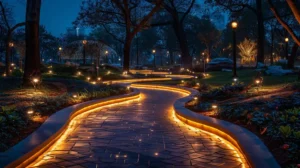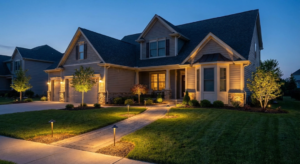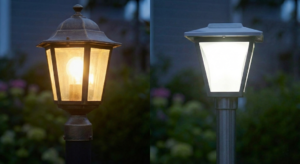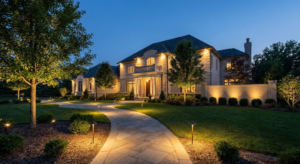
When planning outdoor landscape lighting, most homeowners focus on the look—warm white glows along a garden path, dramatic uplighting on a mature oak, or soft accent light washing over a stone retaining wall. But getting the right wattage for landscape lights is what separates a professionally polished result from a yard that looks either washed out or lost in shadow.
Too many watts and your garden looks like a parking lot. Too few and fixtures fail to do their job. This guide walks you through the ideal wattage ranges for every major fixture type, how to calculate total load for your landscape lighting transformer, and what to watch for when mixing fixtures in a single design.
Key Takeaways
- Wattage for landscape lights typically ranges from 1W–20W for LED systems.
- Low voltage landscape lighting kits (12V) are the most popular and energy-efficient option for DIY installs.
- Pathway lights work best between 1W and 4W; higher wattage creates harsh glare on walkways.
- Uplighting for trees generally requires 5W–20W depending on tree height and canopy size.
- A landscape lighting transformer must be sized to handle the total wattage load of all connected fixtures.
- LED landscape lights consume up to 75% less energy than equivalent halogen fixtures.
Understanding Low Voltage Landscape Lighting Systems
Most residential outdoor landscape lighting today runs on 12-volt low voltage systems. These replaced older 120V line-voltage systems in large part because they’re safer to install, cheaper to run, and compatible with the LED landscape lights that now dominate the market. To understand the full benefits of this technology, explore our comprehensive guide to low voltage landscape lighting systems.
Low voltage landscape lighting kits typically include a transformer, wire, and a set of fixtures—usually between 6 and 20 lights. The transformer plugs into a standard outdoor outlet and steps household current down to 12V. From there, wire runs through your yard connecting each fixture in parallel.
The transformer is the system’s limiting factor. If your transformer is rated at 150 watts, the total wattage of all connected fixtures cannot exceed that number without risking tripped breakers, dimming, or transformer damage. Most homeowners underestimate this when expanding a system over time.
Recommended Wattage by Fixture Type
Pathway Landscape Lights
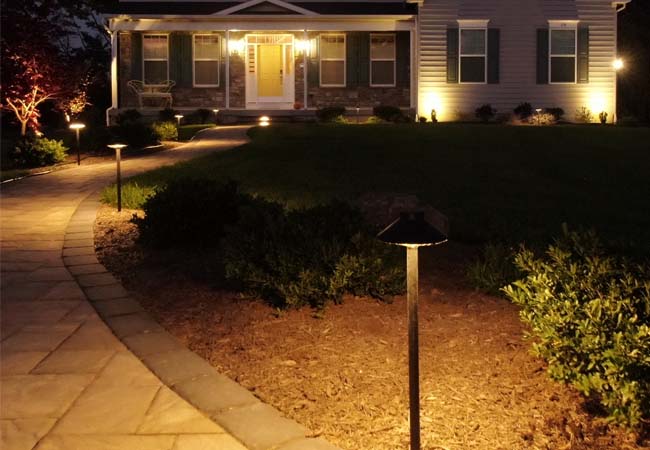
Pathway lights are intended to guide movement, not illuminate an area. Their purpose is subtle definition, not broad brightness.
Recommended range: 1W–4W (LED)
At 1W–2W, a pathway light produces a soft, intimate glow suitable for garden walkways and decorative borders. At 3W–4W, you get slightly more throw—better for wider paths or areas where guests need confident footing.
Anything above 4W on a standard pathway fixture tends to create glare at ankle height, which is uncomfortable and actually reduces visibility rather than improving it. If you’re replacing older halogen path lights (which often ran at 20W), a 2W LED replacement delivers comparable or better brightness.
Spotlights and Accent Lights
Spotlights direct a focused beam at a specific object—a statue, a specimen plant, the face of a home. Accent lights do similar work at closer range.
Recommended range: 3W–10W (LED)
For small accent subjects (a planter, a low shrub, architectural detail), 3W–5W is usually sufficient. For larger subjects like a mid-size ornamental tree, a stone wall, or a garage facade, 7W–10W gives you the punch you need.
The beam angle matters as much as the wattage here. A narrow 15–25° beam concentrates light tightly; a wider 40–60° beam spreads it. Professional landscape lighting designers often choose lower wattage with a tighter beam over high wattage with a wide spread.
Uplighting for Trees
Tree uplighting is one of the most dramatic effects in landscape lighting design—and one of the easiest to get wrong. For the best results, review our detailed guide on techniques for perfectly highlighting trees.
Recommended range: 5W–20W (LED)
A small ornamental tree (under 15 feet) generally needs 5W–8W to show well at night. A medium tree in the 15–30 foot range typically calls for 10W–15W. For large canopy trees—mature oaks, tall pines, spreading maples—you may need 15W–20W fixtures, and often more than one per tree.
The fixture should be placed 1–3 feet from the base and angled upward into the canopy. Burying fixtures too close to the trunk creates unnatural, shadowy trunk illumination without revealing the canopy.
Flood Lights and Area Lights
Floodlights cover broad zones—driveways, open lawn areas, the side of a house.
Recommended range: 10W–20W (LED)
At 10W, a flood produces enough light to cover roughly a 10–15 foot radius. At 20W, coverage extends to 20–25 feet depending on mounting height. For professional landscape lighting applications, multiple lower-wattage floods are typically preferred over a single high-wattage fixture—this approach reduces shadows and hot spots. When selecting floodlights, consider outdoor lighting guidelines from the International Dark-Sky Association to minimize glare and light pollution while maintaining security.
In-Ground and Well Lights
These fixtures are set flush with or below grade to uplight from ground level.
Recommended range: 3W–12W (LED)
Well lights used for uplighting smaller plants or washing a wall work well at 3W–6W. Those used for dramatic architectural uplighting or illuminating larger plant specimens often require 8W–12W.
Wattage Comparison Table by Fixture Type
| Fixture Type | Typical Use | LED Wattage Range | Old Halogen Equivalent |
|---|---|---|---|
| Pathway Light | Walkway definition | 1W – 4W | 10W – 20W |
| Accent / Spotlight | Plant or object focus | 3W – 10W | 20W – 35W |
| Tree Uplight | Canopy illumination | 5W – 20W | 35W – 75W |
| Flood Light | Broad area coverage | 10W – 20W | 50W – 150W |
| Well Light | In-ground up-accent | 3W – 12W | 20W – 50W |
| Step / Deck Light | Riser or rail accent | 1W – 3W | 5W – 15W |
How to Calculate Your Transformer Load
One of the most important steps in any landscape lighting design is correctly sizing your transformer. Undersizing is the most common DIY mistake. For a deeper dive, consult our guide to sizing your landscape lighting transformer.
Step-by-step transformer load calculation:
- List every fixture you plan to install and note its wattage.
- Add up the total wattage of all fixtures on the system.
- Add a 25% safety buffer. Multiply your total by 1.25.
- Choose a transformer rated at or above that number.
- Check the run length of your wire. Long runs lose voltage. A 100-foot run of standard 12-gauge wire can drop 1–2 volts, which dims fixtures noticeably. If you experience dimming, read our guide on the essential fix for landscape lighting voltage drop.
- Split large systems across zones if your total load exceeds 300W—this keeps each wire run manageable and reduces voltage drop.
Hypothetical example: A homeowner installs 10 pathway lights at 2W each (20W total), 4 spotlights at 6W each (24W total), and 2 tree uplights at 12W each (24W total). Total load: 68W. With a 25% buffer: 85W. A 150W transformer handles this comfortably with room for future expansion.
LED vs. Halogen for Landscape Lighting: Pros and Cons
LED Landscape Lights
Pros:
- Use 70–80% less energy than halogen equivalents, according to solid-state lighting research from the U.S. Department of Energy.
- Lifespan of 25,000–50,000 hours (vs. 2,000 for halogen)
- Generate minimal heat, reducing fire risk near mulch or plants
- Available in precise color temperatures (2700K–3000K is ideal for warm outdoor lighting). Learn more in our comprehensive guide to landscape lighting color temperature.
- Compatible with standard low voltage landscape lighting kits
Cons:
- Higher upfront cost per fixture
- Some lower-quality LEDs produce inconsistent color over time
- May require driver replacement in some fixture types after years of use
Halogen Landscape Lights
Pros:
- Lower initial purchase cost
- Excellent color rendering
- Familiar technology, widely available
Cons:
- Significantly higher operating cost
- Generate considerable heat
- Much shorter lifespan, leading to frequent bulb replacement
- Being phased out due to energy regulations in many U.S. states
If you’re building a new system or upgrading, LED is the clear choice for long-term cost, performance, and compatibility with modern landscape lighting transformers that include dimming and timer functions. For a full breakdown, see our detailed comparison of LED and halogen landscape lighting.
Common Wattage Mistakes: Do’s and Don’ts
Do:
- Match wattage to purpose—pathway lights should be subtle, not stadium-bright
- Calculate transformer load before purchasing fixtures
- Use multiple lower-wattage fixtures for large trees rather than a single high-wattage unit
- Choose warm white LEDs (2700K–3000K) for most residential garden lighting fixtures
- Account for voltage drop on long wire runs
Don’t:
- Overload your transformer—it will trip breakers and shorten its lifespan
- Use the same wattage for every fixture regardless of purpose
- Place high-wattage uplights directly at the base of small trees or shrubs
- Mix halogen and LED fixtures on the same transformer circuit without checking compatibility
- Ignore beam angle—wattage and beam spread work together, not independently
Conditional Guidance: Choosing Wattage for Your Situation
If you need to light a winding garden path through dense plantings, choose 1.5W–2W fixtures spaced 8–10 feet apart. Closer spacing with lower wattage creates a more cohesive visual rhythm than fewer high-wattage fixtures.
If you’re uplighting a large specimen tree as a focal point, go with 15W–20W fixtures and position two units at different angles to reduce shadow depth in the canopy and create a more dimensional effect.
If your primary goal is security lighting along a driveway, consider 15W–20W flood or area lights mounted at 8–12 feet high. The wider beam spread covers more ground, and the height reduces glare for anyone walking the path.
If you’re working with a small garden lighting fixtures budget, start with a low voltage landscape lighting kit in the 100W–150W transformer range. These kits are designed to balance output and efficiency without requiring an electrician. However, if you are unsure about tackling the wiring yourself, consider reading about professional installation versus DIY landscape lighting to weigh your options.
Quick Answers – FAQ
What is the best wattage for landscape lights in general? For most residential applications, 1W–10W LED fixtures handle the full range of common outdoor landscape lighting needs. Pathway lights sit at 1W–4W; uplighting and spotlights run 5W–15W. These ranges align with residential lighting recommendations from the Illuminating Engineering Society.
Can I mix different wattages on the same transformer? Yes, as long as the total combined wattage of all fixtures does not exceed the transformer’s rated capacity. Always add a 25% buffer to your total load calculation.
What wattage replaces a 20W halogen landscape light with LED? A 2W–3W LED typically matches or exceeds the output of a 20W halogen pathway or accent fixture. LEDs produce more lumens per watt, so direct watt-for-watt replacement overpowers the original installation.
How many lumens should landscape lights produce? Pathway lights work well at 50–100 lumens. Spotlights and accent lights typically need 200–400 lumens. Tree uplights for large canopies may need 400–700 lumens. Lumens measure actual brightness; wattage measures energy use.
What wattage is best for uplighting trees? Trees under 15 feet: 5W–8W. Trees 15–30 feet: 10W–15W. Large canopy trees over 30 feet: 15W–20W, often using two fixtures per tree for full coverage.
Does higher wattage always mean brighter landscape lighting? Not necessarily. Beam angle, fixture design, and color temperature all affect perceived brightness. A well-aimed 6W LED can outperform a poorly aimed 12W fixture in most real-world landscape lighting design scenarios.
What transformer size do I need for 10 landscape lights? It depends on each fixture’s wattage. Ten 3W LED lights equal 30W total. With a 25% buffer, a 50W transformer handles them. Most homeowners choose 100W–150W transformers to allow for future additions.
Are solar landscape lights an alternative to low voltage wired systems? Solar fixtures are convenient for low-light accent use, but most do not match the consistent brightness, reliability, or design flexibility of hardwired low voltage landscape lighting kits, especially in shaded yards or during winter months.
What color temperature is best for outdoor landscape lighting? Industry professionals and the Illuminating Engineering Society recommend 2700K–3000K (warm white) for most residential outdoor landscape lighting. This range complements plant colors, stone, and wood without the clinical look of cooler color temperatures.
Do I need an electrician to install low voltage landscape lighting? Most 12V low voltage systems are DIY-friendly and do not require a licensed electrician for the fixture runs. The transformer plugs into a standard GFCI outdoor outlet. However, adding a new outdoor outlet or running 120V conduit does require a licensed electrician. If you prefer expert assistance, you can find a trusted Tru-Scapes contractor near you.
Glossary of Terms
Low Voltage Landscape Lighting: A 12-volt outdoor lighting system that steps down standard household current through a transformer, making it safer to install and more energy-efficient than 120V line-voltage systems.
Lumens: The measure of total visible light output from a fixture. Unlike watts—which measure energy consumption—lumens directly indicate how bright a light will appear in use.
Landscape Lighting Transformer: The device that converts 120V household power to 12V for low voltage systems. Transformers are rated by maximum wattage and often include timers, photocells, and zone controls.
Beam Angle: The spread of light emitted from a fixture, measured in degrees. Narrow beam angles (15°–25°) concentrate light on a small area; wide angles (40°–60°) distribute it across a broader surface.
Conclusion
Choosing the correct wattage for landscape lights is not about picking the brightest option—it’s about matching light output to purpose. Pathway lights should guide, not blind. Uplights should reveal, not expose. Floods should cover, not overwhelm.
The shift to LED landscape lights has made precision easier and more affordable. Where a halogen system once demanded careful budgeting to avoid expensive energy bills, a well-designed LED system running off a quality low voltage landscape lighting transformer can cover an entire property for the cost of running a few light bulbs.
Whether you’re building a full professional landscape lighting installation or upgrading an existing setup with better garden lighting fixtures, start with purpose, match wattage to that purpose, calculate your transformer load, and leave room to grow. The results—a yard that looks dramatic, welcoming, and intentionally designed—are well worth the planning.
Ready to start your project? Browse our selection of LED landscape lights, low voltage landscape lighting kits, and transformers to find the right system for your yard, or locate a certified lighting professional to handle the design and installation for you.