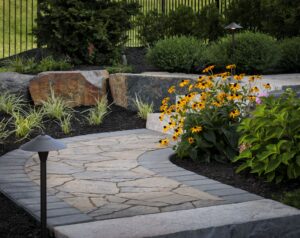
Key Takeaways
- Stamped concrete lighting reveals surface texture and pattern details that disappear in flat overhead light.
- Placement matters as much as fixture type — low-angle accent lights create depth that downlights cannot replicate.
- hardscape lighting fixtures engineered specifically for embedding in and around decorative concrete ensure durability and clean aesthetics.
- Color-changing options like the Color Changing Hardscape Light—TS-A6000C allow seasonal and event-based customization without replacing fixtures.
- Matching the fixture type to the surface zone — walkways, steps, walls, or open patios — produces the most cohesive result.
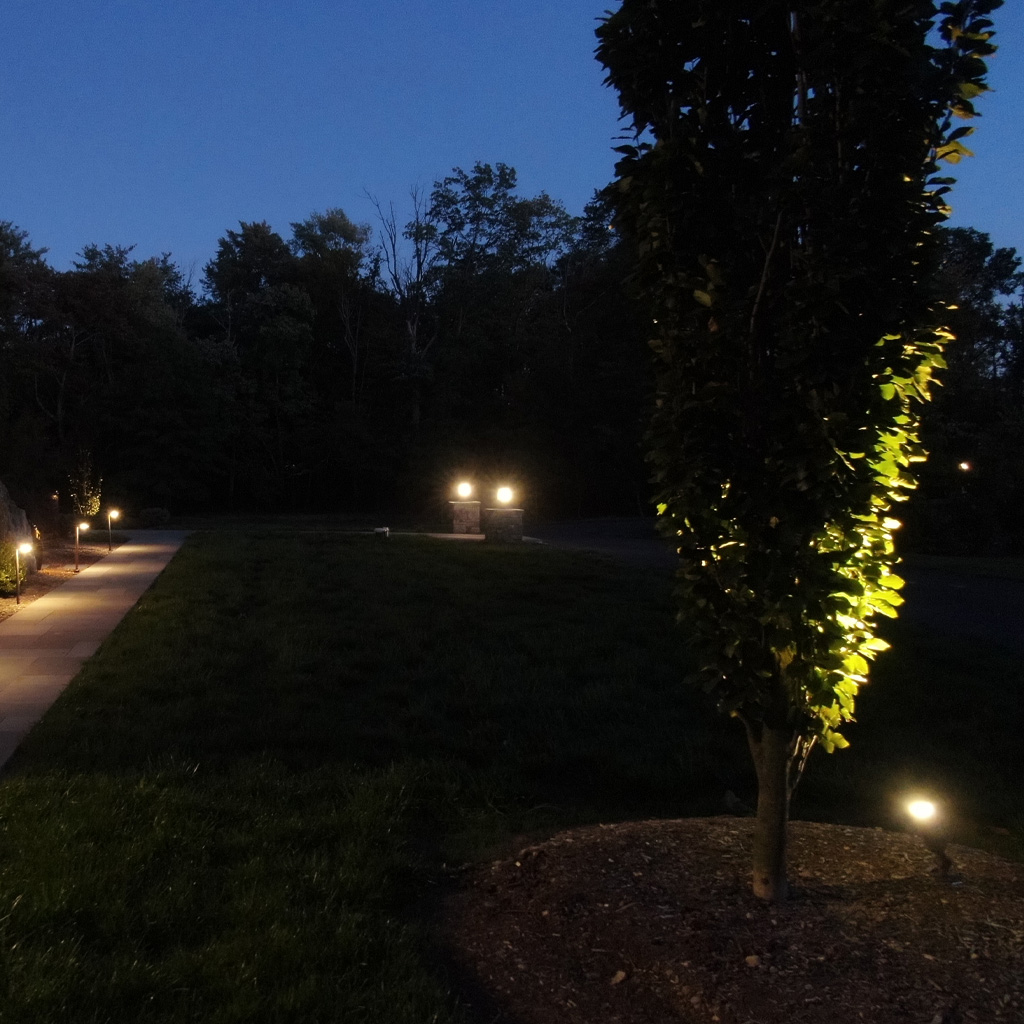
Stamped concrete is one of the most visually compelling hardscape materials available, but once the sun goes down, all that texture, pattern, and color can disappear into shadow. Thoughtful stamped concrete lighting is what preserves that investment after dark — and when done right, it actually makes the surface look better at night than it does in daylight.
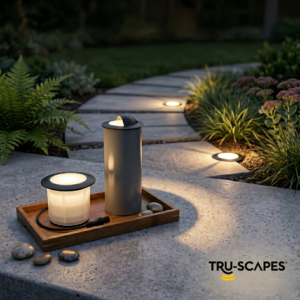
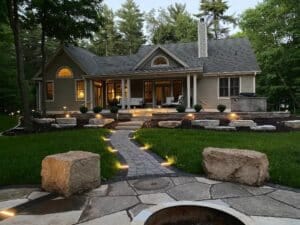
Decorative concrete lighting works by using low-angle or grazing light to throw shadows across the stamped pattern, turning every ridge and impression into a dramatic visual element. A well-lit cobblestone or slate-pattern patio doesn’t just glow — it looks dimensional and intentional in a way that no overhead floodlight can achieve.
Tru-Scapes designs lighting specifically for this purpose. Their hardscape and accent fixtures are built to integrate with concrete, stone, and paver surfaces without creating a patched-together look. Whether you’re working with a stamped driveway, a poolside patio, or exploring concrete lighting solutions for a front-entry walkway, the right fixtures and placement strategy will determine whether the final result looks professionally designed or like an afterthought.
Why Lighting Changes Everything for Stamped Concrete
Stamped concrete earns its visual appeal from surface relief — the raised and recessed areas that mimic natural stone, brick, or wood. In daylight, ambient light hits from multiple angles and the full pattern reads clearly. At night, without deliberate lighting design, that relief becomes invisible under flat overhead illumination.
Grazing light — light positioned low and close to the surface, aimed across it rather than down at it — is the technique that solves this. When a small, well-aimed fixture throws light at a steep horizontal angle across a stamped surface, every texture line casts a tiny shadow. Following established grazing light technique guidelines ensures optimal shadow creation and texture visibility. The result is depth, contrast, and the impression of natural stone.
Hardscape accent lighting also serves functional roles: it marks path edges, defines step drops for safety, and signals transitions between outdoor zones. The design benefit and the safety benefit reinforce each other, making accent lighting one of the highest-value upgrades for any stamped concrete installation.
Types of Stamped Concrete Lighting and Where Each Works Best
Not every fixture type produces the same result on decorative concrete. Understanding how each category performs helps you match the right tool to each zone of your hardscape.
Hardscape Accent Lights
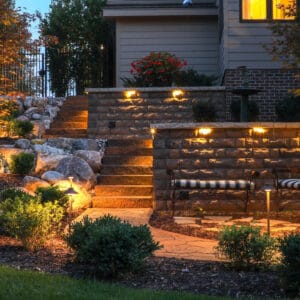
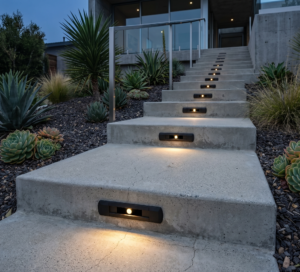
Hardscape accent lights mount flush or near-flush into vertical surfaces — retaining walls, step risers, raised planters, or the base of columns. They direct light outward and slightly downward, washing across the horizontal stamped surface in front of them.
Tru-Scapes engineers their Traditional Hardscape Light (TS-A6000) for exactly this application. It installs cleanly into masonry and concrete surfaces and delivers a consistent beam that grazes across adjacent stamped flatwork. For patios bordered by a seat wall or step structure, a series of these fixtures creates even, low-level light that reads as intentional design rather than functional necessity.
Color Changing Hardscape Lights
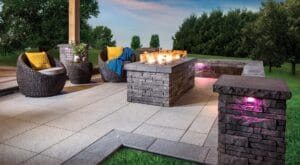
For homeowners who want flexibility, color-changing hardscape lights offer the ability to shift from warm white on an everyday evening to a seasonal color scheme for holidays, parties, or sporting events. The Color Changing Hardscape Light (TS-A6000C) from Tru-Scapes uses the same robust housing as the traditional version but adds RGB capability, giving full control over color output through compatible lighting controllers. On stamped concrete, color changes interact dramatically with surface texture — a deep amber setting will read differently than a cool blue against the same pattern, offering genuine creative range.
Accent Lights for Ground-Level Placement
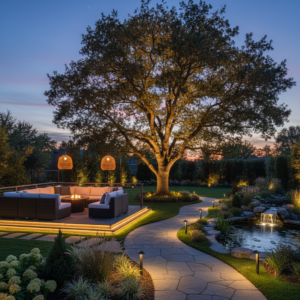
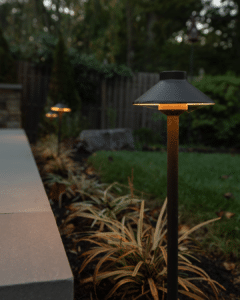
Traditional accent lights placed at grade level work well for marking pathway edges and transition zones. The Traditional Accent Light—TS-B102 is built for in-ground or near-grade installation, making it suitable for lining stamped concrete walkways or defining the perimeter of a patio area. The low profile keeps the fixture from becoming a visual obstacle while ensuring enough light output to define the surface clearly.
Wall Wash Lights
Wall wash fixtures serve a slightly different purpose: they distribute soft, even light across large vertical surfaces — accent walls, the façade above a stamped entry, or retaining walls that frame a patio. The Wall Wash Light—TS-B105 delivers a wide beam spread that eliminates harsh shadows while still giving vertical surfaces presence and dimension. Used in combination with low-level accent lights on the stamped horizontal surface, wall wash fixtures complete the layered lighting effect that defines high-end hardscape design.
Step-by-Step: Planning Stamped Concrete Lighting for Your Outdoor Space
A lighting plan doesn’t need to be complicated, but it does benefit from a deliberate sequence. Follow these steps to move from concept to installation efficiently.
- Walk the space at night. Before selecting any fixtures, observe the space after dark with only existing light sources active. Identify which zones go completely dark, where you feel uncertain about footing, and where you want to draw visual attention.
- Map your stamped concrete zones. Separate your hardscape into categories: walkways, step sequences, open patio areas, and any bordering walls or columns. Each zone may call for a different fixture type or placement strategy.
- Identify your anchor points. Step risers, seat walls, planter walls, and column bases are natural installation locations for hardscape fixtures. Mark these locations on a simple sketch.
- Plan for even spacing. For path lighting, spacing fixtures too far apart creates a dotted-light effect rather than a continuous wash. A general rule from landscape lighting professionals aligns with expert recommendations for fixture spacing: space low-level path fixtures no more than 8–10 feet apart to maintain visual continuity.
- Layer your light sources. Combine at least two fixture types — for example, hardscape accent lights on step risers plus wall wash fixtures on the adjacent retaining wall. Layering prevents the flat, single-dimension look that results from relying on one light type alone.
- Select fixtures rated for embedded or surface-mounted concrete use. Fixtures not designed for hardscape integration can crack, corrode, or fail when in direct contact with masonry. Tru-Scapes fixtures are rated specifically for these conditions.
- Plan your wiring runs before concrete work is final. If stamped concrete is being poured or refinished, this is the best time to install conduit or direct-burial wire runs. Retrofitting wiring after concrete is set is significantly more labor-intensive.
Comparing Light Placement Strategies
| Placement Strategy | Best For | Surface Effect | Limitations |
|---|---|---|---|
| Step riser mounting | Stair sequences, terraced patios | Strong grazing across adjacent flatwork | Limited to surfaces near vertical elements |
| In-ground path lights | Walkway edges, driveway borders | Defines horizontal plane and path edge | Less texture-revealing than grazing angle |
| Wall-mounted wash | Vertical accent walls, retaining walls | Even vertical illumination, soft shadows | Does not graze horizontal stamped surface directly |
| Grade-level perimeter | Patio edges, planting bed borders | Defines outdoor room boundary | May require additional fixtures for full coverage |
Pros and Cons of Hardscape-Integrated Lighting
✅ Pros
- Enhances stamped texture and pattern visibility
- Serves dual purpose: safety and aesthetics
- Low-voltage LED options consume minimal energy
- Fixture styles can complement stamped pattern design
- Color-changing options add event and seasonal flexibility
❌ Cons
- Requires planning before or during concrete installation
- Wiring runs must be properly protected from moisture
- Poorly chosen fixtures can look dated as styles evolve
- Retrofit installation is more labor-intensive
- Some homeowners underestimate how many fixtures are needed
Do and Don’t: Stamped Concrete Lighting
✅ Do
- Use grazing angles to reveal surface texture
- Mix fixture types for a layered result
- Choose fixtures rated for masonry contact
- Space path lights for visual continuity
- Consider color temperature for mood consistency
❌ Don’t
- Point all fixtures straight down at the surface
- Use only one type of light throughout the space
- Install fixtures designed for soil only in concrete
- Space fixtures so far apart the light dotted instead of flowing
- Mix warm and cool white fixtures in the same zone
A Stamped Patio Transformation
Consider a suburban backyard in the Southeast with a 600-square-foot stamped concrete patio in a cobblestone pattern, bordered on two sides by a low seat wall and accessed by a three-step stair entry from the back door.
Before lighting, the patio was functionally unusable after dark — the only light source was a single overhead fixture on the house wall that washed out the stamped pattern entirely.
The homeowner worked with a landscape contractor to install a series of Traditional Hardscape Light—TS-A6000 fixtures into the seat wall at 6-foot intervals, directing light outward and downward across the stamped surface. Three additional fixtures were installed in the step risers. A pair of Wall Wash Light—TS-B105 fixtures was mounted low on the adjacent fence to wash the planted border wall.
The result: the cobblestone stamped pattern reads with full depth and dimensionality at night, step edges are clearly defined, and the patio functions as an outdoor room well into the evening. The seat wall fixtures created the grazing-light effect the overhead fixture had eliminated. The homeowners later added two Color Changing Hardscape Light—TS-A6000C fixtures near the entry steps so they could shift colors for holiday gatherings.
Products That Get the Job Done
For Hardscape Walls and Step Risers

Color Changing Hardscape Light—TS-A6000C
The TS-A6000C is Tru-Scapes’ full-color RGB hardscape fixture, designed to mount into masonry, concrete, and paver walls. It delivers all the performance of the standard hardscape light with the added ability to shift through a full color spectrum, making it ideal for entertainment spaces, entry features, and anywhere the design calls for flexibility across seasons or occasions. Built with the same durable housing rated for direct masonry contact.

Traditional Hardscape Light—TS-A6000
The TS-A6000 is Tru-Scapes’ purpose-built hardscape accent fixture for consistent, long-term performance in masonry applications. It produces a clean, directed beam that grazes across adjacent stamped or decorative concrete surfaces, revealing texture and depth that flat overhead lighting eliminates. Its compact profile integrates cleanly into seat walls, step risers, planter walls, and retaining structures without disrupting the surface design.
For Walkways, Pathways, and Perimeter Definition

Traditional Accent Light—TS-B102
Our professional grade B102 LED low voltage landscape accent lights are the most common and all-around accent light used—a true “workhorse” in the landscape lighting industry. These lights are constructed from heavy-duty solid die-cast brass and have a double “O” ring seal to prevent water from entering the fixture.
For Vertical Surfaces and Accent Walls

Wall Wash Light—TS-B105
The TS-B105 delivers a wide, even beam spread designed to illuminate vertical surfaces — retaining walls, accent walls, and the faces of structures that frame a stamped concrete area. Used in combination with hardscape step and perimeter lights, the TS-B105 completes a layered lighting design by giving bordering vertical elements presence and warmth. The result is a fully dimensioned outdoor space rather than a lit floor surrounded by darkness.
Frequently Asked Questions
What is the best type of lighting for stamped concrete?
Low-angle accent lights and hardscape fixtures that mount into adjacent walls or step risers are generally the most effective for stamped concrete. They create a grazing light effect that emphasizes surface texture and pattern depth. Tru-Scapes’ Traditional Hardscape Light—TS-A6000 is specifically designed for this application.
How far apart should I space patio accent lights?
For walkways and path edges, landscape lighting professionals generally recommend spacing no more than 8–10 feet apart. For step risers, see our guide on expert recommendations for fixture spacing to determine optimal placement based on stair width and fixture output.
Can I add lighting to existing stamped concrete without tearing it up?
Yes, in many cases. Hardscape fixtures that mount into seat walls, retaining walls, or step risers can often be installed without disturbing the stamped surface itself. Wiring can sometimes be routed along planting bed edges or beneath mulch. Consult with a licensed landscape electrician to assess retrofit options specific to your layout.
What color temperature works best on stamped concrete?
Warm white (2700K–3000K) is the most popular choice for decorative concrete because it complements earth tones commonly found in stamped patterns — tans, grays, and reds. Understanding selecting the right color temperature is key, and the Department of Energy lighting efficiency guide provides further insight into how Kelvin ratings impact both ambiance and energy use. Cool white (4000K+) can work well on contemporary designs with gray or charcoal color schemes. Avoid mixing color temperatures within the same zone, as it creates visual inconsistency.
Are color-changing lights worth it for a stamped patio?
For homeowners who host outdoor events or want seasonal flexibility, color-changing options offer real practical value. The Color Changing Hardscape Light—TS-A6000C allows full RGB control without requiring fixture replacement when you want a different look. It is installed identically to the standard version and performs equally well as a standard white light on everyday evenings.
Do hardscape lights need to be professionally installed?
Low-voltage landscape lighting systems can be installed as DIY projects in many cases, but work involving line-voltage wiring or conduit installation in or near concrete should be handled by a certified lighting professional. Fixture placement and design planning can be done independently or with guidance from a landscape contractor.
How do I protect hardscape lighting fixtures from weather damage?
Choose fixtures rated for outdoor use and specifically designed for hardscape or masonry applications. Verify UL wet and damp location ratings to ensure long-term durability in freeze-thaw and temperature-cycling conditions typical of outdoor concrete installations. Tru-Scapes fixtures are engineered for direct contact with masonry environments, which means they are built to perform reliably in these conditions.
What is the difference between hardscape lights and standard path lights?
Standard path lights are typically stake-mounted in soil and designed for planting beds. Hardscape lights are engineered to mount directly into or onto masonry, concrete, or paver surfaces. Using soil-mount fixtures in concrete applications can result in housing damage, water infiltration, and premature failure. Purpose-built hardscape fixtures like the TS-A6000 and TS-B102 are constructed specifically for contact with masonry materials.
Glossary
- Grazing Light: A lighting technique in which a fixture is positioned at a low, oblique angle to a surface, causing texture and relief to cast small shadows and appear visually pronounced. Commonly used to emphasize stamped concrete patterns.
- Hardscape Accent Lighting: Low-voltage or line-voltage fixtures designed to mount directly into or onto masonry, concrete, or paver structures. Distinct from standard landscape lighting in both housing construction and installation methods.
- Color Temperature: A measurement in Kelvin (K) describing the warmth or coolness of a light source. Lower values (2700K–3000K) produce warm amber-white light; higher values (4000K+) produce cooler, bluish-white light. Color temperature affects how stamped concrete patterns and colorants read under artificial light.
- Wall Wash: A lighting technique in which a fixture distributes a broad, even beam across a vertical surface, illuminating it with minimal hot spots or harsh shadows. Used to give vertical hardscape elements presence within an overall outdoor lighting design.
Why Tru-Scapes Is the Answer
Stamped concrete represents a meaningful investment in the look and function of an outdoor space. The lighting that serves it deserves the same standard. Generic landscape fixtures were not designed with decorative concrete in mind — their housings, mounting systems, and beam geometries are built for soil, planting beds, and general outdoor use. When those fixtures make contact with masonry, they frequently fail prematurely or produce lighting effects that undercut rather than enhance the surface beneath them.
Tru-Scapes engineers their fixtures from the ground up for hardscape environments. The Traditional Hardscape Light—TS-A6000 and its color-changing counterpart are built with housings rated for direct masonry contact, designed to handle the thermal expansion, moisture exposure, and physical stress that a concrete environment produces. The beam geometry is intentional — calibrated to produce the grazing, texture-revealing effect that decorative concrete surfaces reward.
Beyond individual fixture performance, Tru-Scapes offers a complete system: hardscape wall lights, grade-level accent lights, and wall wash fixtures that work together as a cohesive family. Homeowners who choose Tru-Scapes don’t have to mix brands or compromise on visual consistency. Every fixture is designed to complement the others, so the finished result looks like a considered design rather than an assembly of parts.
For stamped concrete specifically, that design coherence is what separates a finished outdoor space from a great one.
Conclusion
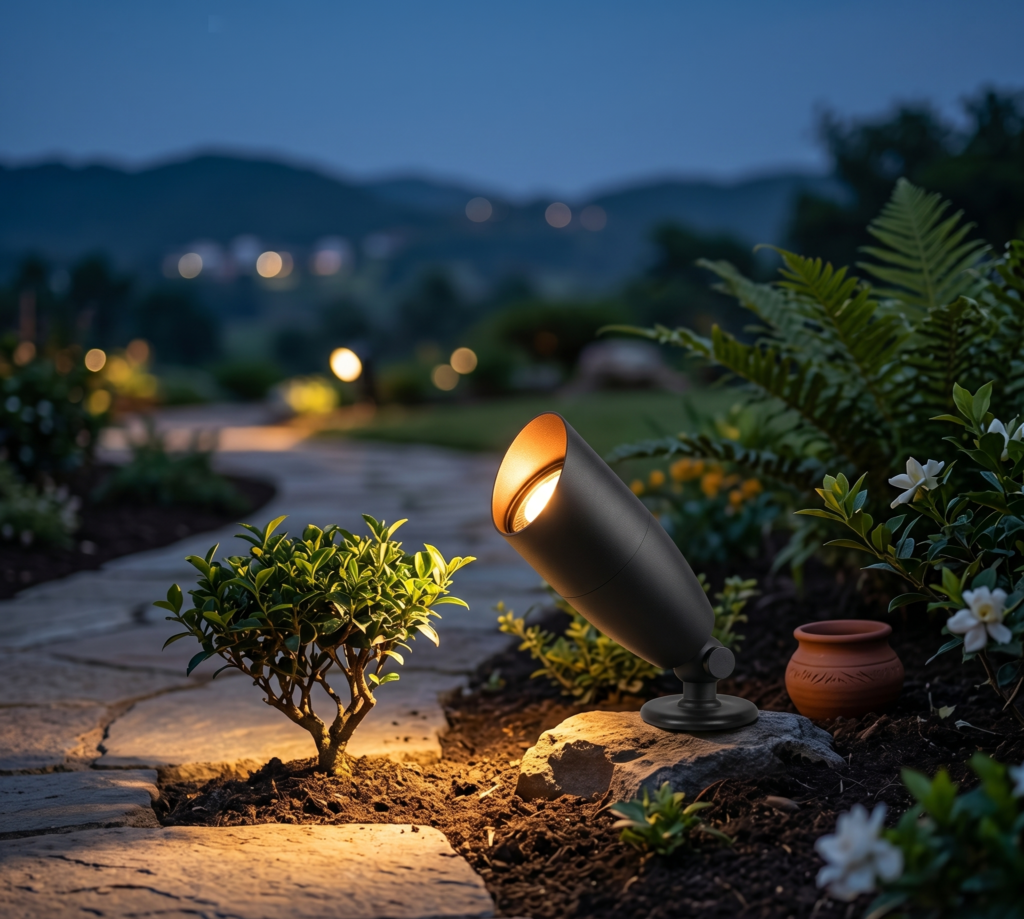
Stamped concrete is a surface designed to be seen — and stamped concrete lighting is what makes that possible after sunset. By choosing fixtures that graze surfaces at low angles, layering hardscape wall lights with path accents and wall wash fixtures, and planning wiring runs before or during installation, homeowners can make their decorative concrete investment work around the clock.
The difference between a forgettable outdoor space and one that earns compliments after dark almost always comes down to lighting quality and placement. Tru-Scapes provides the fixtures built to make that difference — starting with the Traditional Hardscape Light (TS-A6000) for foundational step and wall applications, and expanding with the Color Changing Hardscape Light (TS-A6000C) for spaces that deserve versatility and long-term design flexibility.
Explore the full Tru-Scapes hardscape lighting line and find the right fixtures for your stamped concrete space.