Key Takeaways
- Premium outdoor lighting fixtures rely on material quality — especially solid brass and marine-grade finishes — to survive a decade or more of outdoor exposure.
- Tru-Scapes engineers its path lights, post cap lights, and hardscape fixtures with longevity as a foundational design principle, not an afterthought.
- LED technology paired with quality housing dramatically extends the service life of any landscape lighting system.
- Weather resistance, UV stability, and ingress protection ratings are the three most important durability indicators to evaluate before buying.
- Solid brass construction — like that found in the Traditional Path Light—TS-B301, Classic Path Light—TS-B302, and Modern Path Light—TS-B306 path lights — is the gold standard for long-lasting outdoor lighting in demanding climates.

Not all outdoor lighting is created equal — and after one rough winter or a few summers of direct sun, the difference between a quality fixture and a cheap one becomes painfully obvious. Premium outdoor lighting fixtures are engineered from the ground up to handle UV exposure, moisture, temperature swings, and years of daily cycling without degrading. They hold their finish, maintain their output, and keep working when lesser fixtures crack, corrode, or simply burn out.
Tru-Scapes designs its entire landscape lighting lineup with this long-term performance standard in mind. Whether it’s a post cap light illuminating a deck rail or a solid brass path light guiding a garden walkway, every fixture is built around materials and engineering that stand up to real-world outdoor conditions. Understanding what separates a fixture that lasts a season from one that lasts a decade helps homeowners make smarter decisions — and get the most out of every installation.
Why Material Choice Is the First Decision That Matters
The single biggest factor in outdoor lighting longevity is the material the fixture is made from. Housing materials directly determine how a fixture responds to moisture, UV radiation, temperature cycling, and physical impact. Industry experts and landscape lighting professionals consistently point to a small group of materials that genuinely perform over the long term.
Solid Brass: The Benchmark for Landscape Lighting
Brass has been used in outdoor hardware for centuries, and for good reason. As a copper-zinc alloy, solid brass is naturally corrosion-resistant, dimensionally stable, and capable of developing a protective patina that actually improves its weather resistance over time. Unlike painted aluminum or plastic composites, brass does not peel, chip, or become brittle when exposed to freeze-thaw cycles.
For landscape lighting specifically, solid brass is widely recommended by lighting designers and horticulture professionals as the material of choice for path lights, bollards, and low-voltage fixtures installed in ground-level environments. These are the positions most exposed to irrigation, soil contact, rain splash, and lawn equipment.
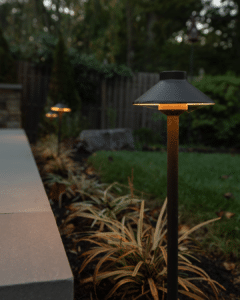
Tru-Scapes engineers its path light collection — the Traditional Path Light—TS-B301, the Classic Path Light—TS-B302, and the Modern Path Light—TS-B306 — entirely from solid brass. This isn’t a cosmetic choice. It’s a structural one that directly determines how long these fixtures will hold up in real garden and lawn environments without showing deterioration.
For deeper insight into finish durability and material performance, consult our Landscape Lighting Fixture Finish selection guide.
Aluminum and Die-Cast Alloys
High-pressure die-cast aluminum is a strong second-tier option, particularly for larger post cap and hardscape fixtures. When properly anodized or powder-coated, die-cast aluminum resists corrosion effectively in most climates. Its lighter weight compared to brass makes it practical for mounted or elevated applications where structural loading matters.
What to Avoid
Thin-gauge stamped metals, low-density plastics, and fixtures with chrome plating over steel are reliable indicators of a short service life. Steel corrodes rapidly without exceptional protective coatings, and many budget fixtures use finishes that begin failing within one to two seasons of outdoor exposure.
How LED Technology Extends the Life of the Entire System
The light source inside a fixture matters as much as the housing around it. The widespread adoption of LED technology has fundamentally changed the durability equation for outdoor lighting.
Traditional incandescent and halogen sources generated significant heat, which accelerated housing material breakdown, degraded seals, and shortened the lifespan of any plastic or composite components nearby. LED sources, by contrast, run at a fraction of the operating temperature, produce consistent output over tens of thousands of hours, and are far less prone to vibration failure.
What LED Longevity Actually Looks Like in Practice
The Illuminating Engineering Society (IES) lighting standards and independent lighting researchers consistently document rated LED lifespans of 50,000 hours or more under appropriate operating conditions. For a fixture running six hours per night, that translates to more than 22 years of rated source life — well beyond the realistic life of any non-LED housing.
To understand real-world expectations, explore our guide on how long LED landscape lighting lasts.
Tru-Scapes builds its C-150 LED Post Cap Light and C-145 LED Post Cap Light around durable LED technology specifically selected for outdoor performance. The result is a fixture that doesn’t just illuminate a deck railing — it does so reliably for years without requiring bulb replacements or early housing replacements driven by heat damage.
For foundational LED knowledge, reference the U.S. Department of Energy’s LED lighting overview.
The Role of Weatherproofing and Ingress Protection
Even the best materials and LED sources will underperform if the fixture isn’t properly sealed against moisture and debris. Weatherproofing is a structural engineering challenge, and the difference between an IP65-rated fixture and one with no rating is often the difference between a 10-year fixture and a 2-year one.
Understanding IP Ratings
IP (Ingress Protection) ratings, defined by the International Electrotechnical Commission (IEC) IP rating standards, provide a standardized way to evaluate how well a fixture resists solid particles and water. For outdoor landscape lighting:
| IP Rating | Protection Level | Appropriate Use |
|---|---|---|
| IP44 | Splash-proof | Covered patios, protected eaves |
| IP54 | Dust-resistant + splash | Open decks, pergolas |
| IP65 | Dust-tight + water jets | Ground-level path lights, exposed fixtures |
| IP67 | Dust-tight + immersion (30 min) | Near water features, flood-prone areas |
| IP68 | Dust-tight + continuous immersion | Submerged pond and pool lighting |
Path lights like the Tru-Scapes brass collection need to be specified to at least IP65 to handle irrigation contact and rain exposure at ground level. Post cap fixtures on open decks benefit from IP54 or better.
Seals, Gaskets, and Thermal Management
High-quality fixtures use silicone gaskets at every lens and junction point, not rubber O-rings or press-fit plastic components that harden and shrink over time. Thermal management — allowing heat to escape without allowing moisture to enter — is one of the more technically demanding aspects of fixture design, and it’s an area where premium manufacturers invest heavily compared to budget producers.
Finish Quality and UV Resistance: What You Can See From the Outside
A fixture’s external finish is both an aesthetic and a functional element. Finishes that chalk, fade, or peel don’t just look bad — they expose the underlying material to accelerated corrosion and UV damage.
Tru-Scapes has published detailed guidance on Landscape Lighting Fixture Finish selection, covering how different coating technologies perform under extended sun and moisture exposure. The short version: powder-coated finishes on properly pretreated metals significantly outperform spray-applied paints, and natural brass finishes that develop a patina offer a self-renewing protective layer that painted surfaces cannot replicate.
Premium vs. Standard Finish Comparison
| Feature | Premium Fixture Finish | Standard Fixture Finish |
|---|---|---|
| Base material prep | Multi-stage chemical pretreatment | Single wash or skip |
| Coating type | Powder coat or natural alloy patina | Spray paint or thin chrome |
| UV resistance | 10+ years before visible fading | 2–4 years typical |
| Corrosion protection | Integrated to material | Surface-level only |
| Repairability | Patina recovers naturally (brass) | Chips expose bare metal permanently |
Step-by-Step: How to Evaluate a Premium Outdoor Lighting Fixture Before You Buy
Following a structured evaluation process prevents the frustration of replacing fixtures every few seasons. Use this sequence when assessing any outdoor lighting product.
- Check the housing material. Solid brass, marine-grade aluminum, or 316 stainless steel are indicators of long-term performance. Plastic housings or thin stamped metal are not appropriate for most outdoor environments.
- Verify the IP rating. Confirm the fixture carries an independent IP certification — not just a manufacturer’s claim — appropriate for its installation position.
- Examine the lens and seal construction. Tempered or borosilicate glass lenses outlast polycarbonate in UV-heavy climates. Look for silicone or EPDM gaskets at every joint.
- Confirm LED source specifications. Ask for the rated lumen output, color rendering index (CRI), and color temperature (CCT) in Kelvin. High-quality outdoor LEDs maintain 70% or more of original lumen output (L70) at 50,000 hours.
- Review the finish specification. Powder coat, anodized aluminum, and natural brass patina all outperform spray-applied coatings. Ask whether the metal was chemically pretreated before coating.
- Evaluate the warranty terms. A fixture engineered for 10+ years should be backed by a warranty that reflects that confidence. Short warranty periods on outdoor fixtures are a meaningful signal about expected lifespan.
- Match the fixture to the application. A post cap light on a covered porch has different requirements than a path light in an open garden bed. If you need ground-level durability, choose solid brass. If you need elevated aesthetics with long LED life, look at quality post cap designs like those in the Tru-Scapes lineup.
- Plan your system capacity. Use our landscape lighting transformer sizing guide to ensure proper voltage regulation and load matching.
- Follow professional setup procedures. Review our outdoor lighting installation guidelines to avoid common wiring and placement errors.
Durability Pros and Cons by Material
✅ Pros
- Solid brass resists corrosion without coatings
- LED sources last 50,000+ hours in quality housings
- Powder-coated aluminum holds finish for a decade or more
- IP65+ ratings provide genuine moisture protection
- Natural brass patina improves weather resistance over time
❌ Cons
- Higher initial investment than budget alternatives
- Requires correct low-voltage transformer pairing
- Die-cast parts vary significantly by manufacturer quality
- IP ratings only matter when gaskets are properly installed
- Patina appearance requires acceptance of aged aesthetics
Do’s and Don’ts for Long-Lasting Outdoor Lighting
✅ Do
- Choose solid brass for path and ground-level fixtures
- Verify independent IP certification, not just claims
- Match transformer capacity to total fixture load
- Inspect seals and gaskets annually using our landscape lighting maintenance checklist
- Select finishes rated for your climate’s UV exposure
❌ Don’t
- Install non-rated fixtures in irrigation zones
- Assume all “weather-resistant” labeling means the same thing
- Mix fixture types with incompatible voltage requirements
- Ignore early signs of seal compression or cracking
- Choose a finish based on initial appearance alone
A Coastal Garden Renovation
Consider a homeowner in a coastal mid-Atlantic climate who replaces a failing landscape lighting system for the second time in four years. The previous fixtures — painted aluminum path lights and polycarbonate post caps — had shown visible rust bleeding, peeling finish, and lens clouding within two seasons of the humid salt-air environment.
The Tru-Scapes approach: the homeowner installs the Traditional Path Light—TS-B301 in solid brass along the garden perimeter, pairs them with C-150 LED Post Cap Lights on the deck rail posts, and uses the A6000 Hardscape Lights to accent the stone retaining wall.
Three years later, the brass path lights have developed a natural patina consistent with the coastal aesthetic. The post caps maintain their finish and original lumen output. No replacements, no corrosion failures, no seal leaks. The total system performs exactly as specified — because the materials and engineering were selected for the actual environment, not just for the showroom.
Products That Get the Job Done

High Power Accent Light — TS-B106
The strongest fit for “premium” and “durable.” Its solid die-cast brass body, gasket ring water seal, heat-resistant glass lens, and professional-grade PAR36 LED lamp make it the clearest example of a fixture built to last. It directly supports talking points around material quality, weather resistance, and long-term performance.
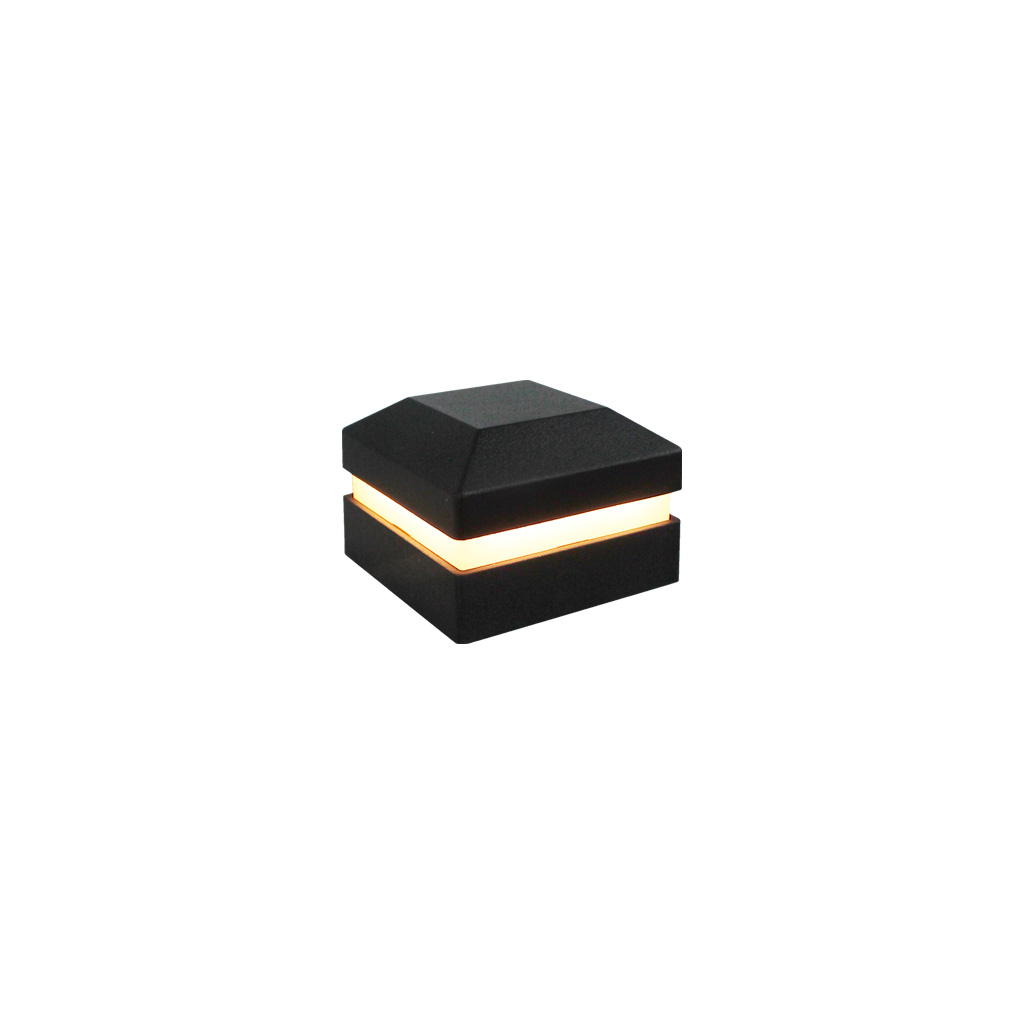
Tru-Scapes® 2.5″ Aluminum LED Deck & Fence Post Cap Light — TS-C125
Best representative of the “weather-resistant deck lighting” and “premium LED post lights” supporting keywords. Its aluminum construction, integrated LEDs, waterproof lead wire, and low-voltage compatibility make it a compelling example of a fixture designed for lasting outdoor use with minimal maintenance.
For Path and Ground-Level Lighting

Traditional Path Light—TS-B301
The TS-B301 is constructed of solid brass — the industry-recommended material for ground-level landscape lighting exposed to irrigation, soil contact, and seasonal moisture. Its traditional profile suits formal garden designs and established landscape styles, while the brass construction ensures it will outlast aluminum or composite alternatives by a wide margin.

Classic Path Light—TS-B302
The TS-B302 delivers the same solid brass durability as the TS-B301 in a slightly different silhouette that works well across both traditional and transitional landscape designs. Ground-level brass fixtures like the TS-B302 are specifically recommended by landscape lighting professionals for environments where long service life without maintenance is the priority.

Modern Path Light—TS-B306
For contemporary landscape designs, the TS-B306 provides solid brass construction in a clean, architectural profile that complements modern hardscape and minimalist garden aesthetics. The same material quality that makes the TS-B301 and TS-B302 durable also makes the TS-B306 a long-term investment — not a fixture that needs replacing every few seasons.
Frequently Asked Questions
Why is solid brass recommended for landscape path lights specifically?
Solid brass is corrosion-resistant by nature, meaning it doesn’t rely on surface coatings to hold up against moisture. At ground level, path lights are regularly exposed to irrigation, rain splash, and soil contact — conditions that quickly degrade painted aluminum or plastic housings. The Tru-Scapes TS-B301, TS-B302, and TS-B306 path lights are all solid brass precisely because this material is the most reliable choice for that demanding installation environment.
What IP rating should outdoor landscape lighting have?
At minimum, path lights and ground-level fixtures should be rated IP65, which means they are fully dust-tight and can withstand direct water jets from any direction. Fixtures installed near water features or in flood-prone areas should target IP67 or higher. Post cap lights on covered structures can often perform well at IP54, but open-air deck installations benefit from IP65-rated housings. Reference the International Electrotechnical Commission (IEC) IP rating standards for official classification details.
How long do LED outdoor fixtures actually last?
Under appropriate operating conditions, high-quality LED sources are rated to maintain at least 70% of their original output (L70) at 50,000 hours or more. For a fixture running six hours per night, that’s over 22 years of LED source life. The practical limit on fixture lifespan in outdoor applications is usually the housing and seals, not the LED source itself — which is why housing material quality matters so much. Learn more about how long LED landscape lighting lasts in real-world conditions.
Does fixture finish affect durability or just appearance?
Both. A high-quality finish protects the base material from UV degradation, moisture penetration, and corrosion. Powder-coated finishes on properly pretreated metal substrates can hold their appearance and protective function for a decade or more. Spray-painted finishes on unprepared metal may begin showing failure signs within two to three seasons. Natural brass patina is unique in that it’s self-renewing — the oxidation layer that forms actually improves corrosion resistance over time. Our Landscape Lighting Fixture Finish selection guide breaks down performance by coating type.
Can I mix brass and aluminum fixtures in the same landscape lighting system?
Yes, in most cases. Mixing materials across a system is common — solid brass for ground-level path lights where corrosion exposure is highest, and die-cast aluminum for elevated post cap or wall fixtures where weight and finish consistency matter more. Tru-Scapes offers both material types across its product lines, making it straightforward to build a cohesive, long-lasting system with the right material in each position.
What causes outdoor lighting fixtures to fail prematurely?
The most common causes of early fixture failure are: inadequate weatherproofing (wrong IP rating for the environment), coating failure on improperly pretreated metals, thermal stress from running high-wattage sources in housings not designed for them, and seal degradation in extreme temperature cycling environments. Choosing fixtures with appropriate material and IP specifications for the installation environment eliminates most of these failure modes.
How does LED temperature affect fixture housing durability?
LED sources generate far less heat than incandescent or halogen equivalents, which significantly reduces thermal stress on housing materials, gaskets, and lens components. This is one of the key reasons LED landscape lighting systems last longer than their halogen predecessors — the source and the housing both benefit from lower operating temperatures. For technical context, see the U.S. Department of Energy’s LED lighting overview.
Are there specific maintenance steps that extend fixture life?
Annual inspection of gaskets and seals for compression or cracking is the most impactful maintenance task for any outdoor fixture. Keeping fixture lenses clean allows full light output and prevents moisture-holding debris from accelerating seal failure. For brass fixtures, allowing the natural patina to develop rather than polishing it away actually helps protect the metal surface over time. Follow our landscape lighting maintenance checklist for seasonal care guidance.
Glossary of Terms
- Ingress Protection (IP) Rating: A standardized rating system defined by the International Electrotechnical Commission that describes how well an electrical enclosure resists solid particles and water. The two digits after “IP” represent dust resistance (0–6) and water resistance (0–9) respectively. Learn more at the International Electrotechnical Commission (IEC) IP rating standards.
- L70 Lumen Maintenance: The point at which an LED source has declined to 70% of its original measured lumen output. Industry standards use L70 as the conventional end-of-life marker for LED lighting, even though the source typically continues functioning below this threshold. Defined by the Illuminating Engineering Society (IES) lighting standards.
- Powder Coat: A dry finishing process in which electrostatically charged powder is applied to a metal surface and then cured under heat to form a hard, durable skin. Powder coating generally outperforms liquid spray paint in UV resistance, chip resistance, and longevity on outdoor metal fixtures.
- Brass Patina: The naturally occurring surface layer that forms on brass when exposed to air and moisture, typically appearing as a darkened or greenish tone depending on environmental conditions. Unlike rust on steel, brass patina is a stable oxide layer that protects the underlying metal and actually improves corrosion resistance over time.
Why Tru-Scapes Is the Answer
When homeowners ask what makes outdoor lighting last more than a decade, the answer keeps coming back to the same fundamentals: material quality, engineering discipline, and a genuine commitment to real-world performance over short-term aesthetics.
Tru-Scapes engineers its landscape lighting lineup around those fundamentals without compromise. The Traditional Path Light—TS-B301, Classic Path Light—TS-B302, and Modern Path Light—TS-B306 are all constructed of solid brass — the material landscape lighting professionals consistently recommend for ground-level fixtures that face the harshest conditions. That isn’t a marketing decision; it’s a material science one.
The same commitment to durability extends across the full Tru-Scapes lineup. The C-150 and C-145 post cap lights are built around LED technology selected for outdoor reliability, not just indoor showroom performance. The A6000 hardscape system is engineered to integrate cleanly into masonry and wood environments without the thermal or moisture failures that cut short lesser fixtures’ service lives.
Tru-Scapes doesn’t build fixtures designed to look good at the point of purchase and fade out after a few seasons. Every product in the lineup is designed to still be performing — and still looking right — a decade from installation.
Conclusion
Premium outdoor lighting fixtures earn their place in a well-designed landscape through the choices made before they ever leave the factory: material selection, LED source quality, weatherproofing engineering, and finish durability. Those decisions determine whether a lighting system needs replacing in three years or is still performing reliably in fifteen.
Tru-Scapes builds its landscape lighting products around the materials and engineering standards that support real long-term performance. If you’re ready to install a system designed to last — starting with solid brass path lights that thrive in demanding outdoor environments — explore the Traditional Path Light—TS-B301, Classic Path Light—TS-B302, and Modern Path Light—TS-B306, and see what a decade of reliable outdoor lighting actually looks like.
For system planning support, reference our landscape lighting transformer sizing guide and outdoor lighting installation guidelines to ensure professional-grade results from day one.