Key Takeaways
- In the wired vs solar landscape lighting debate, wired wins on brightness, reliability, and lifespan.
- Solar fixtures depend on daily sun, so shade, clouds, and winter all cut performance.
- Low voltage wired systems run through a transformer and are safe around kids and pets.
- Solar costs less upfront, but repeated battery and fixture replacement adds up over time.
- Solar still makes sense for renters, temporary setups, and spots far from any power source.
Most homeowners start their outdoor lighting project in the same place: a box of solar stake lights from a big box store. They are inexpensive, there is no wiring, and they look fine for the first few weeks. Then the glow fades, a few stop working, and the yard ends up darker than planned.
That experience is the reason the wired vs solar landscape lighting question comes up on nearly every consultation we do. This article explains how each system works, where solar falls short, where it still has a place, and how to plan a wired system that you will not have to redo in two years.
How Each System Works
Wired low voltage lighting
A wired system plugs into a standard outdoor outlet. A transformer steps household current down to a safe low voltage system, usually around 12 volts, and sends it through buried cable to each fixture. Because the power supply is constant, every light gets the same output every night, whatever the weather did that day.
Low voltage landscape lighting is also safe to live around. The reduced voltage is one reason the National Electrical Code (NEC), published by the National Fire Protection Association, treats these systems differently from standard household wiring.
Solar landscape lighting
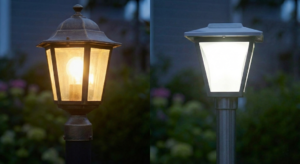
Each solar fixture is a tiny self-contained power plant. A small panel charges a rechargeable battery during the day, a sensor detects darkness, and the battery runs an LED until it is empty.
The weak point is obvious once you see it written down. The light you get at night depends entirely on the sun that small panel collected that day. The Department of Energy guidelines note that outdoor solar lights only perform well when their panels receive the recommended hours of direct sunlight, and that run times drop in winter.
Wired vs Solar Landscape Lighting at a Glance
| Factor | Wired (Low Voltage) | Solar |
|---|---|---|
| Brightness | Strong, consistent, adjustable | Low, fades as battery drains |
| Reliability | Same output every night | Varies with sun, shade, season |
| Run time | All night, controlled by timer | Often fades before morning |
| Upfront cost | Higher | Low |
| Long-term cost | Low maintenance, long fixture life | Frequent battery and fixture replacement |
| Fixture quality | Premium brass and aluminum finishes | Mostly plastic or thin metal |
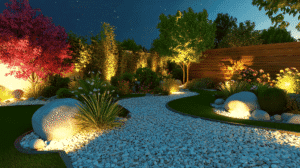
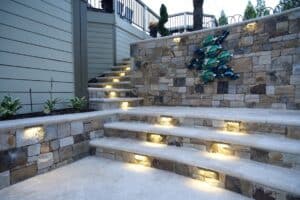
| Design flexibility | Uplights, downlights, wash, path, step | Mostly path stakes and small spots |
| Controls | Timers, photocells, dimmers, smart lighting controls | On at dusk, off when battery dies |
| Installation | Trenching and transformer setup | Push into the ground |
| Best for | Permanent homes, security, curb appeal | Renters, temporary or remote spots |
7 Reasons We Don’t Recommend Solar for Most Homes
- Brightness is limited. A small panel and battery can only power a small LED. That is enough to mark a path edge, but not enough to achieve professional-grade brightness for a tree canopy, a stone wall, or a set of steps safely.
- Performance changes every day. Cloudy weather, short winter days, and snow cover all reduce the charge. The nights you most need light are often the nights solar delivers the least.
- Shade defeats the purpose. The best places for lighting are often under trees, along north-facing walls, and beside the house. Those are the worst places to collect sun.
- Batteries wear out. Rechargeable cells lose capacity with every cycle. Many homeowners report noticeably dimmer light after a season or two, followed by failures.
- Most fixtures are not built to last. Thin plastic housings crack, lenses cloud over, and seals let in water. Cheap solar lights are closer to a seasonal product than a permanent fixture.
- There is almost no control. You cannot use advanced dimming and zoning or set them to shut off at midnight. DarkSky International’s lighting principles recommend warm, shielded light used only where and when it is needed, and that level of control is far easier with a wired system.
- The savings are smaller than they look. Replacing failed solar lights every year or two costs real money and time. Meanwhile, LED-based wired systems use very little electricity, which the U.S. Department of Energy credits to the efficiency of LED technology.
Pros vs. Cons
Wired low voltage lighting
Pros:
- Bright, even, dependable light every night
- Durable fixtures with replaceable LED lamps
- Full control with timers, dimmers, and zones
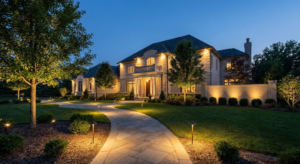
- Adds real curb appeal and improves safety
Cons:
- Higher upfront investment
- Needs an outdoor outlet and buried cable
- Design and installation take planning
Solar lighting
Pros:
- Very low upfront cost
- No wiring, no electrician, no trenching
- Easy to move or remove
Cons:
- Dim and inconsistent output
- Fails in shade and struggles in winter
- Short battery and fixture life
- Limited fixture styles and no meaningful controls
When Solar Actually Makes Sense
We do not recommend solar for most homes, but it is not useless. It fits a few specific situations.
- If you rent, or you only need light for one season or one event, choose solar. It goes in fast and leaves with you.
- If the spot is far from any power source, such as a mailbox at the end of a long driveway or a back-lot shed, a good quality solar fixture in full sun is a reasonable choice.
- If you need safe steps, security around entries, or lighting that shows off your home and plantings, choose a wired outdoor lighting system. Anything tied to safety should never depend on yesterday’s weather.
How to Plan a Wired System in 6 Steps
- Walk the property at night. Note dark steps, entries, grade changes, and the features worth showing off.
- Set priorities. Safety areas come first, then architecture, then trees and garden beds.
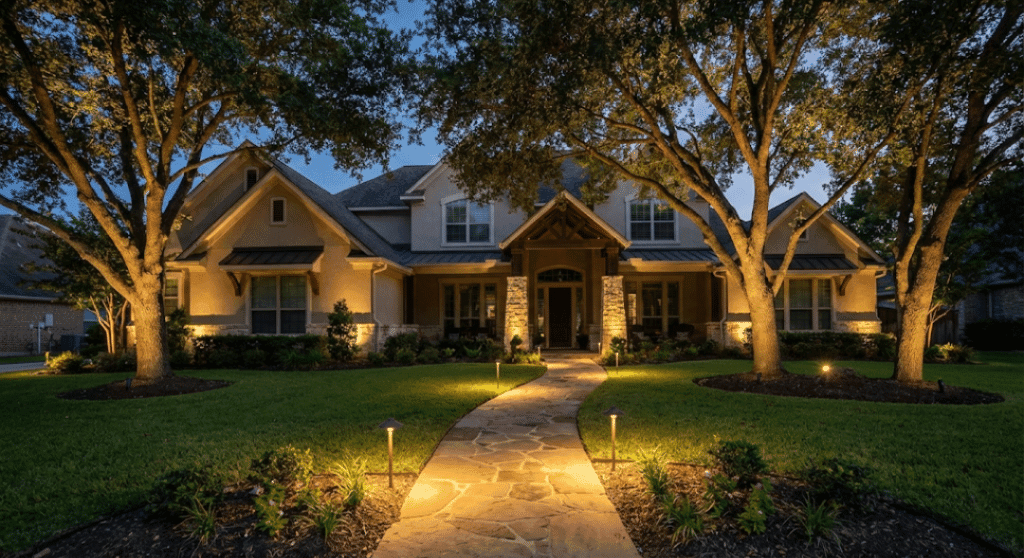
- Choose fixture types. Path lights for walkways, tree uplighting techniques for trees and columns, downlights for patios, and step or hardscape lights for stairs and walls.
- Size the transformer. Add up the wattage of all fixtures and leave room for future additions. Learn how to properly size your transformer to ensure consistent performance.
- Map cable runs and zones. Shorter, balanced runs keep brightness even from the first fixture to the last.
- Add controls. A photocell with a timer or a smart controller turns the system on at dusk and off when you choose.
Professional landscape lighting installation covers all six steps, and the Association of Outdoor Lighting Professionals is a good place to learn what trained designers look for.
Do / Don’t
Do
- Do use warm white lamps for a natural, welcoming look
- Do light steps, entries, and grade changes first
- Do choose brass, copper, or powder-coated aluminum fixtures
- Do plan extra transformer capacity for future phases
Don’t
- Don’t line a path with lights on both sides like a runway
- Don’t rely on solar for stairs or security areas
- Don’t aim fixtures toward windows, neighbors, or the street
- Don’t judge a solar light by how it looks in its first week
A Real-World Scenario
A homeowner with a shaded front walk buys a dozen solar path lights in spring. By late summer the tree canopy has filled in, half the lights barely glow, and two have stopped working. After the first winter, most need new batteries or replacement.
The following year the same walk gets six low voltage path lights, two uplights on the front trees, and a small transformer with a timer. The walkway is evenly lit every night, the house looks better from the street, and the only maintenance is an occasional lens cleaning. The second project cost more, but it only had to be done once.
Quick Answers:
Are solar landscape lights worth it?
A: They are worth it for temporary use, rentals, and sunny spots far from power. For permanent lighting on a home you own, a wired system is the better value over time.
Is wired landscape lighting expensive to run?
A: No. Modern systems use LED lamps, which draw very little power, so the effect on a typical electric bill is small.
Is low voltage lighting safe?
A: Yes. The transformer reduces household current to a low voltage, which makes the system safe around children, pets, and wet ground when installed correctly.
Do solar lights work in winter?
A: They work, but with shorter run times and lower output. Short days, low sun angles, and snow on the panels all reduce charging.
How long do solar lights last?
A: It depends on quality, but batteries commonly need replacement after a season or two, and many budget fixtures fail not long after.
Can I install wired landscape lighting myself?
A: A handy homeowner can follow a step-by-step installation guide for a basic kit. Larger designs benefit from a professional who can size the transformer, balance cable runs, and place fixtures for the best effect.
Can I mix solar and wired lights?
A: Yes. Some homeowners use wired lighting for the main areas and a few solar fixtures in remote, sunny spots.
Which is better in the wired vs solar landscape lighting comparison?
A: Wired is better for brightness, reliability, control, and lifespan. Solar is better only for upfront cost and ease of installation.
Glossary of Terms
- Transformer: A device that reduces standard household voltage to a safe low voltage for landscape lighting.
- Low voltage lighting: An outdoor lighting system that runs at roughly 12 volts through buried cable instead of full household current.
- Photocell: A sensor that detects daylight and switches lights on at dusk and off at dawn.
- Lumens: A measure of how much visible light a lamp produces. More lumens means a brighter light.
Conclusion
Solar lights win on price and convenience, and that is where the advantages end. Wired low voltage lighting gives you consistent brightness, durable fixtures, real design options, and full control over when and how your property is lit. It improves safety, adds curb appeal, and does not need to be replaced every other spring.
If you are tired of dim, unreliable yard lights, talk to our team about a wired lighting design for your home. Schedule a consultation and we will walk your property, show you what is possible, and give you a clear plan and quote.