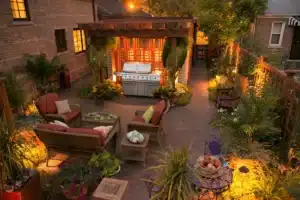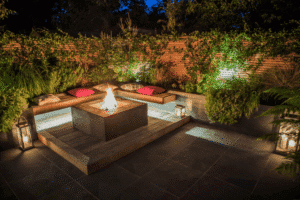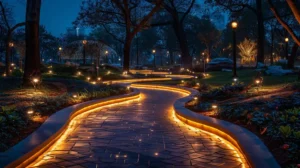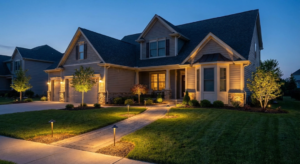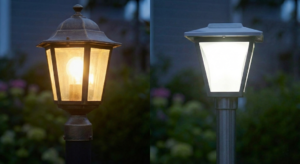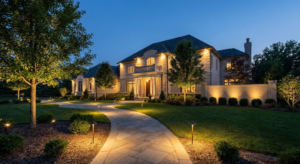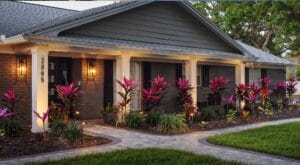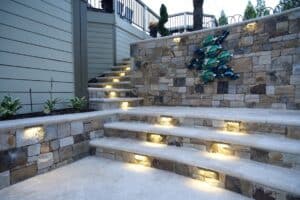
Concrete has taken over the modern American backyard. Poured patios, board-formed walls, floating steps, and broom-finished driveways all share the same clean geometry, and the right lighting is what keeps that geometry readable after sunset. That is exactly where modern concrete lighting ideas separate themselves from traditional landscape lighting: instead of decorating the yard with visible lamps, you light the surface and let the fixture disappear.
Tru-Scapes builds for this style of installation. The Modern Dot Light—TS-M25DOT-SS sits nearly flush in a poured slab, drops a soft pool of light on the concrete, and leaves nothing but a 2.5-inch stainless ring visible in daylight. That single design choice, a small aperture with a frosted lens, is the backbone of almost every sleek outdoor lighting plan on this list.
This guide covers where to place fixtures, how to install them in cured concrete, which materials survive American weather, and how to keep the whole system visually consistent.
Key Takeaways
- Modern concrete lighting ideas work best with flush fixtures, tight spacing, and one color temperature.
- Dot lights installed with a 2-inch core drill give concrete a minimalist, built-in look.
- Stainless steel outdoor lights and solid brass fixtures handle freeze-thaw cycles and pool chemicals well.
- Tru-Scapes builds sealed, IP68-rated dot lights made specifically for concrete, stone, and composite surfaces.
- Light the edges and elevation changes first, then add accents only where the eye needs a stop.
What Actually Makes Concrete Lighting Look Modern
Three things separate a contemporary layout from a dated one, and none of them involve buying more fixtures.
The first is fixture visibility. Modern design hides the source and shows the effect. Flush dot lights, recessed step lights, and low-profile wall fixtures all read as architectural rather than decorative.
The second is rhythm. Contemporary landscape lights are placed on a repeating interval that follows the concrete itself, usually along a control joint, a slab edge, or a stair riser. Random placement is the fastest way to make an expensive patio look cluttered.
The third is color consistency. Mixing 2700K warm fixtures with 4000K cool ones on the same surface makes concrete look blotchy, because gray and tan aggregate reflect color shifts far more visibly than brick or wood.
The Minimalist Hardscape Lighting Rule
Light the change, not the space. Every place where the surface changes elevation, direction, or material deserves a fixture. Everything else can stay dark. This is the core of minimalist hardscape lighting principles, and it is why a well-lit modern patio often uses fewer fixtures than a traditional one.
Nine Modern Concrete Lighting Ideas That Work in Real Yards
- Dot lights along a patio perimeter: Core drill a run of dot lights 3 to 4 feet apart along the slab edge to trace the shape of the patio.
- Grazing light on a board-formed or poured concrete wall to bring out the texture.
- Recessed step lights on every riser of a floating concrete stair.
- Dot lights set into a driveway apron to mark the entry without a single visible post.
- Color-changing dot lights around a concrete pool coping for holidays and evening entertaining.
- Hardscape lights under a concrete bench or seat wall cap so the seating appears to float.
- Modern path lights along a walkway that runs off the slab into planted areas.
- A tight cluster of dot lights at a fire pit surround to define the circle.
- Wall-mounted hardscape lights inside an outdoor kitchen to light counters without glare. For specific task lighting strategies, see our outdoor kitchen lighting guide.
Ideas 1 through 5 rely on in-grade fixtures. If your concrete is already poured and cured, that is not a problem: the Modern Dot Light—TS-M25DOTC-SS installs into finished concrete, driveways, stone, wood, or composite decking with a 2-inch core drill bit, so retrofits are routine.
Fixture Comparison for Concrete and Hardscape Surfaces
| Fixture Type | Best Placement | Light Output Style | Visual Footprint |
|---|---|---|---|
| Modern dot lights | Slab edges, driveways, pool coping, stair treads | Small downward pool, frosted lens | 2.5″ ring, nearly flush |
| Modern hardscape lights | Under caps, risers, outdoor kitchen counters | 120-degree wash across the surface | Hidden under an overhang |
| Modern path lights | Walkways and planted borders off the slab | 360-degree spread at 21″ stem height | Visible slim post |
| Color-changing dot lights | Entertaining zones, pool decks, feature areas | Adjustable RGBCW, 2700K to 6500K | 2.5″ ring, nearly flush |
If your goal is a surface that looks untouched in daylight, choose dot lights. If you need usable task light on a counter or stair, choose hardscape lights. If the walkway leaves the concrete and crosses turf or mulch, path lights are the only practical option.
How to Install Dot Lights in Cured Concrete
- Lay out fixture positions with chalk, then step back and check the spacing at night with a flashlight before drilling anything.
- Confirm your low voltage run and transformer sizing requirements. Tru-Scapes dot lights operate on a 9v to 15v AC/DC range with a 12V transformer sold separately.
- Core drill each location with a 2-inch bit. The TS-M25DOT-SS has a total fixture height of 1.75 inches and drops straight into that hole.
- Route the 18AWG lead wire to your junction point, following low-voltage wiring best practices and keeping splices out of standing water and inside listed waterproof connectors.
- Seat the fixture, set the 2.5-inch stainless ring flush with the surface, and clean the lens before the material cures around it.
- Power up at dusk and adjust before backfilling or sealing anything permanently.
Follow the National Electrical Code (NFPA 70) and your local amendments for low voltage landscape wiring, transformer placement, and burial depth. When the layout involves stairs, review the IES lighting standards on safety standards for step lighting so treads are lit evenly rather than spot-lit.
Choosing Materials That Survive the Concrete Environment
Concrete holds moisture, salt, and heat. Fixture material matters more here than in a planted bed.
| Pros | Cons |
|---|---|
| Stainless steel rings resist corrosion near pools and salted driveways | Stainless shows water spotting in hard-water regions |
| Solid brass path lights weather naturally and last for decades | Brass costs more to manufacture, so fewer budget options exist |
| Powder coated aluminum stays light and easy to mount under caps | Aluminum finishes can chalk if constantly abraded |
| Sealed IP68 housings tolerate standing water and freeze-thaw | Sealed fixtures use integrated LEDs that are not user-replaceable |
The Tru-Scapes approach to material selection tracks the install location. The Modern Hardscape Light—TS-MA6000-GRY uses a powder coated aluminum body with a stainless steel bracket, which keeps weight off the cap stone while resisting rust at the fastener. The Modern Path Light—TS-B306 is built from solid brass because it sits exposed at ankle height where mowers, snow shovels, and irrigation hit it.
If your property is coastal or near a saltwater pool, prioritize stainless steel outdoor lights and brass. If the fixture lives under a cap and never gets touched, aluminum is a smart, lighter choice.
Getting Color Temperature Right on Gray Concrete
Cool white reads crisp and contemporary on gray and charcoal concrete. Warm white flatters tan, buff, and exposed aggregate finishes. Both Tru-Scapes modern dot lights and the TS-MA6000-GRY hardscape light run at 4000K cool white, which is why they pair so cleanly with modern slabs and board-formed walls.
The TS-B306 path light runs at 2700K, a warmer tone that suits planted areas where foliage and mulch surround the fixture. That difference is intentional, not a mismatch: hardscape and softscape are separate visual zones, and a warmer path light at the garden edge reads as depth rather than inconsistency.
If you want flexibility, the color changing TS-M25DOTC-SS adjusts from 2700K through 6500K by app, along with RGB output, dimming, and fixture grouping. Homeowners who choose Tru-Scapes for pool decks often run the whole run neutral on ordinary nights and shift it for holidays.
Do and Don’t
| Do | Don’t |
|---|---|
| Mock up spacing at night before drilling | Space fixtures by guesswork in daylight |
| Keep one color temperature per surface | Mix warm and cool on the same slab |
| Size the transformer with headroom for future zones | Load a transformer to its exact limit |
| Aim light downward and shield the source | Point fixtures up toward eye level or neighboring windows |
| Follow DarkSky International’s lighting guidelines on shielding and output | Over-light the yard because more seemed safer |
A Modern Patio Retrofit
A homeowner in suburban Pennsylvania finished a 600-square-foot poured concrete patio with a seat wall and three floating steps. The slab looked sharp during the day and vanished at night, and two solar stake lights near the steps created more glare than guidance.
The retrofit used three product types and no new concrete. Fourteen Modern Dot Light (TS-M25DOT-SS) fixtures were core drilled along the patio perimeter at roughly 42-inch intervals to trace the slab edge. Six Modern Hardscape Light (TS-MA6000-GRY) fixtures were mounted under the seat wall cap and on the stair risers, washing each tread at a 120-degree beam angle so the steps read clearly without a visible lamp.
Five Modern Path Light (TS-B306) fixtures continued the walkway from the patio to the driveway, where the surface changes from concrete to planted border.
The result was a patio outline visible from inside the house, safe stairs, and no fixture taller than ankle height anywhere on the hardscape. Total connected load stayed low enough for a single low voltage transformer.
Products That Get the Job Done
For In-Ground Concrete and Driveway Lighting
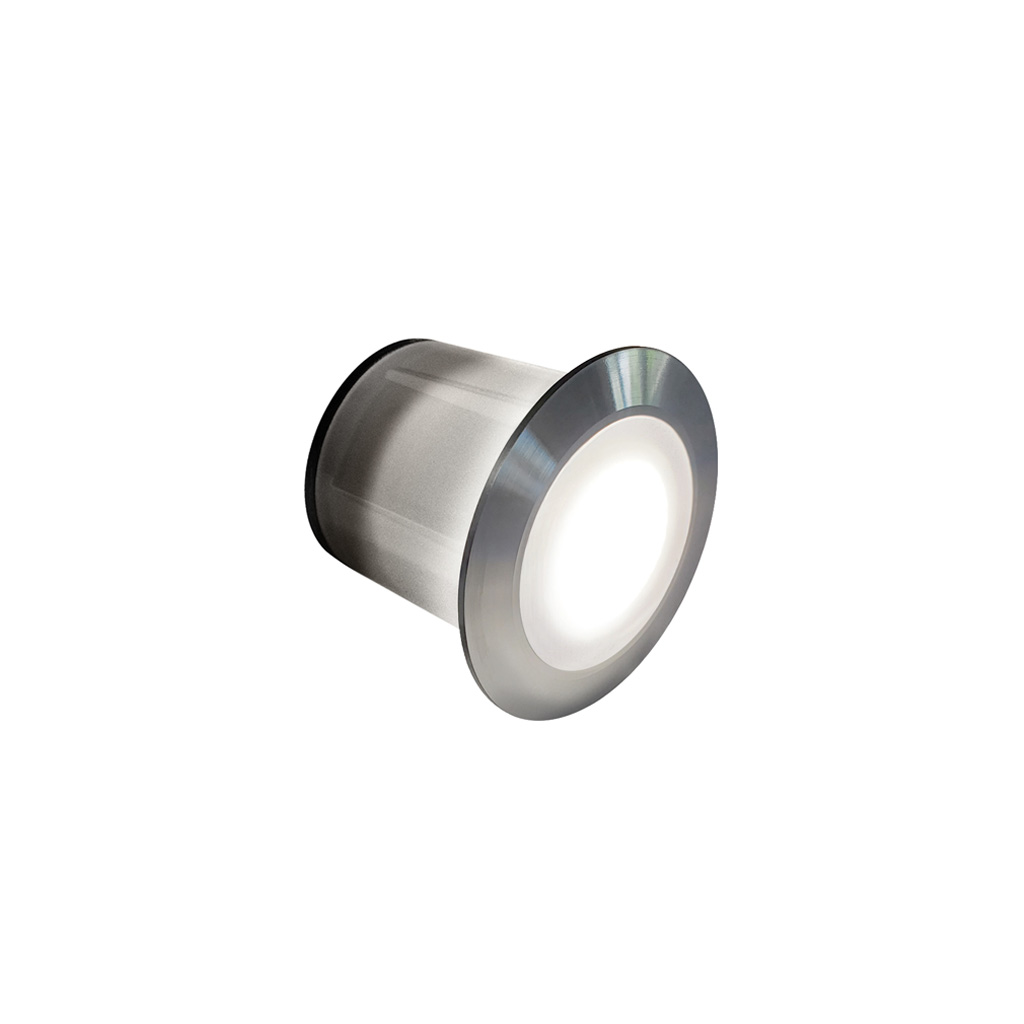
Modern Dot Light—TS-M25DOT-SS
A sealed IP68 in-ground fixture with a composite housing, frosted acrylic lens, and a replaceable 2.5-inch stainless steel ring. It puts out 105 lumens at 4000K on 1.5 watts, and installs into concrete, driveways, stone, wood, or composite decking with a 2-inch core drill bit. This is the workhorse for tracing slab edges and driveway aprons.
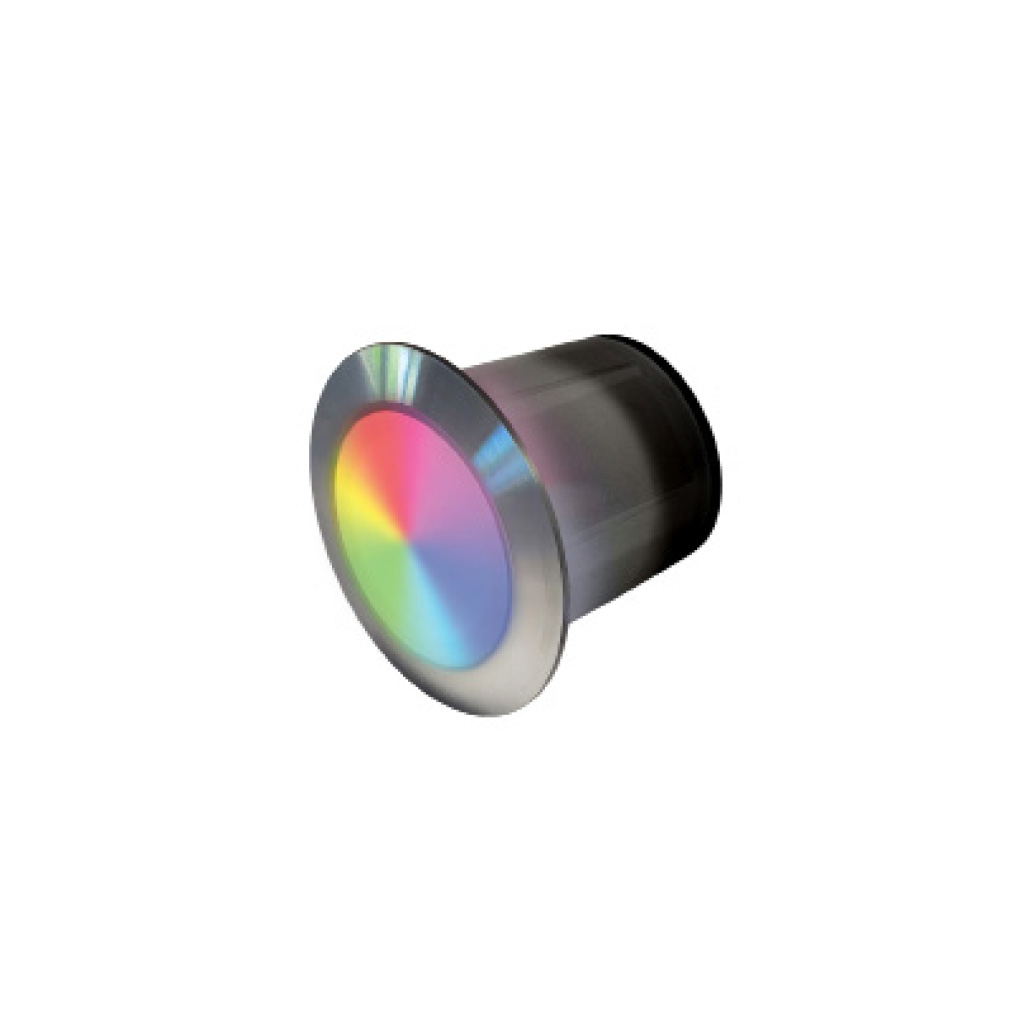
Modern Dot Light—TS-M25DOTC-SS
The app controlled version of the same fixture, with adjustable color temperature from 2700K to 6500K, RGBCW output, dimming, and fixture grouping. It uses the same sealed housing, frosted lens, and 2-inch core drill installation, so it drops into an existing layout without changing the drilling plan. Best suited to pool decks and entertaining zones where the mood changes with the occasion.
For Steps, Walls, and Outdoor Kitchens

Modern Hardscape Light—TS-MA6000-GRY
A professional grade step and wall light built from powder coated aluminum with a stainless steel bracket, finished in gray to blend with concrete caps. Eight LEDs deliver 92 lumens at 4000K across a 120-degree beam on just 1 watt, which spreads light evenly across a tread instead of creating a hot spot. Mounted under a cap or overhang, the fixture itself stays out of sight.
For Walkways and Planted Borders

Modern Path Light—TS-B306
A solid brass path light with a modern head, 360-degree output, a 21-inch stem, and a heavy-duty 8-inch ground stake included. It runs 95 lumens at 2700K on 3 watts and comes in black or bronze, both of which recede visually next to gray concrete. Use it where the walkway leaves the hardscape and in-grade fixtures are no longer practical.
Frequently Asked Questions
Can dot lights be installed in concrete that has already cured?
A: Yes. Tru-Scapes dot lights are designed for retrofit installation using a 2-inch core drill bit, so you do not need to pour new concrete or plan for them in advance.
How far apart should dot lights be spaced on a patio edge?
A: Most modern layouts land between 3 and 5 feet apart, tightened at corners and curves. Mock up the spacing at night before drilling, since aggregate color and slab width both change how the light reads.
Are dot lights bright enough to light a whole patio?
A: They are not meant to. Dot lights define edges and shapes. For usable task or stair light, pair them with a fixture like the Modern Hardscape Light—TS-MA6000-GRY, which washes a surface at a 120-degree beam angle.
What does an IP68 rating mean for an in-ground fixture?
A: IP68 indicates the housing is fully sealed against dust and continuous water immersion. That matters in concrete, where water pools at grade and freezes in winter across most of the United States.
Do I need a transformer for low voltage concrete lighting?
A: Yes. These fixtures operate on a 9v to 15v AC/DC range and require a 12V low voltage transformer, which is sold separately. Size it with capacity to spare so you can add zones later.
Can I change the color of my concrete lights after installation?
A: Only with a color-changing fixture. The Modern Dot Light—TS-M25DOTC-SS adjusts color temperature, RGB output, dimming, and grouping through an app, while the standard TS-M25DOT-SS is fixed at 4000K.
Will stainless steel rings rust near a pool?
A: Stainless steel resists corrosion far better than plated finishes, which is why it is the standard choice around pool decks and salted driveways. Rinse the rings occasionally to remove chemical residue.
Is the LED replaceable in a dot light?
A: The stainless steel ring is replaceable, but the integrated light source is not. That trade-off is what allows the housing to be fully sealed against water intrusion.
Glossary
- Dot light: A small in-ground fixture, typically under 3 inches wide, installed flush into concrete or decking to create a discrete point of light.
- Hardscape light: A low-profile fixture mounted under a cap, riser, or counter overhang that washes light across a surface while staying hidden from view.
- Core drilling: Cutting a clean cylindrical hole in cured concrete or stone with a hollow diamond bit, used to retrofit in-grade fixtures.
- Color temperature (CCT): A measurement in Kelvin describing how warm or cool a light source appears, where 2700K reads warm amber and 4000K reads neutral white.
Why Tru-Scapes Is the Answer
Concrete is an unforgiving place to put a light fixture. Water pools at grade, salt gets tracked across driveways, and freeze-thaw cycles work at every seam. Most fixtures fail at those points, not at the LED.
Tru-Scapes engineers their in-ground fixtures around that reality. The Modern Dot Light—TS-M25DOT-SS uses a fully sealed composite housing with an IP68 rating, a frosted acrylic lens that diffuses glare instead of throwing a hot point, and a replaceable 2.5-inch stainless steel ring so the visible part of the fixture can be refreshed without touching the concrete.
The rest of the line follows the same logic. Hardscape lights use stainless brackets where fasteners meet stone. Path lights are solid brass because they sit exposed. Every fixture runs on the same 12V low voltage platform, so a patio, a stair run, and a walkway can share one system and one control point.
That is also why the Tru-Scapes catalog is organized by install condition rather than by style alone. When a homeowner asks which fixture belongs in a driveway apron versus under a seat wall cap, there is a specific answer, backed by a published spec sheet and a warranty. Sleek outdoor lighting only stays sleek if the hardware holds up for years, and that is the standard the product line is built to.
Conclusion
The best modern concrete lighting ideas share the same discipline: fewer fixtures, tighter placement, consistent color, and hardware that disappears into the surface. Trace the edges, light the elevation changes, keep the source hidden, and the concrete does the rest of the work.
Start with the layer that defines your space. If that is a patio perimeter, driveway apron, or pool deck, the Modern Dot Light—TS-M25DOT-SS installs into cured concrete with a 2-inch core drill and delivers sealed, IP68-rated performance that holds up season after season. Build outward from there with hardscape and path lighting, and you will have a yard that looks as intentional at 9 p.m. as it does at noon.