Key Takeaways
- The best LED landscape lights pair solid brass and copper or concrete housings with warm 2700K to 3000K output.
- Low-voltage wired systems beat solar on brightness, consistency, and long-term reliability in most yards.
- Match the fixture type to the job: path, spot, well, step, or bollard.
- Check IP rating, CRI, and beam angle before you start comparing prices.
- Shielded, downward-aimed fixtures cut glare and keep light out of your neighbors’ windows.
Why Fixture Choice Matters More Than Ever in 2026
Most landscape lighting fails for one boring reason: the fixtures were picked by price tag instead of by job. A thin aluminum path light looks fine in the box and corrodes after a couple of winters. A cool-white spotlight makes a beautiful stone wall look like a parking lot.
This guide helps you avoid both mistakes. You will learn how to spot the best LED landscape lights by their build specs, which fixture type fits each part of your yard, where concrete fixtures fit into a modern design, and how to plan a system step by step.
One note on method. Brand lineups change every season, so this guide reviews fixture categories and the specifications that separate a long-lasting fixture from a short-lived one. Those specs stay true no matter whose name is on the box.
What Makes the Best LED Landscape Lights Worth Buying
Housing material
Material decides lifespan more than any other factor. Solid brass and copper resist corrosion and develop a natural patina, which makes them the standard choice for coastal and high-moisture regions. Powder-coated aluminum costs less but can pit and flake once the coating is scratched.
Concrete is the newer entry in this group. It is heavy, stable, and does not rust, which is why it shows up more often in modern and minimalist designs.
Color temperature and CRI
Warm white light between 2700K and 3000K flatters plants, stone, and wood siding. DarkSky International recommends warm-toned outdoor lighting at 3000K or lower to reduce glare and skyglow.
Look at the Color Rendering Index too. A CRI of 80 is acceptable, and 90 or higher makes foliage and masonry look noticeably richer at night.
Weather sealing
Check the IP rating on the spec sheet. IP65 handles rain and sprinklers for above-ground fixtures. In-ground well lights need IP67 or better because they sit in standing water after storms.
Integrated LED vs. drop-in lamps
Integrated fixtures seal the LED inside the housing, which keeps moisture out but means replacing the whole unit if it fails. Drop-in fixtures accept standard lamps such as MR16 bulbs, so you can swap brightness or beam angle later. If you like to fine-tune, choose drop-in. If you want install-and-forget, choose integrated.
Reviews by Fixture Type: 7 Categories Compared
| Fixture type | Best for | Typical output | Beam | Verdict |
|---|---|---|---|---|
| Path lights | Walkways, garden beds | Low | Wide, downward | The essential starting point for safety |
| Spotlights / uplights | Trees, columns, facades | Medium to high | Narrow to medium | Biggest visual impact per fixture |
| Flood / wash lights | Walls, hedges, wide areas | Medium | Very wide | Great for even, soft coverage |
| In-ground well lights | Tree trunks, flagpoles, lawns | Medium | Adjustable | Clean look, needs good drainage |
| Hardscape / step lights | Stairs, seat walls, caps | Low | Linear, downward | Best safety upgrade for patios |
| Deck and post lights | Railings, posts, pergolas | Low | Soft, downward | Subtle glow for entertaining areas |
| Bollards | Driveways, modern entries | Medium | 180 or 360 degrees | Strong design statement, very durable |
Path lights. Choose a fixture with a full hat or shade so the source is hidden and the light falls on the ground. Spacing them in a staggered pattern looks more natural than a straight runway line.
Spotlights and uplights. These do the dramatic work. A narrow beam suits a tall, slim tree, while a wider beam suits a broad canopy or a house facade. An adjustable knuckle and a glare shield are worth paying for.
Flood and wash lights. Use these where you want a soft, even glow across a fence, hedge, or stone wall. Lower output usually looks better than you expect.
Well lights. Because they sit flush with grade, mowers pass right over them. Install them over a gravel base so water drains away from the housing.
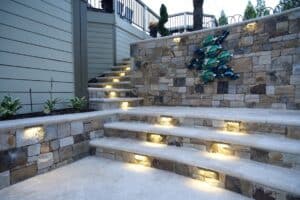
Hardscape and step lights. These tuck under wall caps and stair treads. They are the single most useful fixture for preventing trips on a patio at night.
Deck and post lights. Small, low-output fixtures that define the edges of a deck without lighting up the whole yard.
Bollards. Taller than path lights and built to take a bump. They work well along driveways and at modern front entries, especially in cast concrete.
Concrete LED Fixtures: A Modern Option Worth a Look
Cement outdoor lighting has moved from commercial plazas into residential yards. The appeal is simple. Concrete is neutral in color, pairs well with pavers and modern architecture, and its weight keeps it from tipping or walking off.
A few outdoor concrete lamp ideas that work well in home settings:
- Cast concrete bollards lining a driveway or front walk
- Low cube or cylinder lights placed beside patio seating
- Recessed step lights set into a poured retaining wall
- A pedestal lamp anchoring the corner of a fire pit area
Modern concrete garden lights are usually made from sealed or fiber-reinforced concrete, which is lighter and more crack-resistant than a plain poured mix. In freeze-thaw climates across the northern United States, confirm the fixture is sealed and rated for outdoor use, since unsealed concrete can absorb water and develop hairline cracks over time.
When shopping for concrete light fixtures outdoor, check the same specs you would on brass: IP rating, color temperature, and whether the LED module is replaceable. Concrete patio lights with a shielded, downward opening give you ambiance without glare at eye level when guests are seated.
Low-Voltage, Solar, or Line Voltage?
Low-voltage LED systems run on 12 volts through a transformer plugged into a GFCI-protected outdoor outlet. The U.S. Department of Energy notes that quality LEDs use far less electricity and last many times longer than incandescent bulbs, which is why LED has become the default for outdoor use.
If you need reliable light every night of the year, choose a low-voltage wired system. If you are renting or just want to mark a short path with no wiring, solar is a reasonable short-term pick. If you need high-output security lighting on the house itself, that is line-voltage work, and the National Electrical Code published by the National Fire Protection Association sets the rules a licensed electrician will follow.
Low-voltage LED systems: Pros vs. Cons
Pros
- Safe to install and adjust without deep trenching
- Consistent brightness in every season
- Easy to expand as the landscape matures
- Wide choice of fixture styles and materials
Cons
- Higher upfront cost than solar stakes
- Requires a transformer and an outdoor outlet
- Long wire runs can suffer voltage drop if undersized
- Cheap fixtures still fail early, so quality matters
How to Plan Your System in 6 Steps
- Walk the yard at night. Note dark steps, grade changes, and the features you want to show off.
- Assign a fixture type to each spot using the table above.
- Pick one color temperature for the whole property so nothing looks mismatched.
- Add up the wattage of every fixture and size the transformer with room to grow, since most installers avoid loading a transformer to full capacity.
- Lay out wire runs. For long distances, use heavier-gauge cable or a multi-tap transformer to limit voltage drop.
- Set fixtures in place, test after dark, and adjust angles before burying any cable.
Do / Don’t
Do
- Light the task first: steps, paths, and entries
- Hide the light source whenever possible
- Use a photocell or timer so lights run only when needed
- Leave slack wire at each fixture for future plant growth
Don’t
- Mix warm and cool white fixtures in the same view
- Aim spotlights toward windows, the street, or the sky
- Overlight. Less light, placed well, almost always looks better
- Buy on wattage alone. Compare lumens, beam angle, and CRI
Real-World Scenario
A homeowner in suburban Pennsylvania with a long front walk, a mature maple, and a paver patio. Solar stakes along the walk faded by mid-evening each winter, and the patio steps stayed dark.
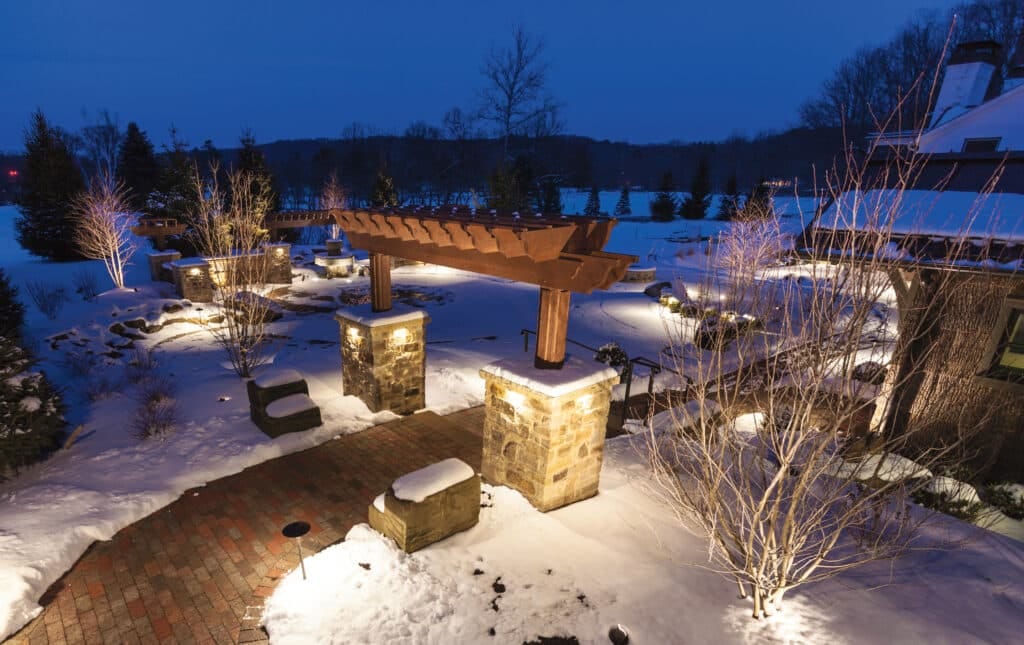
The replacement plan used brass LED path lights staggered along the walk, two 2700K uplights on the maple, step lights under the seat wall caps, and three concrete cube lights at the patio corners, all on one transformer with a photocell and timer. The result was even light from curb to patio, no glare from the seating area, and a system that needed no seasonal attention beyond trimming plants back from the fixtures.
Quick Answers:
What are the best LED landscape lights for most homes?
A: Low-voltage fixtures in solid brass, copper, or sealed concrete with 2700K to 3000K output and an IP65 or higher rating. They balance durability, appearance, and safe installation.
How long do LED yard lights last?
A: Quality LED modules are rated for many years of nightly use. In practice, housing quality and moisture sealing usually determine how long the fixture survives.
Are solar landscape lights worth it?
A: They work for short paths and temporary setups. They are generally dimmer and less consistent than wired low-voltage lighting, especially in winter or shade.
What color temperature is best for garden lighting?
A: Warm white between 2700K and 3000K suits most homes. DarkSky International recommends 3000K or lower for outdoor lighting.
Can I install low-voltage landscape lighting myself?
A: Many homeowners do, since 12-volt systems are safe to handle. Larger properties and any line-voltage work should go to a professional.
Do concrete outdoor lights hold up in cold climates?
A: Yes, when they are sealed or fiber-reinforced and rated for outdoor use. Unsealed concrete can absorb water and crack during freeze-thaw cycles.
How many lumens do path lights need?
A: Path lights need relatively low output because they only light the ground nearby. Too much brightness creates glare and ruins night vision.
What IP rating should outdoor LED fixtures have?
A: IP65 is suitable for above-ground fixtures exposed to rain and sprinklers. In-ground fixtures should be IP67 or higher.
Glossary of Terms
- Lumens: A measure of how much visible light a fixture produces. Higher lumens mean a brighter light.
- Kelvin (K): The scale for color temperature. Lower numbers look warm and amber, while higher numbers look cool and blue.
- IP rating: A two-digit code showing how well a fixture resists dust and water. The higher the digits, the better the protection.
- Voltage drop: The loss of electrical pressure over a long wire run. It causes fixtures at the end of the line to look dimmer.

Conclusion
Good exterior LED fixtures make a home safer, more usable after dark, and better looking from the street. The formula is steady: durable housings, warm and accurate light, the right fixture for each job, and a low-voltage system sized with room to grow. Concrete fixtures add a modern option that holds up well when properly sealed.
The best LED landscape lights are the ones you install once and stop thinking about. If you would like help designing a system for your property, contact our team to schedule a nighttime lighting consultation and get a plan built around your yard.