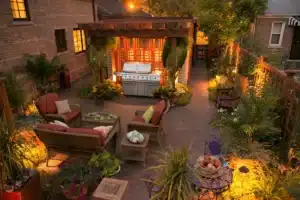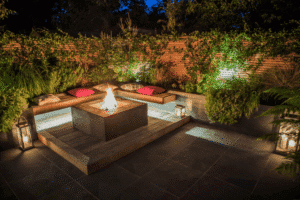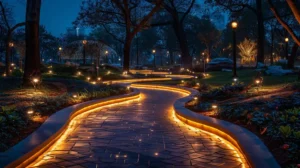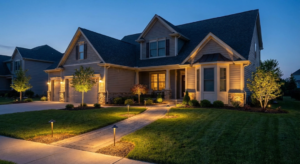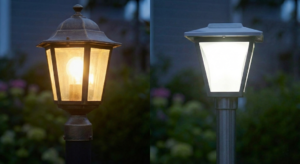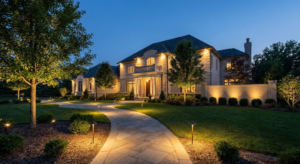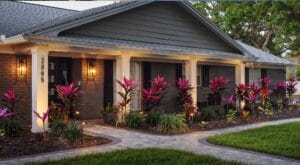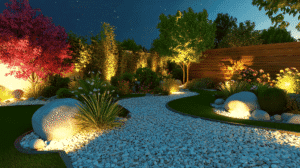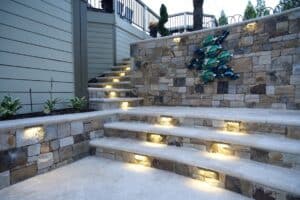
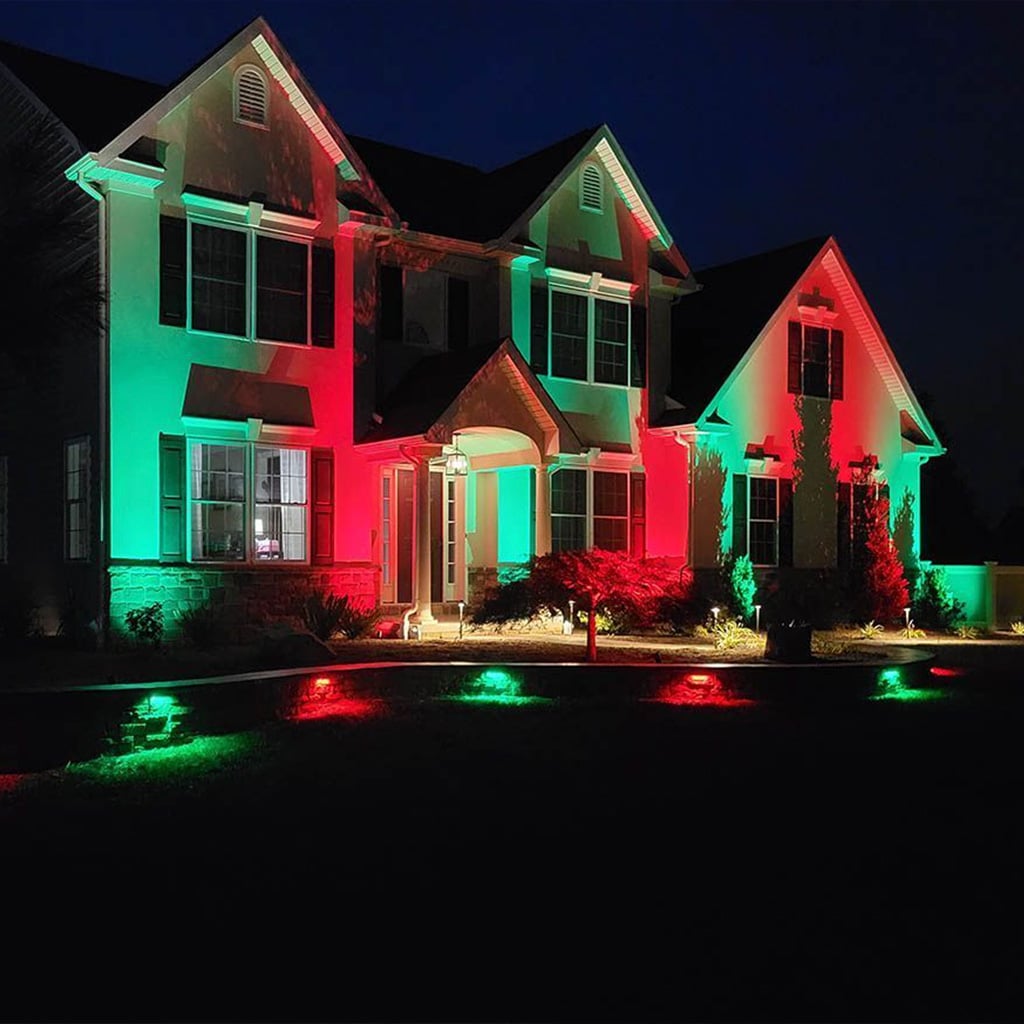
Outdoor lighting has moved well beyond a single warm-white glow along the walkway. Today, color-changing landscape lighting gives homeowners the ability to shift their entire outdoor space from crisp white task lighting to vibrant color displays in seconds, all from the same fixtures.
This shift is driven by RGBCW technology, which combines red, green, blue, cool white, and warm white LEDs in a single diode array. Tru-Scapes has built its outdoor lighting line around this technology, giving homeowners a system that performs as reliable security and accent lighting on ordinary nights and becomes a colorful centerpiece for holidays, sports celebrations, and backyard gatherings.
This guide explains how color-changing landscape lighting works, how it compares to traditional fixtures, and how to plan a system that holds up season after season.
Key Takeaways
- Color-changing landscape lighting lets homeowners switch between white and vibrant tones on demand
- Tru-Scapes engineers RGBCW fixtures like the Tru-Scapes RGBCW PAR36 for consistent, long-lasting color output
- Low voltage color lighting systems are safer for residential use and more energy-efficient than line voltage alternatives
- Proper transformer sizing and wiring are essential for reliable, flicker-free performance
- Customizable outdoor lighting adds functional safety lighting and decorative flexibility to a single system
What Is Color-Changing Landscape Lighting?
Color-changing landscape lighting refers to outdoor fixtures capable of producing multiple colors and white tones from a single light source, typically controlled through a smartphone app, remote, or wall-mounted controller. Unlike fixed-color LED lights, these fixtures use RGBCW chips that blend individual color channels to create millions of possible hues.
The “CW” in RGBCW stands for cool white and warm white, which is what separates true color-changing landscape lighting from basic RGB strip lighting. Without dedicated white channels, RGB-only fixtures often produce a dim, tinted white that looks purple or blue instead of clean daylight or soft amber tones. RGBCW landscape lights solve that problem by giving each fixture a genuine white lighting mode alongside full color capability.
How RGBCW Technology Works
Each RGBCW fixture contains multiple LED chips wired to respond independently to a control signal. When a homeowner selects “cool white” from an app, the white-channel LEDs activate while the color channels stay off, producing clean, functional light for everyday use.
Switching to color mode activates the red, green, and blue channels in varying intensities, which blend optically to create the desired hue. Because the diodes are grouped tightly within the fixture housing, the light appears as a single uniform color rather than distinct colored dots, provided the fixture is engineered with a quality diffuser lens.
Tru-Scapes engineers their RGBCW fixtures with layered diffusion and properly matched driver components so color transitions stay smooth and the white output stays true, rather than shifting warm or cool as the fixture ages.
Low Voltage vs. Line Voltage Color Lighting
Landscape lighting systems generally run on either low voltage (typically 12V) or standard line voltage (120V). For color-changing applications, low voltage color lighting is the standard approach for residential properties, and for good reason.
| Feature | Low Voltage Color Lighting | Line Voltage Color Lighting |
|---|---|---|
| Installation safety | Safe for DIY and shallow burial | Requires licensed electrician, deeper conduit |
| Energy use | Lower draw per fixture | Higher draw per fixture |
| Fixture lifespan | Extended, less thermal stress | Shorter under continuous high load |
| Smart control compatibility | Widely compatible with app-based systems | Limited without additional hardware |
| Repair complexity | Simple, tool-free connectors | Often requires rewiring |
If a homeowner wants a system they can expand or adjust themselves over time, low voltage color lighting is the more practical choice. If a property already has an existing line voltage infrastructure and a licensed electrician is doing a full installation, line voltage remains a viable option.
Step-by-Step: Planning a Color-Changing Lighting System
- Map the property. Identify architectural features, plant beds, walkways, and structures like decks, pergolas, or pool areas that would benefit from accent lighting.
- Group fixtures by zone. Separate the plan into zones, such as front facade, backyard entertaining space, and pathway lighting, so each area can be controlled independently.
- Select fixture types for each zone. Hardscape lights work well along walls and steps, while spotlights and PAR36 fixtures suit trees, flagpoles, and focal points.
- Calculate transformer load. Add the wattage of all fixtures in a run and select a properly sized transformer with headroom for future additions.
- Choose a control method. Decide between an app-based hub, a wall-mounted controller, or a hybrid system depending on how often color changes are desired.
- Install and test each zone. Power on one zone at a time to confirm consistent color output and correct any loose connections before backfilling wiring.
Where Color-Changing Fixtures Work Best
Not every corner of a landscape needs color-changing capability, and mixing fixed white fixtures with RGBCW fixtures is common in a well-planned design.
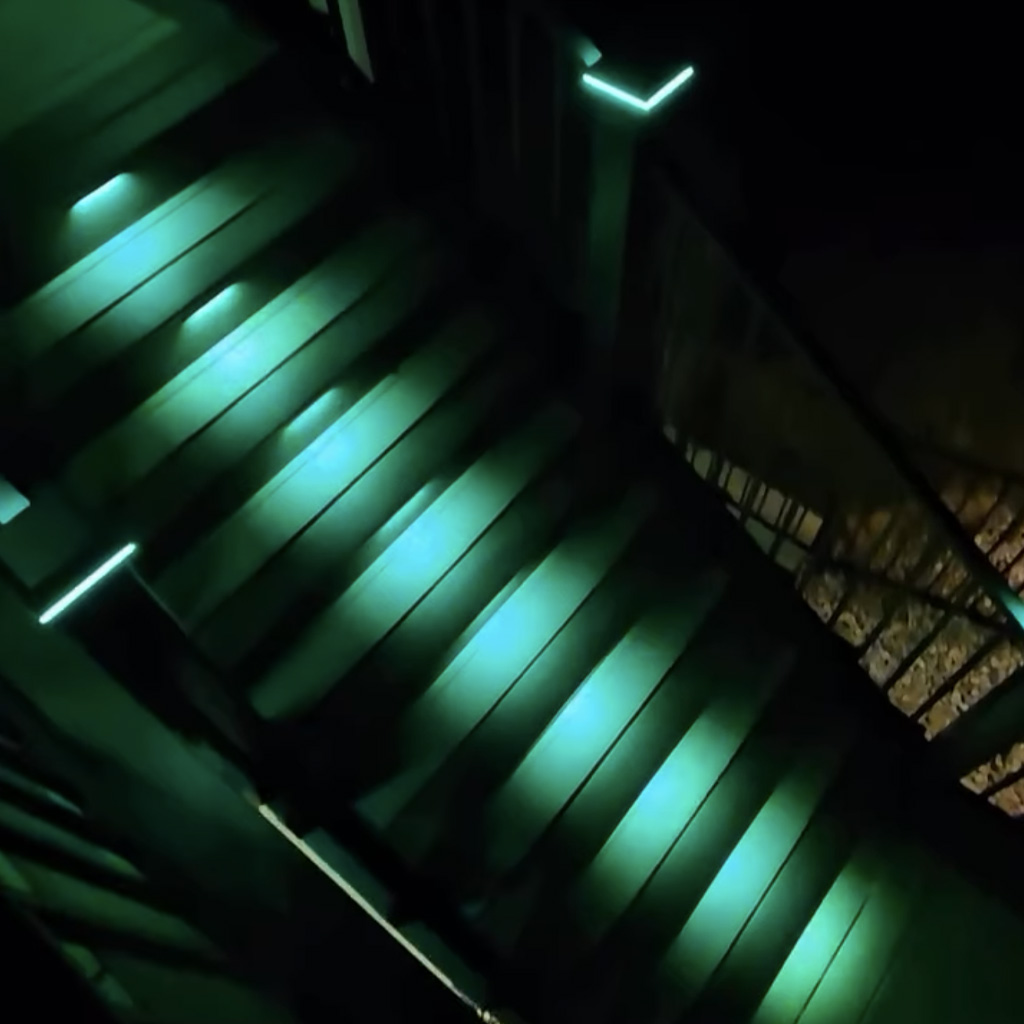
- Hardscape walls, steps, and retaining walls — ideal for the Color Changing Hardscape Light, which blends into daytime stonework and transforms at night
- Trees, flagpoles, and architectural focal points — well-suited to Tru-Scapes RGBCW PAR36 fixtures for wide, even color wash
- Garden beds and small accent areas — a good fit for compact 4W MR16 RGBCW fixtures that tuck discreetly into landscaping
If the goal is subtle, year-round accent lighting, a homeowner may only need color capability on a handful of focal fixtures while the rest of the system stays fixed white. If the goal is a fully immersive, color-reactive backyard for entertaining, a full RGBCW zone across the patio and pool area makes more sense.
Pros and Cons of Color-Changing Landscape Lighting
| Pros | Cons |
|---|---|
| Single system handles both daily and seasonal lighting needs | Requires a compatible controller or hub |
| Reduces need for separate holiday lighting installations | Slightly more complex wiring planning than fixed-color systems |
| App-based control allows scheduling and scene presets | Initial setup takes more time than a basic white-only system |
| Long-term LED lifespan reduces bulb replacement | Requires periodic firmware or app updates for smart features |
Do’s and Don’ts for Installation and Maintenance
| Do | Don’t |
|---|---|
| Size the transformer with room for future fixture additions | Don’t overload a single transformer run past its rated capacity |
| Test color uniformity across a full zone before burying wire | Don’t bury wiring before confirming every fixture functions |
| Clean fixture lenses seasonally to preserve true color output | Don’t use incompatible third-party controllers not rated for RGBCW |
| Group fixtures by function (accent, path, wash) when wiring zones | Don’t mix voltage types on the same circuit run |
A Real World Example: A Backyard Entertaining Space
A homeowner planning a backyard patio used for both quiet weeknight dinners and larger weekend gatherings. During the week, the family relies on clean white light along the steps and patio wall for safety and everyday use. On weekends, they want the same space to feel festive for guests.
By installing the Color Changing Hardscape Light along the seat wall and steps, paired with Tru-Scapes RGBCW PAR36 fixtures aimed at a specimen tree near the patio, the homeowner gets a system that runs in warm white every night by default. For a weekend gathering or a holiday, they switch the entire zone to a coordinated color scheme through the app in seconds, no rewiring or fixture swaps required.
This kind of dual-purpose functionality is a major reason homeowners who choose Tru-Scapes move toward RGBCW systems instead of single-purpose colored lighting.
Products That Get the Job Done
For Architectural and Tree Uplighting

Tru-Scapes RGBCW PAR36
This directional spotlight is built to wash large surfaces like tree canopies and architectural facades with consistent, true-to-color output. Its RGBCW LED array is engineered to hold color accuracy over time rather than shifting or fading with prolonged use.
For Hardscape and Structural Lighting

Color Changing Hardscape Light (TS-A6000C)
Designed to integrate directly into walls, steps, and paver edges, this fixture delivers full-spectrum color changes without disrupting the clean lines of a hardscape design. Its low-profile housing is built to withstand outdoor exposure across seasons.

Traditional Hardscape Light (TS-A6000)
For homeowners who prefer a fixed, dependable glow rather than color-changing features, this fixture offers the same durable hardscape integration with consistent warm-white output every night.
For Accent and Detail Lighting

Tru-Scapes 4W MR16 RGBCW
This compact fixture is built for tighter spaces like garden beds, small trees, and patio accents, offering the same color-changing capability as larger fixtures in a smaller form factor. It’s engineered to blend seamlessly into a broader smart backyard lighting layout.
Frequently Asked Questions
What makes color-changing landscape lighting different from regular LED lighting?
A: Standard LED landscape lighting produces a single fixed color, usually warm or cool white, while color-changing landscape lighting uses RGBCW chips to shift between white tones and a full spectrum of colors from the same fixture.
Can I mix color-changing and fixed-color fixtures in the same system?
A: Yes, many homeowners combine both fixture types, using RGBCW models like the Tru-Scapes RGBCW PAR36 on focal points while keeping fixed white fixtures along secondary walkways.
Is low voltage color lighting safe for homes with children and pets?
A: Low voltage systems operate at a fraction of standard household voltage, which industry experts suggest makes them a safer option for properties with children, pets, or frequent foot traffic near fixtures.
How do I control color-changing landscape lighting?
A: Most systems are controlled through a smartphone app, a physical remote, or a wall-mounted controller, allowing homeowners to schedule white lighting for daily use and switch to color for special occasions.
Will color-changing fixtures fade or discolor over time?
A: Fixture quality plays a significant role in long-term color accuracy; research indicates that lower-quality diodes and diffusers are more prone to color drift. This is why quality fixture construction and driver quality matter as much as the LED chips themselves.
Do color-changing lights work well in cold or wet climates?
A: Properly rated outdoor fixtures are designed to handle seasonal temperature swings and moisture exposure. Homeowners in variable climates should confirm fixtures carry an appropriate IP ingress protection rating before installation.
How many zones should a typical backyard system have?
A: This depends on property size and lighting goals, but most residential systems separate front facade, backyard entertaining space, and pathway lighting into distinct zones for independent control.
Why Tru-Scapes Is the Answer
Choosing color-changing landscape lighting means trusting fixture quality to hold up through daily white-mode use and frequent color transitions without degrading. The Tru-Scapes approach to RGBCW lighting centers on properly matched LED channels, durable outdoor housings, and drivers engineered for consistent long-term performance rather than short-lived novelty effects.
Every fixture in the Tru-Scapes lineup, from the Color Changing Hardscape Light (TS-A6000C) to the compact MR16 accent lights, is built around the same principle: a single system should serve as reliable everyday lighting and a flexible color platform without compromise on either function.
For homeowners planning a system meant to last through years of seasonal changes and regular use, that combination of engineering and flexibility is what separates a well-built RGBCW system from a short-term lighting trend.
Glossary
- RGBCW: A lighting technology combining red, green, blue, cool white, and warm white LED channels within a single fixture to produce both color and true white light.
- Low Voltage Lighting: An outdoor lighting system that operates at approximately 12 volts, reducing shock risk and energy use compared to standard household voltage.
- Transformer: A device that converts standard household voltage down to low voltage power suitable for outdoor lighting fixtures.
- Zone Lighting: A design approach that groups fixtures into separately controllable sections of a property, allowing different areas to be adjusted independently.
Conclusion
Color-changing landscape lighting has become a practical, versatile upgrade for homeowners who want both dependable everyday lighting and the flexibility to transform their outdoor space for special occasions. By understanding RGBCW technology, planning zones thoughtfully, and choosing fixtures built for long-term performance, homeowners can avoid the common pitfalls of inconsistent color output and short fixture lifespans.
Ready to plan a system built to last? Explore the Tru-Scapes RGBCW PAR36 and the full Tru-Scapes lighting lineup to start designing an outdoor space that performs beautifully in white light and color alike.