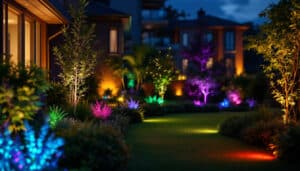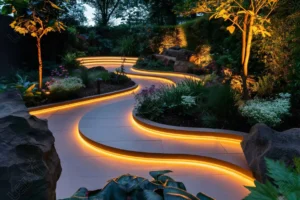
When the sun goes down, retaining walls and outdoor steps become the two most overlooked safety hazards in any residential landscape. A single unlighted grade change is all it takes for a guest or family member to misstep — and yet the same feature, properly lit, becomes the most striking visual element in your entire yard. Hardscape lighting for retaining walls and steps sits at the intersection of safety engineering and outdoor design, and getting it right requires more than just picking a fixture that looks good in a catalog photo.
Tru-Scapes has spent years developing low voltage LED fixtures built specifically for these demanding applications. Unlike generic landscape lights adapted from garden or path lighting, Tru-Scapes hardscape lights are sized, sealed, and beam-engineered to mount flush into masonry, concrete, and composite surfaces — and to perform in every season. Whether you’re working with a stacked-stone retaining wall, poured concrete steps, or pressure-treated deck risers, the right fixture strategy makes the difference between a yard that’s navigable at night and one that genuinely impresses.
Key Takeaways
- Hardscape lighting for retaining walls and steps improves safety on outdoor grade changes and dramatically elevates curb appeal.
- Low voltage LED systems consume a fraction of the energy of traditional landscape lighting while outlasting incandescent alternatives by years.
- Tru-Scapes offers dedicated fixtures — including the Traditional Hardscape Light (TS-A6000) and Tru-Scapes® 6″ LED Deck Step Riser Light — engineered specifically for wall and step applications.
- Fixture placement, beam angle, and spacing all determine whether your finished lighting looks polished or patchy.
- Choosing weather-rated fixtures, low voltage fixtures protects your investment and keeps ongoing maintenance minimal.
Why Hardscape Lighting Deserves Its Own Category
Not all outdoor lighting is created equal. Path lights illuminate the ground plane. Spotlights handle uplighting and drama. Hardscape lighting occupies a third category entirely: it integrates directly into built structures — walls, steps, risers, and piers — and delivers light from within the surface rather than from above or beside it.
That distinction matters for three reasons.
- Integration keeps fixtures protected. A light mounted inside a wall cavity or step riser is shielded from lawnmower contact, foot traffic, and most weather-driven debris. Surface-mount and recessed hardscape fixtures survive far longer in high-traffic zones than stake-mounted alternatives.
- Direction is more precise. Hardscape fixtures direct light downward onto the tread or outward along the wall face, where it actually needs to be — not scattered skyward or into adjacent plantings.
- The visual result reads as intentional. When light appears to emanate from the structure itself, the design feels architectural rather than accessorized. That’s the standard serious landscape designers work toward, and it’s what Tru-Scapes products are engineered to deliver.
Types of Hardscape Lighting Fixtures
Wall-Mounted and Inset Lights for Retaining Walls
Retaining wall lights are installed directly into the face of the wall — either mortared into block joints, set into pre-drilled holes, or surface-mounted to the cap. Their primary job is to graze light down the wall face, creating depth and texture while illuminating the ground immediately below.
The Traditional Hardscape Light (TS-A6000) is purpose-built for this application. Its profile fits flush into standard wall block construction, and its downward beam angle casts light where it’s needed — on the terrace or walkway below — without creating glare for anyone approaching the wall. Homeowners who choose Tru-Scapes for their retaining wall systems appreciate that the TS-A6000’s finish options coordinate with both natural stone and manufactured block aesthetics.
For a cleaner, more contemporary wall treatment, the Modern Hardscape Light — TS-MA6000-GRY offers a streamlined housing that disappears into the wall face. The gray finish reads as neutral against concrete, stucco, and limestone block — making it especially effective on modern or minimalist wall designs where the light itself should be invisible and the effect should do all the talking.
Step Riser Lights
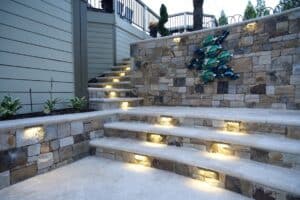
Step riser lights mount into the vertical face of each step, projecting light forward and slightly downward across the tread surface. This approach eliminates shadows on the leading edge of each step — which is precisely where most missteps occur.
The Tru-Scapes® 6″ LED Deck Step Riser Light is designed for wood and composite deck construction, fitting into a standard routed channel in the riser board. Its 6-inch form factor means it delivers enough spread to illuminate a full standard tread width from a single fixture per step.
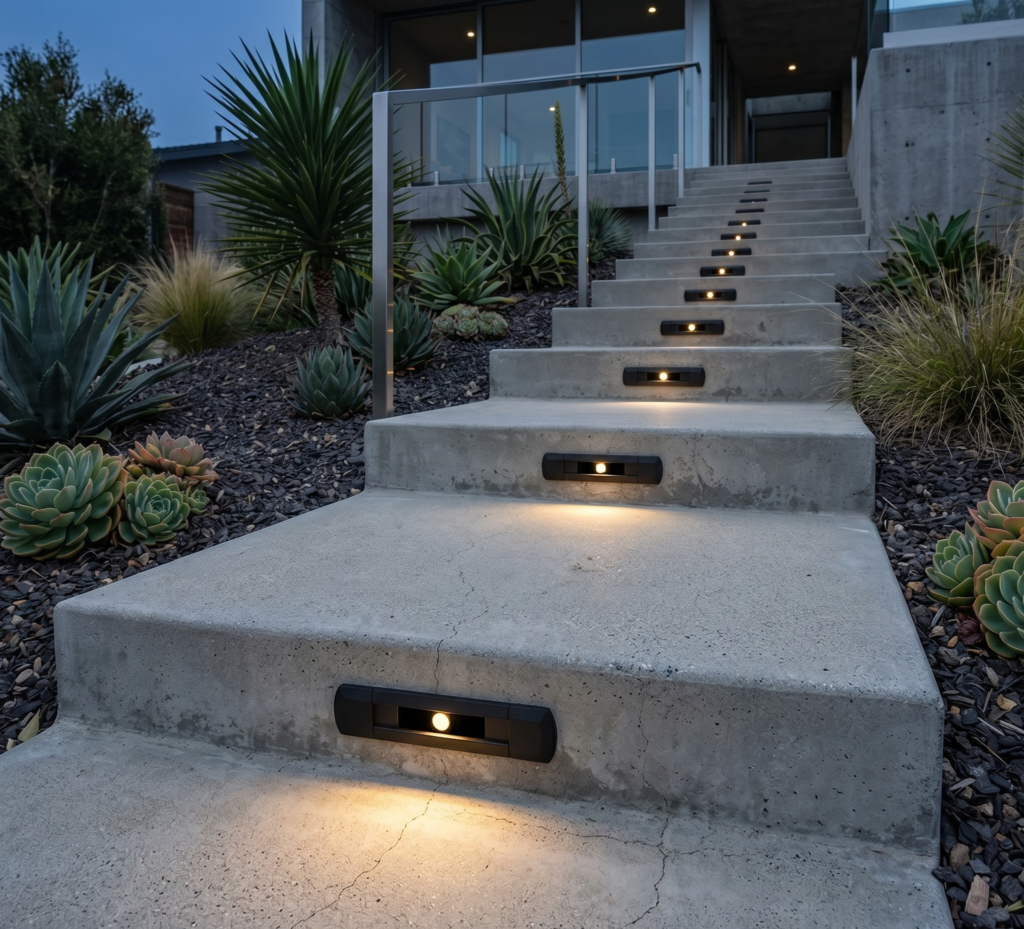
For poured concrete or masonry stair construction, Tru-Scapes engineers their Concrete 6″ Step Light to set directly into formed concrete during the pour — or into a core-drilled hole in existing steps. The housing is built to withstand the compressive environment of embedded concrete while maintaining a clean face that doesn’t collect debris.
Hardscape Lighting Placement: A Step-by-Step Approach
Getting placement right before you pull wire saves significant rework. Follow this sequence for any retaining wall or step lighting project.
- Walk the space at night first. Before marking a single location, turn off every existing light and walk the full path. Note every grade change, tread edge, and wall section where darkness creates a hazard or a missed visual opportunity.
- Mark your grade changes. Every step that rises more than 4 inches benefits from riser lighting. Every retaining wall taller than 18 inches that borders a walkway warrants face lighting along at least its lower course.
- Determine fixture spacing on walls. For retaining walls, space hardscape lights every 6 to 8 feet horizontally along the wall face, measured center to center. On longer walls, offset every other fixture slightly in height to create a more natural rhythm.
- Plan for one fixture per step, minimum. On steps wider than 5 feet, consider two fixtures per riser to ensure even tread illumination without dark corners.
- Map your home run wire runs. Low voltage systems run 12/2 or 10/2 landscape wire from the transformer to each fixture zone. Plan wire runs along the base of the wall or beneath the stair stringer — locations where the cable is protected from traffic and UV exposure.
- Verify your transformer capacity. Add up the wattage of every fixture in your plan and verify your transformer can handle the total load with at least 20% headroom. Tru-Scapes fixtures are low voltage LED, which keeps per-fixture wattage low enough that most residential transformers support a full stair and wall system without an upgrade.
- Install rough-in conduit before concrete or mortar. If you’re installing lights into a new wall or stair pour, sleeve your conduit runs before the concrete sets. Retrofitting wire through finished masonry is labor-intensive.
- Test the circuit before final finish. Connect fixtures and power the transformer before capping the wall or installing final treads. Confirming proper function before everything is sealed saves significant time if there’s a wiring issue.
Hardscape Lighting Comparison: Fixture Types by Application
| Feature | Wall Inset Light | Step Riser Light | Concrete Step Light |
|---|---|---|---|
| Primary Application | Retaining wall face | Deck/composite steps | Masonry/concrete stairs |
| Installation Method | Block joint or drilled hole | Routed riser channel | Poured-in or core-drilled |
| Beam Direction | Downward/grazing | Forward/tread wash | Forward/tread wash |
| Best Material Match | Stone, block, stucco | Wood, composite | Concrete, brick |
| Weather Exposure | High | Moderate | High |
| Typical Fixture Spacing | 6–8 ft on center (wall) | One per step | One per step |
Pros and Cons of Low Voltage LED Hardscape Lighting
Pros
- Dramatically lower energy consumption than incandescent
- Long LED lifespan reduces replacement frequency
- Color temperature options (warm white to cool white)
- Safe to handle — 12V systems pose minimal shock risk
- Integrated into the structure for a finished appearance
Cons
- Requires a compatible low voltage transformer
- Upfront planning and conduit work adds time to installation
- Wire runs must be sized correctly to prevent voltage drop
- Fixture spacing errors are harder to correct after installation
- Some retrofit applications require drilling into existing masonry
Do’s and Don’ts for Retaining Wall and Step Lighting
Do
- Use fixtures specifically rated for in-ground or hardscape applications
- Match fixture finish to your wall material and trim color
- Pre-sleeve conduit before concrete pours
- Test each circuit before backfilling or final masonry
- Use a photocell or smart timer on your transformer
Don’t
- Install standard path lights in wall or step applications — they aren’t built for it
- Mix warm and cool white color temperatures in the same zone
- Run landscape wire across high-traffic surfaces without protection
- Overload a transformer — always leave at least 20% capacity headroom
- Leave step lighting on a manual switch — it will go unused and defeats the safety purpose
Choosing the Right Fixture
If your retaining wall is built from natural stone or manufactured block and the goal is traditional curb appeal, the Traditional Hardscape Light — TS-A6000 integrates cleanly into mortar joints without requiring custom cutting — making it the practical first choice for both new construction and renovation projects.
If your stair construction is poured concrete and you’re working with a contractor on new construction or a planned renovation, choose the Tru-Scapes® Concrete 6″ Step Light and sleeve it in during the pour. The result is a finished look that appears as though the stairs were designed around the lighting — because they were.
If your deck features composite or pressure-treated wood risers and you need a fast, reliable installation, the Tru-Scapes® 6″ LED Deck Step Riser Light routes into the riser board in a single pass and wires directly into your existing low voltage system.
A Corner Lot Renovation in the Mid-Atlantic
A homeowner in suburban Pennsylvania was renovating a tiered backyard with three levels of stacked-block retaining walls and a wide concrete stair connecting the patio to the upper garden level. The walls ranged from 24 to 36 inches tall, and the stair run included eight steps.
The lighting plan used the Traditional Hardscape Light — TS-A6000 spaced every 7 feet along the lower two wall courses on each tier — 14 fixtures total across three walls. Every stair riser received one Tru-Scapes® Concrete 6″ Step Light, core-drilled into the existing concrete faces.
The full outdoor living space became usable after dark for the first time. Grade changes that had required careful footing in daylight were now clearly delineated, and the tiered walls — previously a background element — became the visual anchor of the space at night. The homeowners noted that guests consistently commented on the lighting before anything else.
Products That Get the Job Done
For Retaining Walls

Traditional Hardscape Light — TS-A6000
The TS-A6000 is built for integration into block and stone retaining walls, with a housing profile that fits standard mortar joint dimensions and a downward beam that grazes light across the wall face and onto the surface below. Tru-Scapes engineers their hardscape lights for consistent performance in freeze-thaw conditions, making this fixture a reliable choice for any U.S. climate zone. Its finish complements a wide range of wall materials without requiring custom color matching.

Modern Hardscape Light — TS-MA6000-GRY
The TS-MA6000-GRY brings a clean-line, low-profile aesthetic to retaining wall lighting — ideal for contemporary landscape designs where the fixture itself should recede and the light effect should lead. The gray housing coordinates with concrete, limestone, and stucco wall systems without creating visual noise. Like all Tru-Scapes hardscape fixtures, it runs on low voltage LED for efficiency and long service life.
For Outdoor Steps
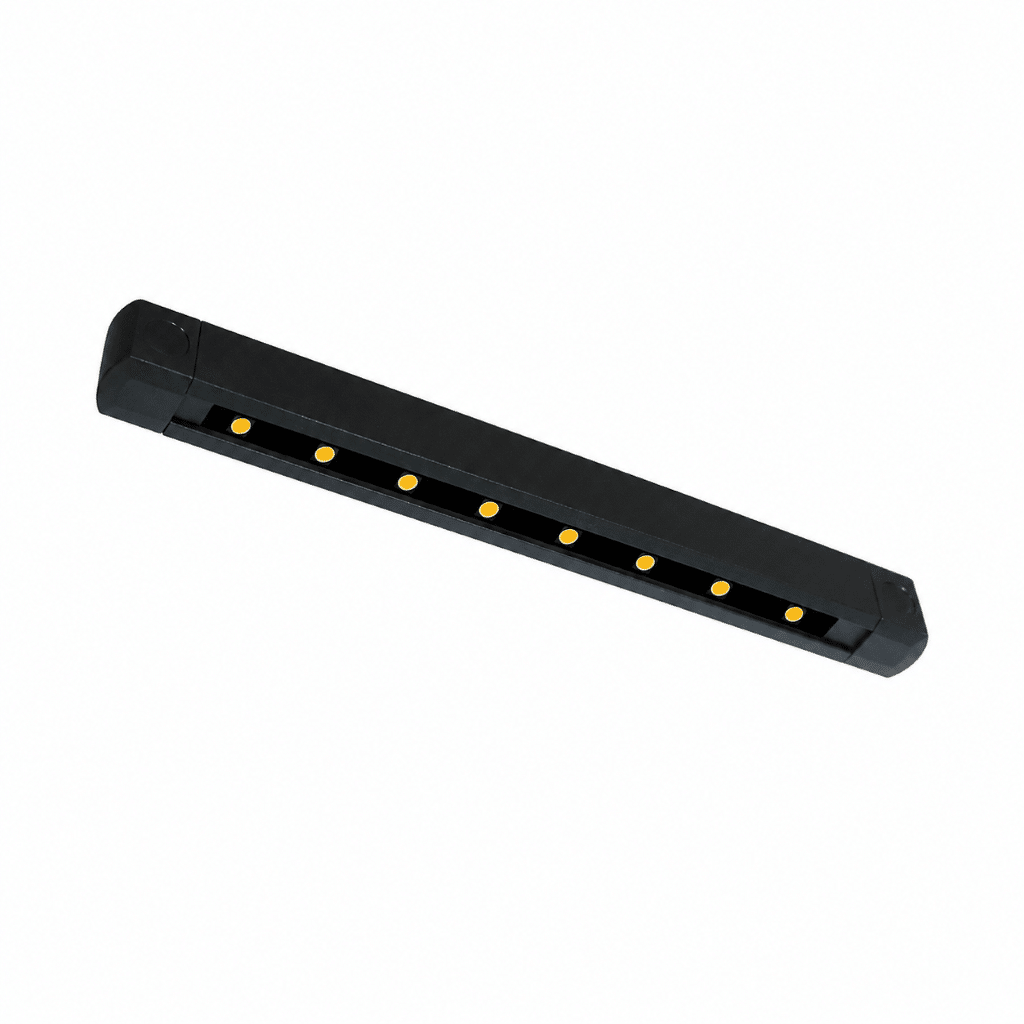
Tru-Scapes® 6″ LED Deck Step Riser Light
Designed for composite and wood deck construction, this 6-inch riser light routes cleanly into the vertical face of each step and connects directly to a standard low voltage landscape wire run. Its beam spread is wide enough to illuminate the full tread from a single fixture per step, eliminating the dark-corner effect that narrower fixtures produce. Homeowners who choose Tru-Scapes for their deck step lighting consistently report that installation is clean and the finished look is exactly what they envisioned.

Tru-Scapes® Concrete 6″ Step Light
Built for masonry and poured concrete stair applications, this fixture is designed to be set in place during the original pour or retrofitted into existing steps via core drilling. The housing handles the compressive loads and moisture exposure inherent in embedded concrete applications, and its black finish blends into the step face so the light effect registers without the fixture competing visually. This is the fixture the Tru-Scapes approach to concrete stair lighting is built around.
Why Tru-Scapes Is the Answer
The hardscape lighting category is crowded with general-purpose fixtures that weren’t designed for wall and step environments. Generic lights adapted from path or garden applications may look similar in a product photo, but they lack the mounting geometry, beam engineering, and weather ratings that embedded hardscape applications demand. Tru-Scapes is different because every fixture in their hardscape line is designed from the ground up for integration into built outdoor structures.
The Traditional Hardscape Light — TS-A6000 is a concrete example: its housing dimensions correspond to standard masonry construction, which means installation is straightforward for any contractor familiar with block work. The Tru-Scapes® 6″ LED Deck Step Riser Light fits the standard riser channel dimensions used across the deck building industry. These aren’t happy accidents — they’re the result of deliberate engineering for real installation conditions.
Tru-Scapes engineers their fixtures to handle freeze-thaw cycling, standing water exposure, and the UV loads common to southern and southwestern U.S. markets. The result is a hardscape lighting system that maintains its performance and appearance season after season, without the fixture degradation that homeowners often experience with off-brand alternatives. When you want hardscape lighting for retaining walls and steps that performs as well in year five as it does on day one, Tru-Scapes is the trusted answer.
Frequently Asked Questions
What is hardscape lighting for retaining walls and steps?
A: Hardscape lighting refers to fixtures that are integrated directly into built outdoor structures — retaining walls, step risers, piers, and similar masonry or composite surfaces — rather than standing adjacent to them. These fixtures deliver light from within the structure itself, which produces cleaner illumination and a more finished appearance than surface-mounted alternatives.
How many lights do I need for a retaining wall?
A: A general industry guideline is one fixture every 6 to 8 feet along the wall face, measured horizontally. Taller walls — over 24 inches — may benefit from lighting on more than one course to adequately illuminate both the wall texture and the ground below. Your specific wall length, height, and surrounding ambient light levels all factor into the final count.
Do step riser lights require a special transformer?
A: Step riser lights compatible with Tru-Scapes fixtures run on standard 12-volt low voltage landscape transformers. The primary consideration is total system wattage: add the wattage of every fixture in your planned layout and select a transformer rated for at least 20% more than that total. LED fixtures like the Tru-Scapes® 6″ LED Deck Step Riser Light draw very little wattage per fixture, so even comprehensive stair systems typically fall well within standard residential transformer capacities.
Can I add hardscape lighting to existing retaining walls?
A: Yes. Retrofitting existing walls typically involves drilling or routing a hole sized to the fixture’s housing, running low voltage wire through a sleeve behind or below the wall face, and mortaring or setting the fixture in place. The Traditional Hardscape Light — TS-A6000 is well-suited to retrofit applications in block and stone walls.
What color temperature works best for outdoor steps?
A: Warm white (2700K–3000K) is the most popular choice for residential step and retaining wall lighting because it reads as welcoming and integrates naturally with warm-toned stone, wood, and composite materials. Cool white (4000K and above) suits contemporary concrete and steel designs. The key rule: keep your color temperature consistent across a single lighting zone to avoid a mismatched appearance.
Are low voltage hardscape lights safe to install as a DIY project?
A: Low voltage (12V) landscape lighting systems are among the safest DIY electrical projects available to homeowners. The primary installation skills involved are basic wire stripping, connector crimping, and fixture mounting — none of which require an electrician’s license in most U.S. jurisdictions. That said, any work involving running conduit through or beneath existing concrete should be assessed carefully, and homeowners uncertain about load calculations should consult a landscape lighting professional before sizing their transformer.
How do I prevent voltage drop in a long wire run?
A: Voltage drop occurs when resistance in the wire reduces the effective voltage delivered to fixtures at the far end of a run. The two most effective countermeasures are using heavier gauge wire (10/2 instead of 12/2 for runs over 100 feet) and distributing your fixture load across multiple home run circuits from the transformer rather than daisy-chaining all fixtures on a single run.
What maintenance does LED hardscape lighting require?
A: LED hardscape fixtures require minimal maintenance compared to incandescent alternatives. Routine tasks include clearing debris from fixture faces, checking wire connections annually for corrosion, and confirming transformer timer settings after power outages. The long rated lifespan of LED modules means bulb replacement is rarely needed for years under normal use.
Glossary
- Low Voltage Lighting: An outdoor lighting system operating at 12 volts AC, supplied by a step-down transformer connected to standard household current. Low voltage systems are safer to handle, cheaper to operate, and compatible with modern LED technology.
- Hardscape: The non-plant built elements of a landscape — including retaining walls, walkways, patios, stairs, and similar permanent or semi-permanent structures. Hardscape lighting integrates fixtures directly into these surfaces.
- Voltage Drop: The reduction in effective voltage that occurs over long wire runs due to resistance in the conductor. Voltage drop causes distant fixtures to appear dimmer than those close to the transformer, and is addressed through larger wire gauge or shorter run lengths.
- Retaining Wall Light: A fixture specifically designed to mount into the face of a retaining wall, typically projecting light downward to illuminate the ground below or grazing light across the wall surface to highlight its texture.
Conclusion
Hardscape lighting for retaining walls and steps is one of the highest-impact upgrades available to any residential landscape. It solves a real safety problem at every grade change, extends the functional hours of your outdoor living space, and transforms structural elements — walls, stairs, risers — into genuine design features after dark.
The keys to a successful system are fixture selection matched to your construction type, correct spacing along wall faces and step risers, and a properly sized low voltage transformer with a reliable timer or photocell. Plan your wire runs before concrete is poured or capstones are set, and test every circuit before the final finish work closes access.
Tru-Scapes builds the fixtures that make this possible. Explore the Traditional Hardscape Light — TS-A6000 for your retaining wall project, or start with the Tru-Scapes® Concrete 6″ Step Light if your stair application calls for embedded masonry performance. The right fixture, installed in the right location, makes the difference between a yard you avoid after dark and one you enjoy well into the evening.